Over the past three years of the genocide, and even before that, German courts have served as an effective tool for suppressing pro-Palestinian activism through expansive interpretations of what constitutes antisemitism, writes Hebh Jamal. [GETTY]
On 10 July, the German states voted in the Bundesrat (Germany’s federal council) in favour of a proposal to criminalise the denial of Israel’s right to exist. The Bundestag (federal parliament) is expected to consider the initiative, which originated in the state of Hesse, in the near future.
The draft law provides that anyone who publicly denies Israel’s right to exist or advocates for its elimination could face a prison sentence of up to five years or a substantial fine. The offence would only apply where such statements are deemed to “encourage a willingness to commit anti-Semitic acts of violence or arbitrary measures”. However, the bill is drafted in deliberately broad and vague terms, leaving significant discretion to prosecutors and judges in determining when the law applies.
Hesse’s Minister of Justice, Christian Heinz, stated that since 7 October, the “barbaric attack” by Hamas, this “hatred” has “spread” throughout the world and also to Germany. Antisemitism is “publicly taking place on our streets.”
He added: “For the first time in the history of the Federal Republic of Germany, a bill has received a majority that criminalises the denial of Israel’s right to exist. From this day forward, an important signal is being sent to all Jews in our country: We want to and we will better protect Jewish life in Germany. I am very grateful for this significant sign.”
Antisemitism
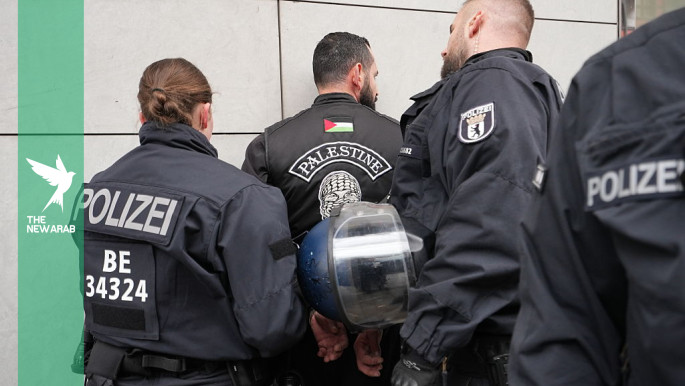
From October 2023, and even prior, Germany has categorised nearly everything pro-Palestinian as an antisemitic act. Nakba commemoration events are banned, keffiyehs near Jewish memorial sites are banned, speeches of UN officials such as Francesca Albanese are censored in German universities, and severe police brutality is deployed against people fighting for a ‘free Palestine’ on German streets.
Leaving the definition of “antisemitic acts of violence” deliberately vague subjects the entire German public to the discretion of the legal system. In practice, that often means placing enormous power in the hands of individual judges, who have significant latitude in determining guilt or innocence.
Over the past three years of the genocide, and even before that, German courts have served as an effective tool for suppressing pro-Palestinian activism through expansive interpretations of what constitutes antisemitism and the glorification of violence.
I have sat in court decisions of activists, where the prosecutor and judge are able to claim that the literal statement, “I want to a free Palestine for all people regardless of denominations from the river to the sea,” is hate speech (volkverhetzung), along with the usage of the word “pogrom” to describe settler violence against Palestinians in the West Bank as “reletivization of the Holocaust.” The individual was not only found guilty for a protest speech, but also had to pay nearly €6,500 in fines and was categorised as a felon. He is currently appealing the decision.
In another case, I witnessed a judge leading a police witness who did not remember a single detail of their alleged assault, going as far as to state the defendant could have, in fact, acted in self-defence. Those details did not, however, deter the judge from finding the defendant guilty, despite a complete lack of evidence to support the case.
In theory, Germany has a robust legal system with laws and structures intended to protect. In fact, in Germany, prosecutors are meant to look for evidence that can also exonerate a defendant, not necessarily only that which would incriminate them. However, none of that seems to matter when it comes to the pro-Palestine solidarity movement.
No limits to supporting Israel
This state is intent on maximising its complicity in genocide, and curtailing the civil rights of activists and regular German residents’ ability to criticise a foreign entity, yet how much farther is Germany willing to go to support Israel?
September marks the resumption of Nicaragua’s ICJ case against Germany on whether the country has breached its international legal obligations by supporting Israel during the genocide in Gaza. However, Germany does not seem too concerned.
Germany is the second largest arms exporter to Israel. In 2022, it supplied €32 million worth of arms, and after 7 October, that amount increased tenfold. Weapon deliveries have only increased since then. From 2023 to 2025, Germany sent a total of €485 million in weapons exports to Israel.
Just last week, activists travelled all across Germany to protest the opening of Rheinmetall, a weapons factory in the Berlin working-class neighbourhood of Wedding that is also complicit in the genocide in Gaza. Not only does the arms manufacturer make weapons that directly go to the Israeli state, such as 120 mm artillery shells, but Rheinmetall, as a private company, oftentimes even circumvents the German government’s arms export restrictions by exporting weapons through subsidiaries based in other countries.
And just a few weeks ago, also in Berlin, the mayor, Kai Wagner, approved the establishment of an innovation centre with Israel Aerospace Industries (IAI) and plans to support start-ups within the dual-use technology and defence sectors. While German officials deepen industrial and technological cooperation with Israel’s defence sector, those attempting to disrupt that same military supply chain face severe criminal penalties.
In the high security prison court of Stammheim, activists are facing a cumulative total of 25 years in prison for wanting to mitigate harm by destroying the offices of Elbit Systems, an Israeli arms factory located in the southern German city of Ulm. The defendants, labelled by the community as the Ulm5, are separated from their legal team by bulletproof glass, while the judge, session after session, rejects the lawyers’ legally sound motions advocating for accessible communication with their clients.
Curtailing democratic rights
This brings us to the central question at the heart of this proposed legislation: what exactly constitutes a criminal offence? It is often ambiguous in this state, and this ambiguity is consistently intentional to force activists, writers, journalists and anyone with a conscience to mince their words at the fact that no state has a God-given or unconditional right to exist – not the United States, not Germany and certainly not any state whose actions are contributing to the destruction of another people.
This is not some radical understanding of state sovereignty, but an internationally recognised assessment that it is people who have a God-given right to exist, not nation-states.
The German reason of state, or Deutsche staatsrason, the political doctrine that Germany has a special responsibility for Israel’s national security, has moved beyond a foreign policy principle and is currently curtailing and suspending ordinary democratic standards on behalf of a foreign state.
Politically motivated show trials have damned the concept of freedom of speech and instead brought Zionism into every court case, every brutal police arrest, and every police investigation that cries antisemitism for calling for the liberation of the Palestinian people and an end to the bloodshed.
However, it is not yet time to fear the worst. According to legal experts, it is not uncommon for a legislative proposal from the German Federal Council to be submitted to the Bundestag, and it is extremely rare for this to result in a finalised piece of legislation. In fact, the Federal Council has passed 45 draft bills and forwarded them to the Bundestag, and not a single one of them has yet become law, especially since this proposed law goes directly against Article 10 of the European Convention on Human Rights, which protects freedom of expression, as well as Article 5 of the German Basic Law.
Nonetheless, what this ultimately proves is that Germany is not concerned with how its actions are perceived by the international community. Its commitment to Staatsräson, the protection of Israeli state interests, and the continuation of military and political support for Israel has become, in practice, a principle placed above accountability and international scrutiny.
Three years into a genocide, support for Israel amongst the political elite has not changed. In response to the general public’s dissatisfaction, the government has only seemed more emboldened to squander resistance.
But history has shown that repression does not erase resistance. Courts can issue convictions. Governments can pass restrictive laws. Demonstrations can be banned, and activists can be criminalised. Yet none of these measures can force people to abandon their conscience or their belief that they have a moral obligation to oppose injustice.
German memory culture is built on the supposed promise of “never again,” and they have proven that never again is selective, and never again does not mean less militarisation, less racism or less complicity in yet another genocide. In fact, if anything, Germany has proven that it does not believe in universal rights – not even for their own citizens and residents.
Hebh Jamal is a Palestinian American journalist based in Germany.
Follow Hebh on X and Instagram: @hebh_jamal
Have questions or comments? Email us at: editorial-english@newarab.com
Opinions expressed in this article remain those of the author and do not necessarily represent those of The New Arab, its editorial board or staff.