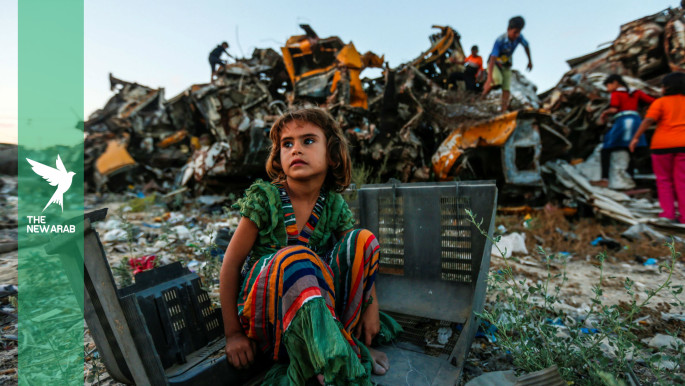
The United Nations has warned of a rapidly escalating outbreak of chickenpox after recording nearly 9,300 suspected cases in displacement sites and shelters over just two weeks. [Getty]
For six-year-old Yahya Abu Nassira, childhood has been replaced by relentless itching, fever and pain. Instead of running between the tents, where displaced children try to make games from what little they have left, he spends his days lying on a thin foam mattress in his family’s tent in western Gaza City, his small body covered in red chickenpox blisters.
As temperatures soar, the tent traps the heat like an oven, while the smell of uncollected rubbish and stagnant sewage hangs in the air, turning an already painful illness into a daily ordeal.
“Every morning begins the same way. Yahya wakes with a fever, crying as he struggles to resist scratching the blisters covering his face, chest and limbs,” Heba, his mother, told The New Arab.
She said that she repeatedly pulls his hands away, worried the sores will become infected, but there is little relief to offer in a tent without electricity, fans or adequate water.
“My son has completely changed. It started with a high fever, then red blisters appeared on his face and chest before spreading across his body within two days,” she added. “Since then, he barely sleeps. He cries constantly because of the itching. Every time he scratches, I worry the blisters will turn into wounds.”
Surviving in the camp, she noted, has become “almost impossible”.
Yahya is among thousands of children in Gaza’s displacement camps affected by a rising outbreak of skin diseases. Overcrowding, water shortages, and broken sanitation foster the spread of contagious illnesses.
The United Nations has warned of a rapidly escalating outbreak of chickenpox after recording nearly 9,300 suspected cases in displacement sites and shelters over just two weeks.
Humanitarian agencies said the surge reflects the devastating collapse of public health conditions after nearly two years of war, repeated displacement and the near destruction of Gaza’s healthcare system.
According to UN assessments, around 83 per cent of displacement sites are infested with rodents, insects or parasites, further increasing the risk of disease outbreaks among already vulnerable communities.
Childhood under siege
For many families, skin diseases have become another daily burden alongside hunger, displacement and the constant struggle to secure clean water.
Nine-year-old Laila al-Quraan spends much of the night awake, crying from the relentless itching caused by scabies.
Her mother, Um Ahmed, 37, told TNA that the symptoms first appeared as a small itch between her daughter’s fingers before spreading rapidly across her arms, stomach and legs.
“The doctor told us she had scabies, but how can we isolate her? Ten of us live inside one tent, and all the children sleep together,” she said. “There isn’t enough water to bathe regularly or wash blankets and clothes. Within days, another child in the family developed the same symptoms.”
“Soaring summer temperatures only make matters worse,” she continued. “The heat is unbearable. Flies and insects never leave us alone, and garbage surrounds us from every direction. We try to protect our children, but we have nothing.”
She believes that even when children recover, they remain vulnerable because the environmental conditions that fuel the spread of disease remain unchanged.
Pollution turns displacement camps into breeding grounds for disease
Medical workers said the surge in skin diseases is inseparable from Gaza’s broader environmental collapse.
For more than two and a half years, Israel’s military campaign has devastated Gaza’s water networks, sewage systems and sanitation infrastructure, while repeated attacks, chronic fuel shortages and the destruction of municipal equipment have brought waste collection and sewage services to a near standstill.
The result has been the accumulation of hundreds of thousands of tonnes of waste across Gaza, according to municipal estimates.
Towering piles of rubbish now surround many displacement camps, while untreated sewage frequently floods nearby areas, creating ideal breeding grounds for flies, mosquitoes, rodents and parasites.
Children are forced to live, sleep and play among these hazards every day while lacking access to sufficient clean water, soap or basic hygiene supplies.
Humanitarian agencies estimate that more than 90 per cent of Gaza’s population has been displaced during the war, with many families forced into overcrowded camps where communicable diseases spread quickly.
Health crisis is worsening
Mohammed Abu Silmiya, director of Al-Shifa Medical Complex, told TNA that medical teams are seeing a continuous rise in children suffering from chickenpox, scabies and other skin diseases.
“The conditions in which displaced families are living have made controlling these diseases extremely difficult,” he said. “Severe overcrowding inside tents, high temperatures, shortages of clean water and the lack of personal hygiene supplies have all accelerated the spread of infection among children.”
Hospitals themselves are struggling with critical shortages of medicines, antibiotics and medical supplies, limiting doctors’ ability to prevent relatively minor illnesses from developing into serious infections.
Abu Silmiya added that widespread malnutrition is further weakening children’s immune systems, increasing the risk of complications.
Mohammed Hajila, a Gaza-based doctor, told TNA that the surge in chickenpox was an expected consequence of the humanitarian conditions prevailing across Gaza.
“Chickenpox is a highly contagious viral disease that spreads easily through respiratory droplets or direct contact,” he said. “When dozens of people are living together inside tightly packed tents, transmission becomes almost inevitable, especially because children make up the majority of the camp population.”
“Overcrowding, water shortages, deteriorating hygiene conditions, accumulated waste and widespread infestations of insects and rodents are contributing not only to skin diseases but also to rising cases of intestinal and respiratory infections,” he added.
Without urgent improvements in water and sanitation services, regular waste collection and stronger primary healthcare, Hajila warned that Gaza could face successive waves of infectious diseases that will become increasingly difficult to contain.