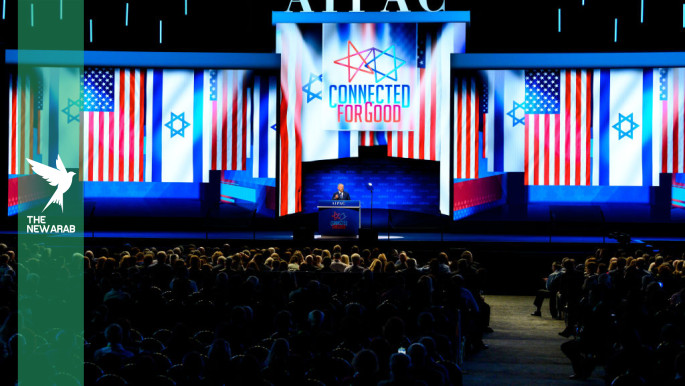
The Israel lobby’s powers have been massively curbed by the impact of Israel’s genocidal war on Gaza [Getty]
Israel is intensifying lobbying efforts in the US as it confronts what analysts say is the deepest challenge in decades to its standing with the American public, with the fallout from the war on Gaza reshaping political debate, particularly within the Democratic Party.
According to Politico, Israeli officials and allied lobbying groups are stepping up efforts to shore up support on Capitol Hill and among policymakers, while the American Israel Public Affairs Committee (AIPAC) has reportedly paused fundraising support for Democratic lawmakers who backed measures to restrict US military aid to Israel.
The renewed push comes as polling suggests support for Israel has eroded significantly since the war began, especially among younger Americans and Democratic voters, raising questions over whether the country’s traditional political influence in Washington can withstand changing public attitudes.
Dov Waxman, director of the Nazarian Center for Israel Studies at UCLA, said the Israeli government appeared increasingly concerned by the erosion of its support in the US.
“I think the Israeli government is aware that Israel is losing support among Americans and is concerned about this trend, particularly about the decline of support among young Republicans, because this is a relatively recent development,” he told The New Arab.
Daniel Levy, president of the US/Middle East Project and a former Israeli peace negotiator, argued that the scale of the shift reflects not only the devastation in Gaza but the unprecedented transparency with which Israeli leaders articulated their objectives throughout the war.
“The most incriminating evidence came from simply reposting what Israelis were saying with translation. No need to fabricate, no need to embellish, no need to exaggerate,” Levy told The New Arab.
“Israel told us what it was doing, and then you looked at what was actually happening: the killing, the destruction, the starvation, schools, hospitals, housing stock – everything that we saw.”
He argued that the result was a significant change in how many Americans, particularly Democrats, viewed Israel.
“Things really began to shift in American public opinion and American culture,” he said, describing the current debate within the Democratic Party as an intensification of trends that had already been developing before the Gaza war.
Political costs
The changing political landscape has become increasingly visible in Washington.
More than 100 House Democrats recently backed legislation seeking to suspend US military aid to Israel, an outcome that would have been almost unimaginable only a few years ago.
Progressive Democrats critical of Israel have also continued to gain prominence, with candidates increasingly willing to campaign on positions that previously carried significant political risk, reflecting broader changes within parts of the Democratic electorate.
At the same time, criticism of AIPAC itself has become increasingly mainstream, with the organisation’s role in financing election campaigns attracting greater scrutiny than in previous election cycles.
Levy nevertheless cautioned against overstating the extent of Israel’s political decline.
“The lobby is far from done and it’s far from giving up,” he said.
“The money is being put into these races. Some of the races they’re losing, but some they’re winning.”
He argued that decades of institutional influence, campaign finance networks and entrenched political relationships continue to provide Israel with formidable advantages in Washington.
“One should not underestimate how entrenched and how deep that has been,” he said, pointing to the role of money in American politics and the longstanding influence Israel has cultivated across both major parties.
Can lobbying reverse the trend?
The renewed outreach also comes ahead of Prime Minister Benjamin Netanyahu’s visit to Washington, where he is due to attend memorial events for the late Senator Lindsey Graham, one of Israel’s staunchest allies in Congress, while also holding meetings with senior US officials.
For Israeli officials, reinforcing longstanding relationships in Washington may prove increasingly important as public opinion becomes more divided.
Waxman argued that Israel’s challenge extended beyond public relations.
“I don’t think lobbying or public relations campaigns by themselves can reverse this shift in American public opinion,” he said. “Israel needs to change its policies, not merely try to improve its communications.”
Levy argued that Israel’s supporters are already adapting to the new political environment rather than retreating from it, including by reframing how military assistance is presented and by attempting to channel criticism towards Netanyahu personally rather than broader Israeli policy.
Despite mounting pressure, he warned against assuming that the political battle had already been decided.
“I’d say it’s game on, which it wasn’t in the past, rather than game over.”
For analysts like Levy, that distinction may ultimately define Israel’s challenge in Washington.
While the genocide in Gaza has profoundly altered public perceptions and widened political divisions, the institutional foundations of Israel’s influence in the US remain deeply embedded, setting the stage for a far more contested debate than at any point in recent decades.