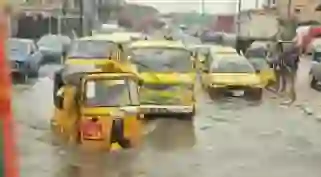
Lagos residents faced widespread disruption after torrential rainfall lasting more than 12 hours triggered severe flooding across several parts of the state, leaving roads submerged, homes inundated, businesses shut, and thousands of commuters stranded.
The heavy downpour, which began on Sunday and intensified into Monday morning, caused flash floods that paralysed movement in many parts of the city. Parents kept their children at home over safety concerns, while many workers were unable to reach their offices as major roads became impassable.
Among the worst-hit areas were the Lagos-Oshodi Expressway, Abeokuta Expressway, Lekki-Epe Expressway, Victoria Island, Ikeja, Agege, Oworonsoki, Gbagada, Yaba, Funsho Williams Avenue, Ikorodu Road, Oyingbo and several coastal communities. Floodwaters also overwhelmed the bridge linking Ojota to Maryland, trapping numerous vehicles.
Several viral videos shared on social media showed motorists and residents stranded in floodwaters, with many appealing to the Lagos State Government for urgent intervention. Others criticised authorities over what they described as the persistent failure to address recurring flooding in the state.
Commercial activities were significantly affected as many shops, offices and markets remained closed, while public transport operations slowed due to flooded roads. Commuters were forced to seek shelter at bus stops or trek through knee-deep water to reach their destinations.
In areas such as Yaba, Ikeja and Oyingbo, businesses opened late, while transport operators who remained on the roads reportedly increased fares because of the difficult driving conditions.
Residents expressed frustration over the recurring flooding despite ongoing drainage and road rehabilitation projects across Lagos.
A Yaba resident, Wasiu, said the floods made it nearly impossible for many people to get to work, adding that parents were reluctant to send their children to school because blocked drainage channels had overflowed.
Similarly, a primary school teacher, Ade Bambo, said attendance dropped significantly whenever heavy rainfall occurred, as many parents prioritised their children’s safety.
Communities in Ago Palace Way, Okota, and parts of Gbagada were also severely affected after drainage systems overflowed, leaving roads submerged and forcing motorists and pedestrians to wade through waist-deep water.
In Isashi, Iba LCDA, Okokomaiko and parts of Ojo, several residents abandoned their flooded homes to seek refuge with relatives and friends. A resident of James Kunle Street, Joel Ubah, appealed to the government for immediate assistance after his newly completed four-bedroom bungalow was completely flooded.
He blamed the situation on blocked canals and ongoing sand-filling activities around nearby waterways, warning that continued flooding could lead to building collapses.
Responding to the situation, Lagos State Commissioner for the Environment and Water Resources, Tokunbo Wahab, attributed the flooding to extreme rainfall, climate change and widespread encroachment on drainage channels.
He said the government had already implemented emergency measures and assured residents that drainage projects were ongoing across the state. According to him, Lagos would continue to experience flash floods during periods of exceptionally heavy rainfall because of its coastal geography and interconnected network of lagoons, rivers and tidal water bodies.
Wahab also blamed illegal developments on wetlands and drainage alignments for worsening the flooding and announced that buildings obstructing waterways in areas such as Lekki and Ikota would be demolished.
He warned that the state would no longer tolerate encroachment on drainage corridors, floodplains and natural water channels, stressing that all illegal structures on such locations would be removed regardless of ownership.
The commissioner further disclosed that Governor Babajide Sanwo-Olu had approved the dredging and maintenance of 28 additional primary drainage channels to improve water flow and reduce flooding across the state.
He noted that the recent flooding was caused by an extreme weather event that overwhelmed existing drainage infrastructure but assured residents that the government was closely monitoring flood-prone areas while intensifying long-term flood control measures.
Environmental experts also blamed the persistent flooding on blocked drainage systems, illegal construction on wetlands, poor urban planning and the increasing intensity of rainfall linked to climate change. They urged authorities to enforce environmental regulations more strictly and accelerate drainage improvement projects to minimise future flooding.
READ ALSO: