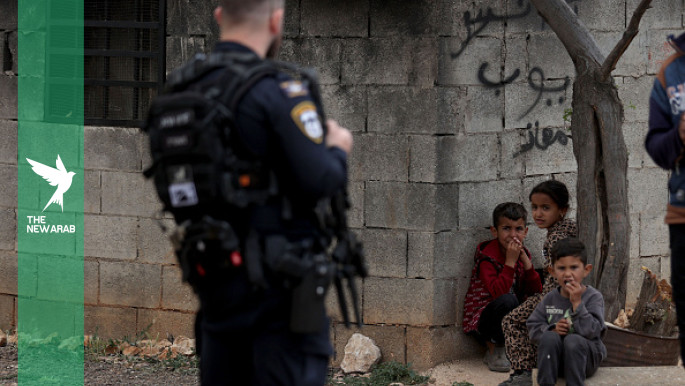
Local and international institutions were aware that the family’s displacement was only “a matter of time”, yet were unable to stop it. [Getty]
Israeli settlers forcibly displaced the Palestinian Al-Tubasi family from their homes in the village of Jalud, southeast of Nablus in the northern occupied West Bank.
For five days, the family was under siege as Israeli settlers cut off all means of survival, including electricity and water, and blocked the road leading to their homes before storming the properties on Wednesday afternoon, forcing the family out at gunpoint to take over the houses. This occurred under the watch and the protection of the Israeli occupation army.
In Jalud, the displacement of the Al-Tubasi family had been apparent to everyone. Local and international institutions were aware that the family’s displacement was only “a matter of time”, yet were unable to stop it.
In recent weeks, everyone had watched as the family lost access to the necessities of life after settlers cut off electricity and water supplies and blocked the road leading to their homes, while also carrying out repeated attacks against them.
Their hours of resistance came to an end on Wednesday afternoon, 22 July, when dozens of settlers stormed the family’s homes, assaulted family members, and forced them to leave by force.
Shadi Al-Tubasi, the family’s son, told The New Arab, “Five days ago, settlers cut the electricity lines supplying my family’s home and the homes of my brothers, causing all the food stored in the refrigerators to spoil amid the power outage and high temperatures.”
“We now have spoilt food that is no longer fit for consumption and must be thrown away, while the family is suffering from hunger after settlers have besieged us for the past 20 days. We can no longer reach the village, and the villagers can no longer reach us,” he added.
A siege
The Al-Tubasi family owns two houses on the eastern side of Jalud, where about 10 people live. A third house, still under construction, belongs to the Arinat family.
In recent weeks, Israeli settlers imposed a tight siege on all three houses and set up a tent about 200 metres away. It later became an outpost where settlers gathered before carrying out repeated attacks on Jalud and its residents, with particular focus on targeting the Al-Tubasi family.
According to the family’s account, forcing them out of their homes, which are relatively far from the centre of Jalud, would enable settlers to seize the eastern lands of the village.
That objective was achieved after the displacement, as settlers blocked roads from both the eastern and western sides, completely isolating the Al-Tubasi family, according to Shadi Al-Tubasi.
He said he now knows by heart the names of dozens of Palestinian and international institutions the family contacted in search of help, without success.
Speaking about this, Shadi said, “We contacted all the institutions operating in the West Bank, local and international, Arab and foreign, but to no avail. Some of them do not answer our calls, and perhaps they have nothing they can do in the face of settler attacks, but they are embarrassed to admit that.”
He said the family also contacted the Palestinian Liaison Authority, which in turn approached the Israeli occupation army.
“During the past 20 days, the occupation army reopened the road blocked by settlers twice, but each time the settlers blocked it again after about 10 minutes to tighten the siege on the family and prevent anyone from reaching us or supplying us with food, medicine or water,” Shadi explained.
Documentation failed to stop attacks
The Al-Tubasi family, like the residents of Jalud, know the identities of the Israeli settlers who attack their homes and burn their crops.
Over recent months, the family sent photographs of no fewer than 10 settlers, along with pictures of their vehicles and registration numbers, to the Israeli police and several international organisations.
According to the family, however, these complaints failed to stop the attacks and instead coincided with an escalation in settler violence targeting the village and its residents.
Raed Al-Rayyis, head of Jalud Village Council, told The New Arab, “Unfortunately, the Al-Tubasi family was displaced from its homes on Wednesday afternoon, and settlers seized the two houses, as well as another house under construction belonging to the Arinat family.”
According to Al-Rayyis, “These homes have stood for decades in areas classified as Area B under the Oslo Accords, meaning Palestinian construction there is legal. Nevertheless, settlers displaced the owners and forced them from their homes.”
“The number of settlers staying in the settlement tent increases according to the schedule of their attacks on the village,” he added. “Sometimes there are 10 settlers inside, but when they see villagers moving in the eastern area, they quickly gather in their dozens, calling in other settlers from nearby settlements and outposts to attack the village or prevent farmers from reaching their land.”
“More than 50 armed settlers gathered during the latest attack on the Al-Tubasi family to force them from their homes, while the occupation army watched what was happening and provided them with protection,” Al-Rayyis continued.
He stressed that “after the displacement of the Al-Tubasi family from its two homes and the settlers’ takeover of the Arinat family house, the entire eastern area of the village has come under settler control, meaning Jalud is now surrounded by about 13 settlements and settlement outposts.”
Just as settlers cut off all the Al-Tubasi family’s means of survival before displacing them from their homes, they continue, according to Al-Rayyis, to pursue the same policy against the village and its residents by restricting their movement and taking control of their land and livelihoods.
“Before 7 October 2023, settlers had confiscated about 17,000 dunams out of Jalud’s total land area of 23,000 dunams. During the past three years, they have seized about 3,000 additional dunams,” he said.
There is no longer any livestock farming in Jalud after settlers tightened restrictions on residents and stole their animals.
Agriculture has also declined sharply, and even orchards located between people’s homes have not been spared. According to Al-Rayyis, settlers almost daily damage them by releasing their cattle into the fields.
Recalling what Jalud was like decades ago, he said, “The Jalud Plain, which covers about 7,000 dunams, used to provide wheat and barley for the entire Nablus governorate. Today, the whole plain has been confiscated by settlers.”
“The confiscation of land has not only deprived the village of its agricultural areas but also deprived its residents of jobs and sources of income. More than 65% of Jalud’s young men are now unemployed after losing their land, which had been their primary source of livelihood,” he concluded.
Article translated from Arabic by Afrah Almatwari. To read the original, click here.