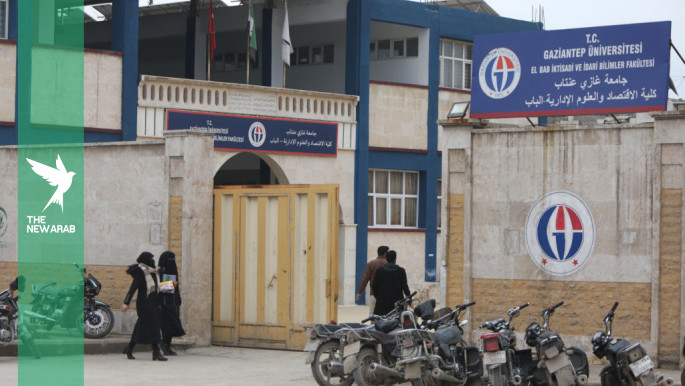
People enter a university campus run by Turkey’s Gaziantep University in al-Bab, northern Syria, on 29 January 2024. [Getty]
When Syrian MPs gathered last week for the first parliamentary session of the post-Assad era, electing a new speaker was among the first orders of business.
Among the three who stood for the position, it was jurist Abdulhamid al-Awak who emerged as parliament’s favoured candidate, garnering the support of almost half the 206 lawmakers in attendance.
Al-Awak, a former professor at Mardin Artuklu University in Turkey, is among a growing number of Syrian officials in the transitional government with ties to Turkish educational institutions, which since Assad’s ouster have emerged as a valuable soft power tool for the Turkish government.
Among the most prominent alumni is the country’s foreign minister, Asaad al-Shaibani, who earned a master’s degree in international relations from Istanbul Sabahattin Zaim University.
Bingol University is the alma mater of Azzam Algharib, a former commander of the Turkish-backed Syrian National Army who was appointed governor of Aleppo soon after Ahmed al-Sharaa took power.
Omer Ozkizilcik, an Ankara-based foreign policy analyst, says that the presence of Turkish-educated officials extends to the lower rungs of the civil service, where many now occupy positions in key ministries, government agencies, and regional authorities.
“If you go to the economy ministry, the ministry of defence, the ministry of foreign affairs, the interior ministry, you will find people who graduated from Turkish universities,” he told The New Arab.
Wartime education
Turkey’s growing role in Syrians’ education is a product of the country’s brutal civil war, which forced millions of people to seek refuge across the northern border.
Over the past 14 years, tens of thousands of Syrians have graduated from Turkish institutions, which provided education not just to refugees but to people living in northwestern Syria where people had limited study options.
Ozkizilcik says that three universities stand out in that they actively sought to enrol Syrians: Mardin and Gaziantep in the south, where most Syrian refugees were based, and Sabahattin Zaim in Istanbul, a favoured destination for students of wealthier families.
Mardin Artuklu University is popular due to the high number of Turkish-Arab professors, which eliminates the language barrier for Syrian students.
Gaziantep not only trained refugees in Turkey but became actively involved inside Syria, establishing four branches inside areas of the north controlled by Turkish-backed militias. This supplemented programmes run by Turkish NGOs, which worked in Idlib and Aleppo provinces providing primary schooling services as well as vocational training to older students.
“The opening of branches of the Gaziantep University inside northern Syria is a clear example of a state policy to train and educate new elites of Syria,” Ozkizilcik says.
Opening faculties in third countries is uncommon among Turkish institutions and Gaziantep’s expansion into Syria likely required government backing, he adds.
He also points to the government’s scholarship programme for foreign students, which requires participants to return to their home countries after they graduate.
A leading player in the new Syria
Turkey has emerged as perhaps the biggest beneficiary of Assad’s downfall in December 2024.
Having backed several of the opposition factions that spearheaded his ouster, Ankara has had long-standing ties with key figures inside al-Sharaa’s transitional government and moved rapidly to normalise ties with Damascus.
It has since become one of Syria’s closest regional allies, becoming heavily involved in the reconstruction process and providing economic, diplomatic and military support to the fledgling government.
Education ties have also deepened in recent months, with Damascus moving to recognise degrees from Turkish institutions and the two sides exploring the establishment of a joint Syrian-Turkish university in northern Syria.
Ozkizilcik says that education is one of the ways Turkey is looking to build long-term influence inside the country, calling it a “proven soft power tool of international relations”.
“Educating and training the new elite of a country is a tool that guarantees impact and influence over a long period of time,” he says.
Turkey is not the only country looking at education as a form of clout inside the new Syria.
France – Syria’s former colonial power – is doing likewise, this month announcing new funding to reopen French-speaking Christian schools inside the country.