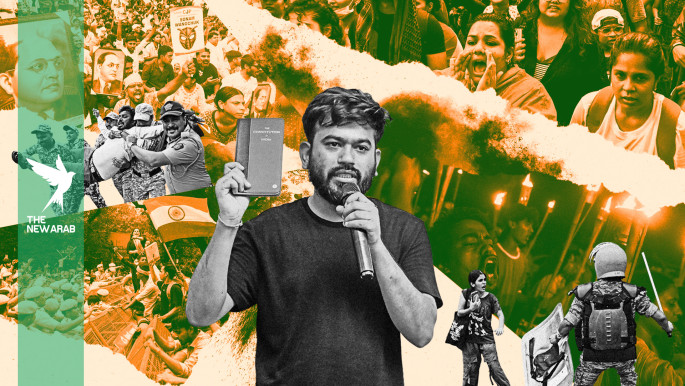
For Atishrey, a 28-year-old mass media student from Delhi, joining the anti-government student protests was less a matter of choice than of responsibility, reflecting what he describes as a growing sense that young people are no longer being heard.
He has spent more than a week at the protests, including taking part in the recent “Parliament March”, one of several demonstrations that have drawn thousands of students onto the streets of the capital despite an escalating police crackdown.
During the march, he said he was repeatedly struck with batons, leaving him with severe back pain that persisted for days. He described the experience as “brutal”, alleging that both uniformed police officers and unidentified men in civilian clothing pushed protesters and tried to break up the demonstration.
“The police crackdown didn’t stop us, though,” the young student tells The New Arab defiantly. “It only encouraged more students to join, and within days, the protests had spread to multiple Indian cities.”
Even after days of escalating confrontations, Atishrey said he had no intention of leaving the protest site.
“It is not going to stop us at all,” he adds. “The government needs to understand that it is in power because of the people, not by itself.”
Atishrey alleges that authorities are using their power and resources to prevent people from joining the protests, saying that the demonstrators are being labelled “anti-nationals” in an attempt to divert attention from their demands.
“Protesters say what began as a campaign demanding the resignation of India’s Education Minister has evolved into a broader movement against unemployment, declining economic prospects and the government’s failure to listen to young people”
His remarks reflect a broader sentiment among many students gathered at the protest site, where demonstrators are demanding the resignation of India’s Education Minister.
Led by the satirical Cockroach Janta Party (CJP), the student protesters say what began as a campaign demanding the resignation of Education Minister Dharmendra Pradhan has evolved into a broader movement against unemployment, declining economic prospects, and what they describe as the government’s failure to listen to young people.
“This is no longer just about one issue. It is about the frustration among students over how the authorities have responded to our voices. Instead of listening to us, they are trying to suppress the movement,” Atishrey says.
NEET scandal
The student protests began on 6 June, with demonstrators demanding the resignation of India’s Education Minister Dharmendra Pradhan and holding him responsible for alleged examination paper leaks reported in May.
A student-led movement, which protesters describe as one of India’s longest-running youth protests in recent years, is now challenging the handling of public dissent by Prime Minister Narendra Modi’s government.
India faces a heightened risk of civil unrest, ranking as the ninth-highest risk country globally in Verisk Maplecroft’s Civil Unrest Index.
The movement gained further attention after activist and educator Sonam Wangchuk joined the CJP-led protest at Delhi’s Jantar Mantar and began an indefinite hunger strike on 28 June over the NEET paper leak.
After 26 days of fasting, Wangchuk ended his hunger strike on 24 July following assurances from the government regarding accountability.
Less like a democracy, more like a dictatorship
P Srishti, a 21-year-old second-year BSc student from Bihar, said she joined the protests after becoming frustrated by what she described as years of inaction over students’ concerns.
According to her, protesters had been sitting peacefully, hoping the Modi government would respond to their demands.
However, she said the government had yet to address the students’ key demands, leaving many young people, including women, to spend days and nights on the streets demanding action and accountability.
She said police had sealed off the main protest area with barricades and used force against demonstrators, leaving many panicked and fearful and turning Delhi’s Jantar Mantar into a heavily fortified zone.
“We are fighting for our future. If we all stay home because we are scared, nothing will change”
Srishti alleges that police officers had verbally abused protesters throughout the demonstrations, including directing misogynistic slurs at women on multiple occasions.
“Police did not even spare women students. They were beaten, slapped, and dragged on the roads. Some women protesters were even inappropriately touched during the crackdown,” Srishti tells The New Arab.
The experience, she said, had left her fearful whenever she saw police.
“I don’t feel threatened by anyone here. I only feel threatened by the police,” she shares, adding that despite her fear, she intends to continue protesting.
“We are fighting for our future. If we all stay home because we are scared, nothing will change,” she said.
Srishti argues that the protests have evolved into a broader struggle for democratic rights, stating that young people are no longer protesting solely over the alleged NEET paper leak but are also demanding accountability and protection of democratic freedoms, including the right to free expression.
“I don’t think democratic rights exist in India anymore. We are treated like criminals just for protesting, and we are constantly being watched through surveillance cameras. It feels less like a democracy and more like a dictatorship,” she said.
Police crackdown and violence
The CJP-led protest has also drawn support from several regional political parties and opposition leaders. On Tuesday, India’s Leader of the Opposition, Rahul Gandhi, was briefly detained after leading a protest outside the Prime Minister’s residence in solidarity with the students.
He demanded Modi’s resignation over the police crackdown on demonstrators protesting alleged irregularities in the NEET examination.
Authorities imposed internet restrictions in parts of Delhi, particularly around Jantar Mantar, disrupting communication for residents, commuters, and protesting students.
During the clashes, Delhi Police said nearly 180 people, including 60 protesters and 118 police and security personnel, were injured. Authorities also stated that 70 protesters were detained and that legal proceedings would be initiated against them.
Paski, a 30-year-old theatre artist from Kerala and a graduate of the National School of Drama in New Delhi, said she had been participating in the protest since its 17th day. She described the authorities’ response to the movement as “intolerable”, saying it was humiliating to see young people face such treatment for raising their concerns.
According to Paski, while the resignation of the Education Minister alone will not resolve all systemic issues, it conveys a broader message that power ultimately remains with the public.
“If we can vote for them and give them the chair, the public also has the right to remove them from office,” she tells The New Arab.
She says that police used batons during the protests and claims that some had nails attached to them, causing serious injuries to protesters.
“The government seems more focused on suppressing the dissent of young people rather than addressing their concerns,” Paski says, adding that protesters are only exercising their right to protest against what they see as failures in the system, but their right to peaceful protest is being taken away.
Amnesty International has raised concerns over the Delhi Police’s handling of the youth-led protests in New Delhi, alleging the use of excessive force, including batons and tear gas, against demonstrators. The rights group said authorities must protect, rather than suppress, the right to peaceful assembly and called for an independent investigation into alleged violations.
Meanwhile, Prime Minister Narendra Modi on Thursday assured that “more strict” action would be taken against those involved in paper leaks, as the CJP-led protests over alleged irregularities in the NEET-UG 2026 examination continued.
On Friday, leaders of the CJP held talks with the government, with the party saying officials sought time until Saturday afternoon to respond to their demand for the resignation of Education Minister Dharmendra Pradhan.
However, despite the government’s assurances, protesters have remained on the streets, demanding accountability and further action.
The New Arab reached out to the government regarding the allegations and its handling of the protests but had not received a response at the time of publication.
Students’ full names have not been used to protect their identities.
Mehran Firdous is a freelance journalist based in northern India whose reporting focuses on conflict, human rights, the environment, and social issues.
Follow him on Instagram: @_mehranbhat