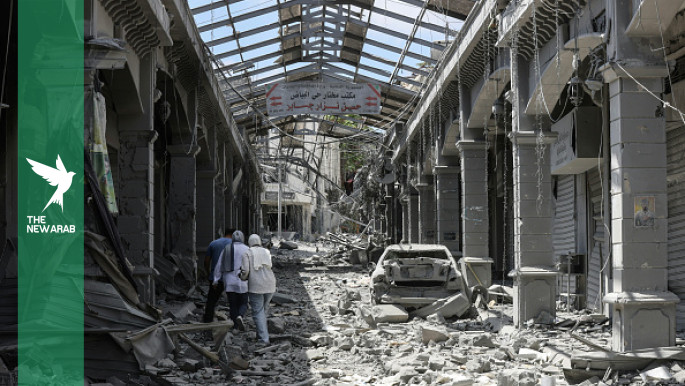
People walk through the heavily damaged historic market of Nabatieh, as residents displaced by the fighting return to southern Lebanon in June 2026 [Getty]
Months into its invasion of southern Lebanon, Israeli forces have occupied, destroyed or taken control of numerous landmarks, including sites that symbolised resistance to Israel’s previous occupation, as well as historic, religious and cultural heritage sites.
Many of these locations sustained heavy damage during Israel’s military campaign that began in October 2024, when Israeli ground forces invaded southern Lebanon following a year of cross-border hostilities with Hezbollah.
In recent days, reports have emerged that the Israeli military has transformed the notorious Khiam detention centre into a fortified military position complete with a helipad.
Originally built by the French Mandate authorities as military barracks, the Khiam detention centre was later operated by the Israeli-backed South Lebanon Army during Israel’s 18-year occupation of southern Lebanon between 1982 and 2000.
More than 5,000 detainees are believed to have passed through the prison, where torture was systematic and at least ten prisoners died.
Following Israel’s withdrawal in 2000, the prison was turned into a museum and memorial documenting the abuses committed during the occupation. It was heavily damaged during Israel’s 2006 war on Lebanon.
Now, 26 years after Lebanon declared the south liberated, Israeli forces have once again seized the site, bulldozing large sections of the former prison and converting it into a military base.
Recent satellite imagery shows the detention centre and its surroundings blackened and heavily altered, with Israeli forces constructing earth berms, defensive positions and radar installations. Although Israeli troops first occupied the site in May, the images have recently resurfaced online, highlighting the scale of the military fortifications.
The town of Khiam, perched on a strategic hill overlooking both southern Lebanon and northern Israel, has itself suffered widespread destruction. It is one of dozens of border communities devastated during Israel’s invasion, with aerial footage showing entire neighbourhoods reduced to rubble.
World Heritage sites and protected areas
Israel’s military campaign has also affected a number of archaeological, cultural and religious heritage sites across Lebanon, with some sustaining direct damage and others remaining under Israeli military control.
Shamaa
Home to the shrine of St Peter, a site revered by both Christians and Shia Muslims, Shamaa suffered extensive destruction during Israeli attacks in 2024 and again in 2026.
Beaufort Castle
The 12th-century Crusader fortress overlooking the Litani River was captured by Israeli forces in late May after days of intense fighting.
Long regarded as one of southern Lebanon’s most strategically important landmarks, Beaufort commands sweeping views across the south and into northern Israel. While no major structural damage has been reported, the castle remains under Israeli military control.
Tyre
One of the oldest continuously inhabited cities on the Mediterranean and home to two UNESCO World Heritage sites, Tyre has been repeatedly bombed during Israel’s offensive.
Entire neighbourhoods have been levelled, while nearby strikes caused damage around the city’s archaeological complex. Images showed dust and debris covering ancient columns, alongside twisted metal and shattered trees scattered among centuries-old ruins.
Archaeologists and heritage organisations have repeatedly warned that continued bombardment threatens one of the eastern Mediterranean’s most significant archaeological landscapes.
Mosques and churches
Beyond Shamaa, Israeli attacks have damaged numerous Muslim and Christian places of worship across southern Lebanon.
According to Lebanese authorities, at least nine mosques have been damaged or destroyed, including the Prophet Shuayb Mosque in Blida, the historic mosque in Aitaroun, the historic mosque in Nabatieh al-Tahta, the Grand Mosque of Bint Jbeil, the Hay al-Bayyad Mosque in Nabatieh, and the Prophet Mhaibib Mosque and shrine in Mays al-Jabal, one of the first villages to be devastated during Israel’s 2024 offensive.
At least eight churches have also sustained damage, including the medieval St Mema Church and Monastery in Deir Mimas, St George Church in Derdghaya and St Elijah the Living Church in Alma al-Shaab, much of whose population has been displaced.
Economic hubs
Israel’s bombardment has also devastated the commercial heart of southern Lebanon, destroying marketplaces, businesses and civilian infrastructure that sustained local communities.
Among the hardest-hit urban centres are Nabatieh, Tyre and Bint Jbeil.
Nabatieh’s historic Ottoman-era souk suffered extensive destruction during Israeli strikes in both 2024 and 2026, with large sections of the city reduced to ruins. Bint Jbeil’s historic market also sustained heavy damage.
In Tyre, air strikes hit busy commercial streets lined with shops, restaurants and cafés, further crippling the local economy.
Environmental devastation
The war has also inflicted severe environmental damage across southern Lebanon. Israel’s repeated use of white phosphorus, alongside intensive bombardment and bulldozing operations, has contaminated farmland, damaged air quality and polluted water sources.
Satellite imagery and field reports have documented the destruction of thousands of olive trees and fruit orchards, while extensive swathes of agricultural land along the occupied border strip have been systematically bulldozed.
Beyond southern Lebanon
Israeli attacks also damaged heritage sites far beyond the southern front. In the eastern Beqaa Valley, several historical landmarks around the ancient city of Baalbek were hit during the 2024 war, including the French Mandate-era Gouraud Barracks, part of a Roman defensive wall, and a 13th-century Ayyubid mausoleum in nearby Douris.
Although restoration work has since begun at some sites, including Baalbek’s historic Palmyra Hotel, concerns remain over the vulnerability of the region’s cultural heritage.
Home to one of the world’s largest and best-preserved Roman temple complexes, Baalbek narrowly escaped direct destruction after Israeli strikes landed nearby, prompting repeated appeals from Lebanese officials and heritage experts to spare the UNESCO-listed site from further attack.