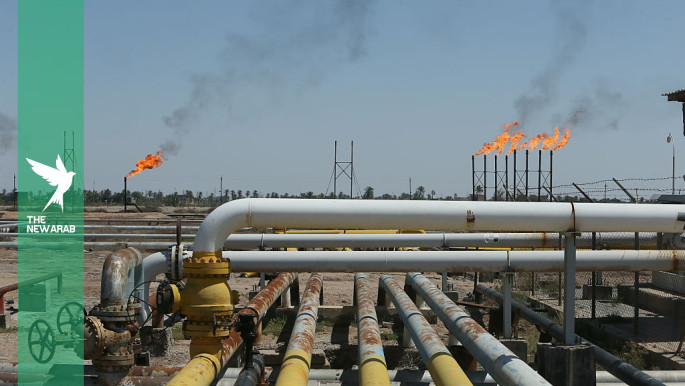
The Nahr Bin Umar refinery in Basra, Iraq, pictured on 29 April 2026. [Getty]
Syria is emerging as one of the few beneficiaries of Iran’s lockdown of the Strait of Hormuz as Gulf states scramble to find new ways of getting their oil out of the region.
The country’s Mediterranean ports have provided an outlet for Iraq, which has assembled an armada of trucks to transport millions of barrels of oil across the Syrian desert.
The flows have been at such a scale as to transform Syria into one of the Middle East’s primary export hubs, shipping out more than a quarter of the region’s fuel oil volumes, according to Bloomberg.
Maritime intelligence company Tanker Trackers said Iraq has exported seven million barrels of crude and 5 million barrels of fuel oil via Syria’s Baniyas refinery since April.
The development comes at a crucial time for Syria, which is trying to rebuild its economy after the civil war and reintegrate into the region after years of isolation under the Assad regime. Syria’s government is earning transit fees from the shipments and has assumed new strategic importance as producers race to diversify their export routes.
“Syria needs the political and economic leverage from being an energy transit corridor,” Mohamad Ahmad, an economist and energy specialist at Karam Shaar Advisory, told The New Arab.
“Syria needs to regain its role in the Middle East and being a corridor for oil is a geopolitical asset,” he said.
The government also needs the revenues to help fund the costly reconstruction effort and finance the budget. Though it is not thought to be making much money from the current arrangement, reactivating the Syria-Iraq oil pipeline could see it bring in hundreds of millions of dollars a year.
Traffic through the Hormuz, which carried about a fifth of the world’s oil supply before the war, has ground to a halt since the US and Israel launched the war on Iran in February. Shipping gradually increased after the US and Iran signed an agreement to end the war, but has since fallen back after Iran resumed attacks on tankers last week.
Iraq has been among the worst-affected producers by the closure of the strait and was forced to shut down production at some of its fields earlier on in the war.
OPEC’s second-largest producer normally exports about 3.6 million barrels of oil per day, and before the war, more than 90 percent was shipped via its southern Basra terminals in the Gulf.
Others in the region have had easier options to bypass the chokepoint. Saudi Arabia has diverted millions of barrels to its Red Sea terminal in Yanbu. Meanwhile, the UAE has ramped up shipments from Fujairah, its only port located outside of the Arabian Gulf.
Permanent routes
Recent moves suggest that the two countries are looking at the arrangement less as a temporary solution and more as a stepping stone towards a long-term relationship.
Syrian and Iraqi oil officials earlier this week signed a deal to rehabilitate and expand the Kirkuk-Baniyas pipeline, which has been out of operation for more than two decades.
The route is expected to enable Iraq to export two million barrels of oil a day via the Mediterranean, more than half of what it shipped through the strait before the war.
Experts say this could bring about $200 million per year into Syrian coffers when it is up and running.
The government has responded to the Hormuz crisis by trying to maximise exports. Ahmad says it has invested to significantly in Baniyas port, which has seen its capacity more than double in recent months.
The pipeline project has been encouraged by Trump’s envoy to Syria and Iraq, Tom Barrack, who has organised discussions between the two countries. It has also been given backing by the CEO of French oil giant Total, who accompanied President Emmanuel Macron on his state visit to Syria earlier this month.
The project comes as other Gulf producers look at infrastructure upgrades and new pipelines to skirt the Strait of Hormuz. The UAE is fast-tracking a new pipeline connected to Fujairah while Kuwait – which is fully dependent on the strait – is considering building a pipeline to connect to Saudi Arabia.