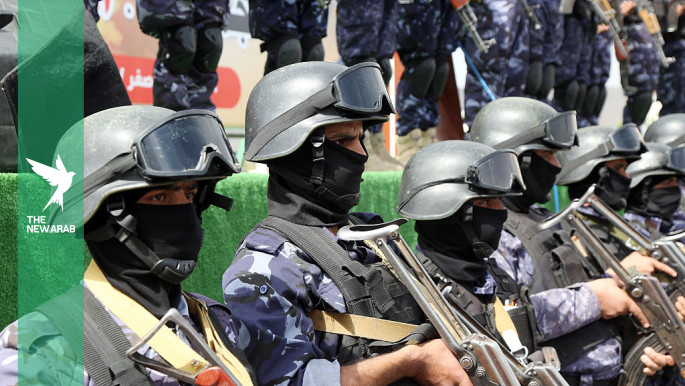
Houthi forces stand guard at a protest against Saudi Arabia in the Yemeni capital Sana’a [Getty]
Four years after a UN-brokered truce largely halted Yemen’s devastating civil war, a sudden confrontation between the internationally recognised government and the Houthi movement is raising fresh questions over whether the conflict could be entering a dangerous new phase.
Senior members of Yemen’s Presidential Leadership Council (PLC) this week declared that the “time has come” for a decisive battle against the Houthis, while the Iran-backed group warned it would treat the continuation of what it describes as the blockade on Yemen as “a full-fledged war”.
The increasingly escalating rhetoric follows the most serious flare-up between the Houthis and the Saudi-led coalition since the 2022 truce, after coalition aircraft struck Sana’a International Airport to prevent an Iranian plane carrying senior Houthi officials from landing.
The Houthis responded by firing missiles towards southern Saudi Arabia, fuelling concerns that the fragile status quo could be beginning to unravel.
Whether the latest exchange marks a temporary crisis or the start of a wider return to conflict remains unclear, but recent developments suggest many of the forces that froze Yemen’s civil war are coming under renewed strain.
Why tensions are rising
At the centre of the latest crisis is a dispute over direct flights between Tehran and Sana’a.
Earlier this month, an Iranian aircraft carried out the first known direct flight between the two capitals in around a decade.
Yemen’s internationally recognised government claimed it carried Iranian military experts and weapons, while the Houthis said it was transporting officials and wounded fighters returning from Iran.
When another Iranian aircraft attempted to land in Sana’a on 13 July, coalition warplanes bombed the airport’s runway, forcing it to divert to Hodeidah.
The Houthis have insisted direct flights will continue regardless of Saudi objections, presenting the route as part of a broader effort to end what they describe as the “air blockade” imposed on areas under their control.
The internationally recognised government and the Saudi-led coalition, however, view the flights as strengthening the Houthis’ ties with Iran while undermining their control of Yemeni airspace.
In a recent analysis, the International Crisis Group warned that the dispute had placed Yemen’s de facto truce under its greatest strain since 2022, arguing that without renewed diplomacy the confrontation risks opening the door to broader military escalation.
Stronger rhetoric, uncertain intentions
Against that backdrop, senior figures on both sides have adopted some of their strongest language in years.
PLC member Othman Mujalli said the “time has come” to recapture state institutions from Houthi control, arguing that years of seeking peace had come at a greater cost than military confrontation.
Abdulrahman al-Muharrami, another PLC member and commander of the Giants Brigades, said government-aligned forces remained committed to peace but were fully prepared for “a decisive battle” if required.
The Houthis responded by warning that maintaining what they call the blockade would amount to “a full-fledged war”.
Mohammed al-Atifi, defence minister in the Houthi administration, said the group’s forces had raised their readiness and stood prepared to carry out any orders from leader Abdul Malik al-Houthi.
The sharp exchange comes as regional tensions remain elevated following the recent US-Israeli conflict with Iran, with the Houthis appearing increasingly determined to assert greater control over territory they hold while deepening their public relationship with Tehran.
Yet a return to all-out war is far from inevitable.
Saudi Arabia has spent years attempting to reduce its direct involvement in Yemen, while the Houthis continue to face significant economic challenges inside territory under their control.