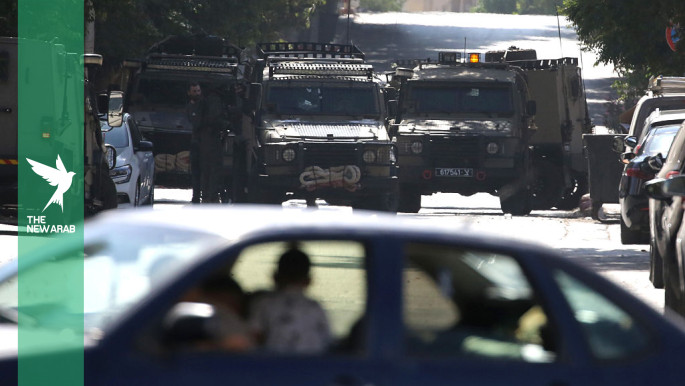
Israeli soldiers block the road leading to Nablus Hospital, after raiding the hospital and detaining a wounded Palestinian, and his sibling in Nablus, West Bank [GETTY]
Israeli settlers carried out a wave of attacks across the occupied West Bank on Friday and into Saturday, targeting several Palestinian towns and villages following a settler attack near Nablus which killed four Palestinians, as the Israeli military launched a large-scale operation in the territory.
The violence has heightened fears of coordinated reprisals against Palestinians, with officials and residents describing a surge in settler assaults accompanied by intensified Israeli military activity.
The escalation followed a deadly shooting in n the town of Tell, west of Nablus, where armed settlers entered the area and opened fire on residents earlier on Friday. Four Palestinians and two Israelis were killed.
In a statement to The New Arab, Francesca Albanese, the UN Special Rapporteur on the occupied Palestinian territories, said Israel was a “structurally colonial government, not one that occasionally deviates, adding that “Smotrich and Ben-Gvir aren’t marginal figures being contained by Netanyahu; they are the engine of the annexationist agenda, and Netanyahu is its political guarantor.”
The Palestinian foreign ministry condemned the attack as a “massacre”, accusing Israel of pursuing a broader policy of “annexation “and ethnic cleansing” in the West Bank.
The former head of the Tell village council, Numan Saleh, told The New Arab that Israeli forces raided the village at the end of the funeral for the four Palestinians killed on Friday, which they were told would be limited to 30 people after imposing restrictions.
Saleh said Israeli soldiers proceeded to raid houses and detained more than a hundred residents, 40 of whom were arrested following interrogations.
Settler attacks escalate across the West Bank
In the hours that followed, multiple settler attacks were reported across the northern West Bank, which Palestinian officials and residents described as part of coordinated revenge assaults.
In the village of Sarra, southwest of Nablus, dozens of settlers stormed the area on Friday evening, injuring at least three people and setting fire to homes, according to the town’s mayor, Naaman Abdullah.
Similar violence was reported in Far’ata, east of Qalqilya, where five residents were injured after settlers fired live ammunition at locals attempting to confront them. Footage circulating from the scene showed fires burning across nearby hills and plumes of smoke rising over the village.
Further north, in the village of Khirbet Imreiha near Ya’bad, residents were assaulted and pepper-sprayed by settlers, according to local mayor Samer Abu Bakr.
Albanese warned that the situation reflected a broader pattern of escalating violence. “Outposts have historically functioned as launching pads for further attacks, and their legalization entrenches land appropriation as a precursor to larger settlements, so this isn’t ad hoc retaliation, it’s a known escalation ladder being climbed on schedule,” she said.
Israeli military launches large-scale offensive
Alongside the settler violence, the Israeli military announced it was reinforcing its presence in the West Bank ahead of what it described as a “significant counterterrorism operation”. According to Israeli media reports, additional troops have been redeployed from Gaza and southern Lebanon, with at least five companies sent to the area.
“Recent events in Tell aren’t an exception mishandled by a government otherwise focused on ordinary administration. They’re evidence that colonization of the West Bank is, in effect, this executive’s central function. Not a security issue nor an accidental side-effect, but the agenda itself,” Albanese told The New Arab.
“The sequence is diagnostic: a deadly clash, followed the same day by the announcement of new outposts and accelerated legalizations.There’s no gap between event and response because the response was already prepared. it’s a mechanism, not a reaction,” she added.
The army has imposed closures on multiple towns and villages, restricting movement across the occupied territory, while a curfew has been introduced in parts of the northern West Bank.
Nablus has emerged as a focal point of the operation, with Israeli forces effectively besieging the city. Military vehicles were deployed along key access routes, including the road from the Huwara checkpoint to the city’s main hospital.
Israeli forces also raided Nablus Specialised Hospital, arresting two brothers and injuring one of them, according to the Palestinian news agency Wafa. Medical staff were reportedly assaulted during the raid.
Footage from inside the hospital showed individuals lying on the ground with their hands restrained behind their heads, while a health official said Israeli forces seized surveillance footage and attempted to blow open administrative offices.
Elsewhere, arrest raids were carried out across the West Bank and East Jerusalem, including in Al-Tur and Bab Hutta in Jerusalem, Qalandiya refugee camp, the Bethlehem area, and towns north of Ramallah and al-Bireh. At least six Palestinians were arrested in Qalqilya governorate overnight, as well as eight others in the Hebron governorate, and more than a dozen people in Ramallah and al-Bireh.
In a statement, the Israeli military said its Central Command was coordinating with settlement leaders and preparing to arrest those responsible for the earlier attack, framing it as a “significant counterterrorism operation”.
Israeli Defence Minister Israel Katz also announced punitive measures against Palestinians, including plans to demolish the family home of an alleged assailant and revoke work permits for residents of the villages involved.
Far-right National Security Minister Ben-Gvir went further in calling for airstrikes on Palestinian villages threatening that “for every Jew murdered, the enemy should lose land and homes. This is the language of the Middle East. Just as we spoke it in Gaza, it is time to speak it in the West Bank.”
The developments come amid growing international concern over rising settler violence in the West Bank and the expanding scope of Israeli military operations, which Palestinians say are increasingly targeting civilian areas under the pretext of security operations.
Asked whether she thought Israel was exploiting the violence to carry out settlement expansion and the further ethnic cleansing of Palestinians, Albanese told The New Arab that “‘Exploiting’ may understate it. Smotrich’s explicit call for nearby villages to be cleared for new settlements suggests the violence functions less as a pretext requiring exploitation and more as a built-in trigger for a policy already decided.”