Layoffs abroad, opportunities back at home? What African tech talent should do next


We’ve only just entered the second half of 2026, and about 164,271 jobs have been lost in 435 layoffs so far. On average, 874 people have lost their jobs per day this year (compared to 674 per day in 2025), and if the trend continues, the number could reach 319,000 by the end of the year.
Among the tech companies that have laid off employees so far are Amazon (16,000), Meta (8,000), Cisco (under 4,000), and Intuit (3,000). In May, Branch, operating in both Kenya and Nigeria, disengaged employees and threw numerous households into uncertainty despite making $30m in profit.
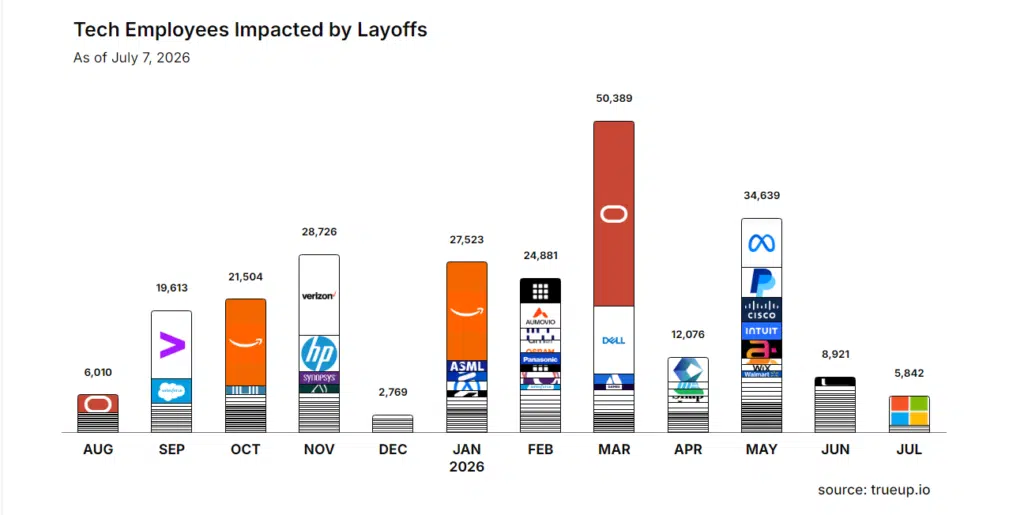
Microsoft became the latest tech company to lay off staff, about 4,800 of them, which accounts for roughly 2.1% of its global workforce. Amy Coleman, Executive Vice President and Chief People Officer, explains that AI isn’t replacing the roles eliminated, but also admits that AI is indeed changing the way work is being done.
“Our business is changing because the world around it is changing,” Coleman notes. “The way technology is built, deployed, and used is transforming faster than at any point in my time here. Our customers’ needs are shifting, the business models that serve them are shifting, and that means the work itself – what we do, where we focus, and how we’re organized – has to transform too.”
Coleman argues that “companies don’t get to choose whether their industry changes; they only get to choose whether they change with it.”
In the wake of these incessant layoffs and the resulting uncertainties, it’s important to ask how this affects African tech talent in the diaspora and for those building skills locally to serve on a global scale, and what practical steps can be taken to remain competitive in a brutal market.
CEO of Siatech Africa, Lanre Olaniyan, views the recent layoffs as a wake-up call, insisting that Africa needs to focus less on exporting talent and more on building African technology companies that can create sustainable, high-value jobs back home.
“The recent wave of layoffs has exposed something we’ve known for a while—Africa still depends too heavily on foreign companies for high-quality technology jobs,” Olaniyan notes. “When decisions are made in Silicon Valley or Europe, talented African professionals lose their jobs, even though the demand for digital transformation across Africa continues to grow.”
For years, many African talent believed that landing a job with a global technology firm like Meta or Google guaranteed stability, but recent events have proven otherwise.

Victoria Fakiya – Senior Writer
Techpoint Digest
Stop struggling to find your tech career path
Discover in-demand tech skills and build a standout portfolio in this FREE 5-day email course
Artificial Intelligence remains the fall guy
Layoffs are often blamed on the astronomical rise of Artificial Intelligence, as organisations continue to embed AI into their operations to cut costs and scale productivity.
Rather than a bloated team, organisations are becoming leaner, deploying AI systems to handle routine operations and tasks that previously required human input. And as AI improves through training, there is a risk that AI will replace even more jobs.
Olaniyan agrees, explaining that AI isn’t replacing great people; it is replacing repetitive work.
“AI is taking over repetitive and routine tasks, allowing organisations do more with smaller teams. But it isn’t replacing strategic thinking, leadership, creativity, relationship management, or deep industry expertise,” Olaniyan notes, adding that smart founders are employing AI to make talented people far more productive.
However, we’ve also seen companies recall previously fired workers because AI didn’t quite meet the standard. Automobile company Ford rehired some human engineers it had previously disengaged after AI failed to meet the required quality-check standards. Ford recalled the human engineers to train the AI systems (which would later replace them) and to provide guidance to junior engineers.
In May, Pope Leo XIX called for caution and fairness in the deployment of AI, warning that AI should serve the common good and preserve human dignity rather than cause widespread exploitation and damage.
The Pope’s message proved timely and rightly generated conversations in the tech space for some time. Still, it’s unlikely that capitalism’s profit-driven push would take a back seat while fairness and human dignity take centre stage, because the big tech empire will crumble once this happens.
Is tech saturated?
One question that keeps coming up when layoffs happen is whether the tech bubble is beginning to burst. During the COVID19 pandemic, many organisations were forced to implement remote work policies, enabling workers to meet their deliverables from the comfort of their homes.
It was also a time of unprecedented hiring across tech; teleconferencing tool Zoom made a kill, meetings moved from boardrooms to online conference rooms, and many individuals needed to connect with team members and even keep up with families in other locations.
CEO of Lendsqr, Adedeji Olowe, agrees, stressing that layoffs are happening because of the massive recruitment during the COVID-19 period, with many firms riding the remote work hype.
“As AI started coming in, people started seeing opportunity and just started dropping people,” Olowe notes. “So most organisations that laid off did so because they found a window of opportunity. But some people are genuinely laying off because AI is actually providing life benefits.”
Reknown HR leader Emmanuel Faith, however, disagrees that tech is saturated. He believes that we’ve reached a point where the market is rewarding value and depth over proximity to technology.
“For years, ‘working in tech’ was seen as a career destination,” Faith explains. “Today, technology is becoming the operating system for every industry. The question is no longer whether you work in tech, but whether you can use technology to solve meaningful problems.”
Faith advises that, rather than African talent abandoning tech entirely because of the saturation question, they should consider where their technical expertise can have the greatest impact: agriculture, healthcare, education, climate, logistics, manufacturing, and many more.
Olaniyan shares similar thoughts with Faith. He argues that tech is the foundation of every industry, and that demand for technology will continue to grow across all sectors. Still, the real opportunity lies in applying technology to solve Africa’s unique challenges rather than simply replicating existing global products.
What to do post layoffs: return and build in Africa?
Faith insists that a layoff should be viewed as an employment event and not a verdict on your ability. Many of those affected have built products at a global scale and solved incredibly complex problems, and the experience gained would remain valuable regardless of where they work next.
African talent affected by layoffs should not shrink or undervalue themselves, but rather make decisions based on opportunity and purpose, not simply because of a difficult job market elsewhere.
On his part, Obinna Osuji, Co-founder and CEO, Medismarts, explains that the recent waves of layoffs have shown that the challenge is not unique to Nigerians or Africans in the diaspora.
Osuji clarifies that, depending on their visa status and whether they can get a new offer within the stipulated 60 to 90 days, they might have to leave the country. However, he argues that returning home does not mean starting over. The skills, experience, networks, and global exposure gained abroad remain incredibly valuable.
He believes that AI has dramatically lowered the barriers to entrepreneurship, enabling employees to become solo founders who build products, acquire customers, and generate revenue before raising a single dollar of external funding.
How layoffs can benefit African companies
For some diaspora-based African talent affected by layoffs, the only viable option would be to return to the continent, and maybe pick up roles with indigenous companies. The offer might not be as juicy as foreign jobs, but it can offer something fulfilling: an opportunity to build for your people and mentor younger talent.
Osuji says many African startups have long struggled with a shortage of experienced talent, and that the return of skilled professionals from abroad presents a unique opportunity to address this challenge on two fronts, especially for those not willing to pursue entrepreneurship.
First, these talents can be absorbed into strategic leadership and specialist roles. Some companies are actively seeking to retain these professionals in their current countries of residence by hiring them remotely or sponsoring alternative work arrangements, recognising the value of their market knowledge, international experience, and professional networks.
The second opportunity lies within local businesses looking to scale. These organisations have an opportunity to strengthen their teams by attracting diaspora talent back home. However, doing so will require a willingness to offer competitive compensation, meaningful career growth, and work environments that allow these professionals to thrive.
“Ultimately, Nigeria, and Africa more broadly, must invest in creating conditions that support long-term growth and opportunity,” Osuji explains. “Without deliberate improvements in areas such as infrastructure, economic stability, ease of doing business, and quality of life, returning professionals may view home not as a destination, but as a temporary stopgap.”
And if that happened, there would be no incentive for such talent to stay, and we would face the same talent shortages that have held Africa back for years.
Faith affirms that diaspora-based talent returning to the continent can be a great addition.
“One of the biggest constraints many African startups face is execution at scale, Faith explains. “Diaspora-trained professionals often bring experience in operational excellence, product thinking, organisational design, customer experience, security, governance, and scaling systems.”
However, he cautions that success would depend on adaptation, maintaining that importing Silicon Valley practices without considering local context rarely works.
Olaniyan says massive layoffs offer Africa an opportunity it should grab with both hands. He says Africa now has a chance to attract highly experienced professionals with global exposure.
“If governments and the private sector create the right environment, these professionals can build companies, mentor the next generation, transfer knowledge, and accelerate innovation across the continent. This could become one of Africa’s greatest competitive advantages,” Olaniyan argues.
Immediate opportunities African governments can tap into
The layoffs present African governments with an opportunity to focus on building and developing local talent rather than exporting. Olaniyan argues that while exporting talent brings remittances, building strong local technology companies creates something much more valuable. It creates industries.
Some of the continent’s best engineers and innovators have left in search of greener pastures, with brain drain remaining a plague that Africa governments have been unable to cure, for obvious reasons: a lack of the right recipe to grow local technology firms.
“Governments across the continent should deliberately invest more in training programs, design and implement tax incentives, research funding, public-private partnerships, easier access to financing, and policies that encourage local companies to scale regionally and globally,” Olaniyan notes. “There are enough examples we can learn from both the USA and China’s playbooks on how they help local firms to become global players.
African governments have to realise that when local technology firms thrive, the home country benefits. Moniepoint, Flutterwave, and Paystack have proven this, creating employment opportunities and contributing to economic growth.
What skills do talent need to thrive in this AI age?
Without mincing words, Olowe believes it’s going to get worse for anyone who is not solid in their craft. He admits that diaspora-based African talent now have to work twice as hard because they are competing with AI and not the next engineer. And unfortunately, AI is cheaper than anyone.
He maintains that the only way to win in the AI age is to have soft skills, and not technical skills that AI can take away.
“The only thing that gives anybody an advantage today in the world of AI is you have good attitude; you have agency; you’re extremely reliable; you’re forward thinking, and solution-minded.”
Osuji likens the rise of AI to the dot-com era, when jobs were lost, but newer, better opportunities emerged. He believes the winners in the AI age will be those who adopt early and adapt quickly to new realities.
“I expect to see a growing shift toward professions that rely heavily on human interaction: emotional intelligence, trust, negotiation, leadership, and relationship-building; areas where AI remains a tool rather than a substitute,” Osuji notes, agreeing with Olowe.
The recent layoffs across global tech companies might present an opportunity for African talent to return home and build meaningful companies, leveraging their experience and expertise. It’s also a wake-up call for African governments to provide an enabling environment for technology firms to thrive.