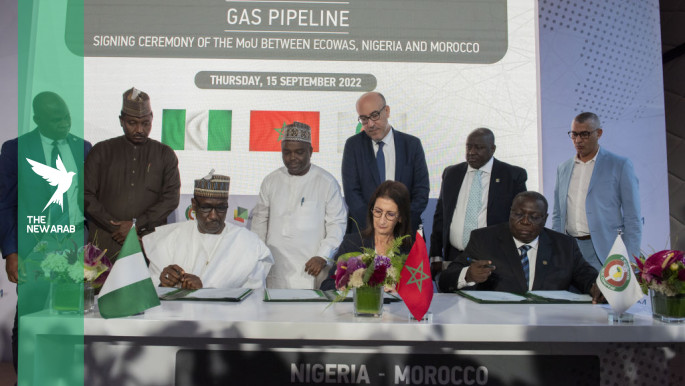
Officials sign a memorandum of understanding (MoU) for Morocco-Nigeria gas pipeline construction during signing ceremony in Rabat, Morocco on September 15, 2022 [GETTY]
West African leaders have backed a $25bn gas pipeline linking Nigeria to Morocco, pushing forward one of the continent’s most ambitious energy projects while raising questions over how such a vast corridor would be secured across multiple jurisdictions and maritime zones.
The intergovernmental agreement was endorsed by Economic Community of West African States (ECOWAS) leaders at a summit in Freetown, Sierra Leone, on 19 July, in a move presented by officials as a major step towards building the Nigeria-Morocco Atlantic gas pipeline – a project designed to carry Nigerian gas north along the Atlantic coast before connecting with Morocco and, eventually, European markets via Spain.
But while political momentum around the project has grown, analysts and regional reporting suggest the pipeline’s success will depend not only on financing and engineering, but on whether participating states can protect infrastructure stretching from the Gulf of Guinea to North Africa.
The planned route would run through Nigeria, Benin, Togo, Ghana, Ivory Coast, Liberia, Sierra Leone, Guinea, Guinea-Bissau, The Gambia, Senegal and Mauritania before reaching Morocco.
Reuters reported in April that the line would have capacity to carry up to 30 billion cubic metres of gas per year, with around half intended for export to Morocco and Europe. BBC reported this week that construction is expected to begin in 2028 and that feasibility and front-end engineering studies have already been completed.
Analysts, however, have warned over the past few months that safeguarding the project would require long-term security cooperation among participating states, reflecting the number of borders crossed and the political and maritime sensitivities along the route.
Although officials have said that offshore routes would avoid some of the Sahel’s riskiest areas, the project would still rely on states being able to protect infrastructure from attacks and wider disruptions.
This comes at a time when several of the countries involved in the pipeline’s route have faced growing security concerns and political instability, including destabilising coup attempts in Benin and Guinea-Bissau in 2025, and Guinea in 2024.
Security concerns are likely to extend beyond sabotage alone. A pipeline spanning so many coastal states would need coordinated naval and coastguard monitoring, intelligence-sharing, legal harmonisation and long-term political buy-in from host governments and local communities, security analysts have argued.
In its report on the agreement, the BBC said one Nigerian adviser argued that drones, aerial surveillance and community engagement would be needed to help secure the line.