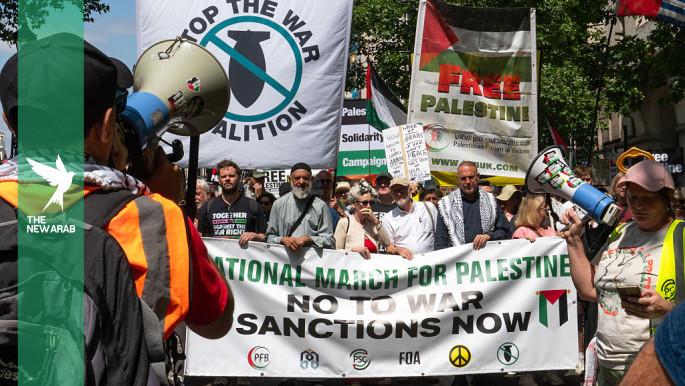
Sophie Bolt of CND, Jeremy Corbyn and Palestinian ambassador Husam Zomlot hold the lead banner during the “National March for Palestine” on 18 July 2026 in London, England. [Getty]
When you speak to Sophie Bolt, the general secretary of the Campaign for Nuclear Disarmament (CND), you immediately sense her passion mixed with fear. She has a passion for a world free of nuclear weapons and their dangers, and fear of a “threat” endangering the world, particularly the Middle East, due to the “hypocrisy” in how countries around the world, especially major powers, deal with the issue of possessing nuclear military capabilities.
Nearly 68 years ago, the Campaign for Nuclear Disarmament (CND), now led by Bolt, was established to rid the world of weapons of mass destruction.
In an interview with The New Arab, the campaign’s general secretary does not believe that the argument promoted by nuclear states that military nuclear capabilities are a deterrent weapon still holds meaning, because “the whole deterrence argument that these are only going to be used defensively has never ever like stood up to scrutiny. It’s never been true.”
Bolt bases her argument on the fact that countries such as the United States, Britain and the North Atlantic Treaty Organisation (NATO) in practice adopt “first strike” and “pre-emptive use of nuclear weapons” policies.
In this context, she recalls that the United States used nuclear weapons in 1945 (in Hiroshima and Nagasaki) based on the logic of a pre-emptive strike.
She warned that the US, Britain, and NATO, the world’s largest nuclear-armed alliance, “also adopt this policy”.
She also pointed out that Russia has lowered “the threshold under which it could use its nuclear weapons” amid the continuation of the war in Ukraine. “So now threats from long-range missiles are something that Russia is now saying we are prepared to use our nuclear weapons against these types of threats,” she adds.
This is one of the reasons Bolt argued in the “unprecedented rise in threats of the outbreak of a devastating nuclear war”.
She says the “collapse” of international agreements governing the global arms race is another reason for “fears that the world is pushing closer and closer towards (nuclear) war”.
Britain’s spending on nuclear weapons
According to the International Campaign to Abolish Nuclear Weapons (ICAN), global spending on nuclear weapons in all their forms reached $119 billion last year, an unprecedented increase.
The latest editions from the Geneva-based campaign indicate that the United States increased its spending by 22% in one go to reach $69.2 billion, exceeding the combined spending of all other nuclear states. China ranked third, with spending reaching $13.5 billion.
Bolt expressed deep concern and strong criticism over Britain’s spending on nuclear weapons, which pushed Russia out of third place, after increasing its spending by 17% to reach $12.6 billion. Russia’s spending increased by 6% to reach $9.5 billion, followed by France, in last place, with spending of $7.7 billion, an 8% increase compared with spending in 2023.
Based on this, Bolt opined that the danger “comes directly from nuclear states continuing to basically increase their nuclear weapons and modernise them, while historic treaties collapse, most notably “the New START treaty” between Washington and Moscow”.
In Britain, Bolt is not alone in criticising the government for spending billions on nuclear weapons while continuing to cut spending on public facilities and services, particularly healthcare.
The British government is currently pursuing a plan to cut £7 billion ($1.35 per pound) and faces another budget shortfall, referred to as a ‘black hole’, estimated at a further £5 billion.
Bolt condemned allocating billions to weapons to the extent that Britain has become the world’s third-largest spender on nuclear weapons, overtaking Russia, “at a time when citizens are suffering from falling living standards and a deteriorating healthcare system”.
The Campaign for Nuclear Disarmament has not only worked to raise awareness of the dangers of nuclear weapons and their economic costs. It is also pursuing, according to Bolt, what she describes as a battle for young people within Britain’s education sector, which is suffering from declining funding.
She condemned the government for “trying to use economic crisis to get young people to join the army to sort of just be part of the war machine” and arms companies for “infiltrating bankrupt universities” which “are in effect prey to arms companies that are saying we will give you all this money”.
She warned that arms companies are exploiting students’ efforts and their need for money to continue their education or achieve a better life.
“Universities are actually becoming victims of arms companies”, according to Bolt, who cited what is happening at the University of Sheffield as an example, saying, “There is a department there which is actually developing Britain’s new nuclear warheads.”
“This makes students ‘victims’ of arms companies that say,” she added, “‘We will give you all money, but you have to hand over your laboratories; you have to hand over your researchers to us so that we can make more money by doing research and development using your universities’.”
According to Bolt’s conversations with students, they expressed fears. “This is shameful,” Bolt remarked, paraphrasing the students she spoke with. “We do not want this kind of future; we want to have a place where we can study what we want.”
Bolt is also deeply concerned that one of the aims of the arms companies’ approach is to suppress students’ freedom to express their anti-war views. She considers this “another very dangerous thing” threatening the education system.
“It is clear that you do not only have a government that completely restricts people’s freedom of expression, their right to gather, and their right to political protest, but this is also happening within the education system, in terms of what people can and cannot say when it comes to the direction they want the country to take,” she added.
For this reason, the Campaign for Nuclear Disarmament believes that more young people “want to get involved and participate” in the campaign’s activities against nuclear weapons and wars, according to Bolt.
In response to criticism over military spending, particularly on nuclear weapons, successive British governments say this approach is necessary to confront threats, guarantee Britain’s security and national interests, and strengthen its role on the international stage.
However, Bolt mocked this argument, saying that what best guarantees Britain’s security and interests is improving people’s lives, and not participating in international conflicts.
She argued, for example, that Britain’s hosting of US nuclear bases and weapons makes it a direct military target.
She pointed out that this is what happened during the Israeli-US war on Iran, when Gulf countries were bombed because they host US military bases.
‘Britain as an independent international power is rubbish’
This is what drives the campaign to top the list of organisers of protests outside US military bases across Britain, applying public pressure in the hope of removing all NATO nuclear weapons and US F-35A fighter jets capable of carrying nuclear weapons from British soil.
Regarding Britain’s global role and reputation, which outgoing Prime Minister Keir Starmer says he restored, Bolt responded that the idea of Britain being an independent international power is “just rubbish” as “nobody takes Britain seriously as an international power because London is completely subordinated to the United States. Its nuclear weapons are completely dependent on the United States.'”
During the interview with The New Arab, Bolt repeatedly highlighted “nuclear hypocrisy”, which she sees as a particular danger to the Middle East because of Israel possessing nuclear weapons and enjoying immunity from major powers such as the US and Britain, while insisting at the same time on confronting Iran to prevent it from obtaining nuclear capabilities.
The activist held various US administrations responsible for undermining diplomatic efforts throughout history to eliminate nuclear weapons, pointing to “America tearing up the nuclear deal with Iran (officially known as the Joint Comprehensive Plan of Action), despite Tehran’s commitment to good faith and reducing uranium enrichment levels”.
Due to US behaviour and its insistence on continuing sanctions, as well as what Bolt described as ongoing aggression against Iran, she fears Tehran could be pushed towards more hardline options because the ongoing attacks against Iran and the complete failure to lift sanctions could, at some point, lead it to reconsider its position.
She cited that “Iranian parliament basically sort of started to discuss whether it was going to withdraw from the NPT”, warning that “this is very concerning”.
Bolt recalled that the Iranian parliament has already begun discussing the possibility of withdrawing from the Treaty on the Non-Proliferation of Nuclear Weapons. She says the treaty itself, which Iran remains committed to so far, gives it the right to develop civilian nuclear energy.
She also drew attention to the fact that Britain, for example, which insists on preventing Iran from obtaining military nuclear capabilities, is violating its obligations under the Non-Proliferation Treaty “by replacing its nuclear submarines and buying aircraft capable of carrying nuclear warheads from America, which fuels the global arms race”.
Possibility of Israel using nuclear weapons
This is where the “nuclear hypocrisy” that Bolt considered one of the campaign’s achievements in exposing to Western publics and warning about its dangers comes from, as “enormous pressure is placed on Iran while Israel is completely exempted from any prosecution or sanctions despite possessing a nuclear arsenal that is not subject to inspection”.
In response to the possibility of Israel resorting to using nuclear weapons to achieve its goals, the biggest of which is the project of a Greater Israel at the expense of Arab countries, she did not hesitate to warn that this was possible.
Bolt links Israel’s genocide in Palestine to Western political, military, and diplomatic cover, pointing to “ministers in its (Israel’s) government openly threatening to strike Gaza with nuclear weapons”.
She expressed her belief that all Israeli acts of genocide should not make carrying out the Israeli threat impossible.
Exposing Israel’s nuclear file and “Western hypocrisy” regarding it is one of the things the Campaign for Nuclear Disarmament considers.
Bolt says her campaign “has succeeded in raising awareness among Western publics about the dangerous Israeli approach”, adding that Israeli conduct in carrying out genocide and illegally possessing nuclear weapons “stems from one mindset that disregards international law”.
For this reason, Bolt stresses that “all manifestations of hypocrisy must be exposed, and it must be made clear that this behaviour is completely wrong. The role played by countries such as Britain and Israel only increases the likelihood of the use of nuclear weapons or other countries obtaining them”.
Advice to Arab countries
Despite insisting that major powers, especially the United States, bear the greatest responsibility for the nuclear immunity enjoyed by Israel,Bolt called on Arab countries to play their essential part in isolating Israel and punishing her.
She advised Arab states to isolate Israel by “taking a unified position and exercising diplomatic and economic pressure using the tools of boycotts and divestment” to force it to join the Non-Proliferation Treaty, stressing that this is “an extremely important means of isolating Israel”.
“We send the same message to Western countries, which is that they should take the same position. It is not possible to establish normal relations with a state that commits genocide, possesses nuclear weapons, and completely refuses to submit to any accountability regarding them,” she said.
The Campaign for Nuclear Disarmament is among the political, trade union, labour, and social justice groups. It is one of the few organisations that maintains channels of communication with official British institutions. It aims to convey people’s concerns about nuclear weapons and war policies.
The latest contact, Bolt noted, took place in April when the campaign wrote to Foreign Secretary Yvette Cooper in the outgoing government.
Representatives from the campaign then met with British official David Riley, who is responsible for the nuclear disarmament file, to discuss Britain’s nuclear expansion.
However, the campaign received “nothing but silence” and what Bolt described as “vague and intangible responses” because they, as she pointed out, “do not have strong arguments” and “only talk about global dangers and threats”.
The campaign official expressed surprise that even the Foreign Affairs Committee in the British House of Commons, which is supposed to represent the public, takes the same position.
The general secretary of the Campaign for Nuclear Disarmament has no optimism that this situation will change with Andy Burnham taking over as prime minister, despite his recent comments on Gaza and his apology over the position of the governing Labour Party at the beginning of Israel’s genocidal war.
Sophie Bolt believes Burnham’s comments are “far from sufficient”, as he must, with all the powers available to him, “take action to stop Israel from continuing to commit genocide. This requires Britain to stop providing actual support to Israel, meaning it must halt arms sales to it, cut all diplomatic relations with it, and impose sanctions on it”.
In her view, this is the only way for Burnham’s government to prove that it wants to make a real difference.
Will Burnham do it? Bolt says, “We are not reassured. We have serious concerns that Burnham’s government will continue with the same approach and perhaps be worse than Starmer’s government.”
For this reason, her organisation took part in protests to “stress that Burnham must take concrete action (against Israel), because we can see this overwhelming evidence Israel is committing a genocide”, as the campaign wants “a peaceful Middle East free of nuclear weapons”, which can only be achieved through “holding Israel accountable”.
“We should be totally breaking all diplomatic ties with Israel to implement our role within the genocide convention,” she said.
Despite these enormous challenges, Sophie Bolt believed that “there has been no nuclear war” and that awareness of the dangers of nuclear weapons is increasing after younger generations engaged with the campaign’s activities.
“Young people are taking part in protests at military bases and bases where American nuclear weapons are located, and more people are doing this for the first time,” she remarked.
“This proves,” according to Bolt, that “the greatest achievement is proving that the voice of peace and disarmament is still alive and influential”.
Article translated from Arabic by Afrah Almatwari. To read the original, click here.