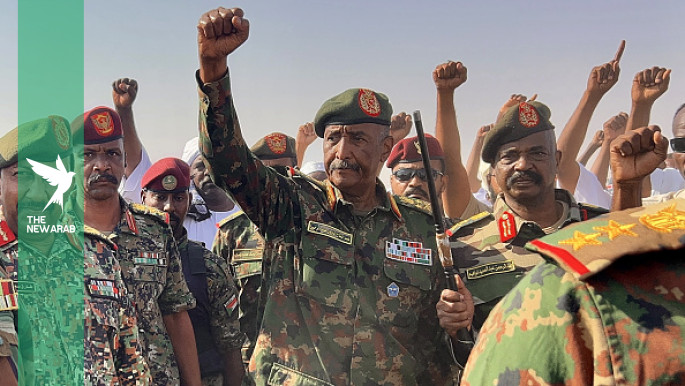
Sudan’s army-led government forms a committee to oversee detainee cases, missing persons reports and potential prisoner exchanges with the RSF. [GETTY]
Sudan’s army-backed government has announced the formation of a committee to document missing civilians and oversee negotiations for detainee exchanges with the paramilitary Rapid Support Forces (RSF) under UN mediation.
Amgad Fareid Eltayeb, an adviser to Sudan’s de facto ruler Abdel Fattah al-Burhan, announced in a post on social media platform X that the committee would work to secure the release of detainees and facilitate prisoner exchanges under the supervision of Pekka Haavisto, the UN envoy for Sudan.
“The committee has begun its work [on Saturday] and has called on the families of civilians detained, abducted, or missing in areas under militia control to file reports about their missing loved ones in militia-occupied areas at the nearest police station or public prosecutor’s office,” Eltayeb wrote on X.
He added: “This step represents a response of utmost humanitarian importance, aimed at documenting the missing, upholding every family’s right to know the fate of their children, and paving the way for ending long years of pain and waiting.”
The move follows Sudan’s approval last month of a UN-backed initiative led by Haavisto aimed at facilitating cooperation on prisoner-of-war exchanges amid the devastating conflict between the Sudanese army and the RSF which has been going on for over three years.
The International Committee of the Red Cross (ICRC) previously said it was prepared to act as a neutral intermediary to facilitate the safe and dignified release and transfer of detainees held by the parties involved in the conflict.
However, at the time, the ICRC confirmed that responsibility for selecting which detainees would be included in any exchange remained solely with the warring parties.
Sudanese Foreign Minister Mohi al-Din Salem also said the government had welcomed the UN initiative, stating that it remained committed to protecting the lives of Sudanese citizens across the country and ensuring any prisoner exchange was carried out in line with legal procedures, international humanitarian law, and the relevant Geneva Conventions governing the treatment of prisoners of war and detainees during armed conflicts.
Meanwhile, the Leadership Council of the Sudan Founding Alliance (TASIS), established by the RSF as an “alternative” government, described UN envoy Haavisto’s initiative as an important humanitarian step.
However, it said the initiative should form part of a wider political process aimed at bringing an end to the war.
This comes as the UN also warned this week that access to food and healthcare remains severely restricted in el-Obeid, the capital of North Kordofan, where UN human rights chief Volker Turk warned earlier this month that a humanitarian and human rights catastrophe was unfolding amid escalating clashes in the war-battered country.
Turk said civilians in el-Obeid had endured siege-like conditions for 18 months, facing severe shortages of clean water and continued drone strikes.
He warned that the situation risked repeating the atrocities witnessed in el-Fasher, the capital of North Darfur, last year.
Rights groups have accused both the RSF and the Sudanese armed forces of committing abuses against civilians.
Amnesty International, for example, said RSF fighters were carrying out “widespread sexual violence” against women and girls in an effort to “assert control and displace communities across the country”.
According to UN Women, an estimated 12.7 million women and girls across Sudan are expected to require support from gender-based violence services this year- nearly four times the number recorded at the start of the war.