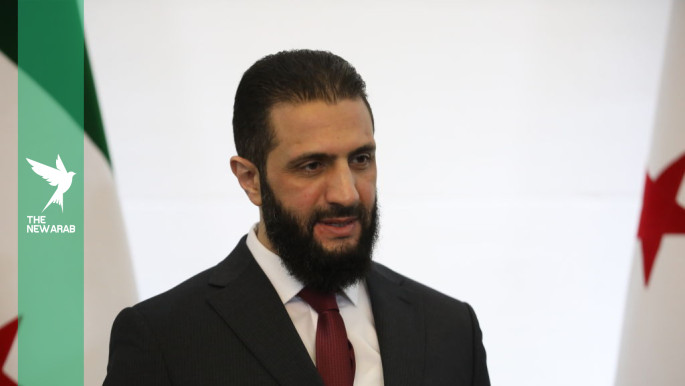
Alongside appointing the judges of the constitutional court, President Sharaa has also appointed 70 of Syria’s MPs [Getty]
Syria’s new constitutional court has been described as “an executive instrument with judicial veneer” after President Ahmed al-Sharaa appointed its judges without oversight from parliament or an independent judicial body.
Sharaa appointed six members of the Supreme Constitutional Court on Monday, along with Issam Khaled al-Khalif as the court’s president.
The appointments allow the constitutional court to begin its work as outlined under the constitutional declaration, announced on 13 March 2025.
The court is tasked with monitoring the constitutionality of laws and regulations, offering opinions on the constitutionality of draft laws at the request of the president, and offering opinions on the constitutionality of proposed laws at the request of the president and speaker of parliament.
It is also tasked with interpreting the texts of the constitutional declaration at the request of the president and speaker of parliament.
Yet the appointment of the court’s president and judges has come under scrutiny, joining a list of presidential appointments that have raised questions over the independence of Syria’s governing institutions.
Bassam Alahmad, executive director of Syrians for Truth and Justice, told The New Arab that Sharaa’s appointment of the court’s judges makes it “an executive instrument with judicial veneer”.
He noted that the appointments were carried out “without any kind of supervision from the people’s assembly or any other judicial body”.
“This is happening in the absence of an independent judiciary system, and also without having a committee to observe the promotion of appointments,” he said, adding “so it’s a worrying red flag that this will be another tool in the hands of the executive power.”
Alahmad said he was concerned that, alongside the direct and indirect appointment of members of Syria’s parliament by Sharaa’s government, the court was unlikely to fulfil its duties because of its lack of independence.
The appointment of the judges comes after Sharaa announced his picks for the remaining 70 MPs in Syria’s parliament, a move that also drew criticism over the nature of the appointments and the lack of representation.