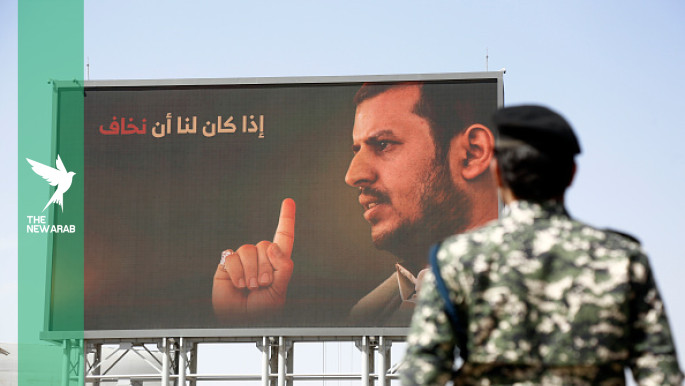
The Saudi-led coalition in Yemen said on Monday it had begun implementing operational measures to protect its commercial vessels in the Bab al-Mandeb Strait. [Getty]
Yemen’s internationally recognised government stepped up its political, military, and economic measures against the Houthi movement, also known as Ansar Allah, on Monday, 20 July, with Presidential Leadership Council Chairman Rashad al-Alimi announcing efforts to resume oil exports and calling for nationwide mobilisation in support of government forces.
The National Defence Council also approved measures to strengthen military and security readiness, as the Saudi-led coalition announced the start of operational measures to protect its vessels in the Bab al-Mandab Strait, warning it would respond to any threats to shipping.
The moves came after the Houthis announced a ban on shipping linked to Saudi Arabia, signalling a new escalation that could affect security in the Red Sea and the course of Yemen’s peace process.
Al-Alimi announces resumption of oil exports
Presidential Leadership Council Chairman Rashad al-Alimi called on Monday for “comprehensive national unity behind the armed forces and security services to restore state institutions and end Houthi control”, while announcing the start of work to resume oil exports and direct revenues towards paying salaries and improving public services.
Al-Alimi said in a statement addressed to the Yemeni people that “the time has come to end the suffering caused by the Houthi militias”, calling on all political, tribal, and social forces to unite behind the state and republican project and support government forces in what he described as the “battle to restore state institutions and end the coup”.
He added that the government would work to resume oil exports “by all means starting today”, noting that export revenues would be allocated to meeting the state’s essential obligations, foremost among them paying salaries, improving services, and strengthening economic stability.
Al-Alimi accused the Houthis of exploiting the suffering of Yemenis to serve the “Iranian regime’s agenda”, saying the past years had proved that the country’s crisis “was not inevitable, but rather a direct result of the Houthi militias’ coup”.
He also called on residents in areas under Houthi control not to engage with what he described as “incitement rhetoric”, urging them to support the state project.
In his statement, the Presidential Leadership Council chairman said the government had never stopped seeking peace and easing citizens’ suffering and that it had dealt “positively” with regional and international efforts, including operating Sana’a Airport through the national carrier.
However, he accused the Houthis of rejecting proposed initiatives and seeking to impose Iranian flights “outside state sovereignty”.
He also noted that the government had exercised “the highest degree of restraint” following attacks targeting oil export facilities, confirming that Saudi Arabia had responded to a request for urgent support for the state’s general budget after oil exports stopped.
Emergency meeting in Riyadh
Al-Alimi’s address came hours after an emergency meeting of the National Defence Council in Riyadh, which approved a package of military, security and economic measures to support the readiness of state institutions amid rising tensions between the Yemeni government and the Houthis.
The tensions have centred on flights to Sana’a Airport, as well as mutual accusations over responsibility for stalled peace efforts.
Al-Alimi chaired the meeting, which included council members and senior officials from the executive and legislative branches.
Those attending discussed the readiness of the armed forces and military formations to deal with what they regarded as Houthi escalation, in addition to mobilising resources for the battle to restore state institutions and end the coup, according to the official Yemeni news agency Saba.
The meeting stressed that “the government’s commitment to the highest degree of restraint and the rules of international law, while ensuring civilians are spared any additional consequences”.
It announced the approval of further military, security, economic, and administrative measures to strengthen the readiness of state institutions for various scenarios.
On the economic front, the council reaffirmed the importance of resuming oil exports, which have been suspended since export ports in Hadramawt and Shabwa were targeted by drone attacks claimed by the Houthis in late 2022.
The council considered oil revenues an essential source of funding for salaries and public services.
Meanwhile, Mahdi al-Mashat, head of the Houthis’ Supreme Political Council, intensified his rhetoric towards Saudi Arabia, saying “the Saudi regime’s behaviour over the past period and its insistence on besieging our people have proved it has no intention of achieving peace”.
He added, in remarks broadcast by the group’s Al Masirah TV channel, that the Houthis retained the “full right to take whatever measures they see fit to end the blockade” after “all peace efforts had been exhausted”.
Al-Mashat accused Saudi Arabia of being behind what he described as the ongoing “blockade” for years, saying “the aggression against Sana’a International Airport was a reckless and condemned act, and the Saudi enemy will pay the price”.
He was referring to recent strikes targeting the airport following the crisis involving the Iranian Mahan Air aircraft and the reciprocal escalation over flights to Sana’a.
Measures to protect vessels in Bab al-Mandeb
The Saudi-led coalition in Yemen said on Monday it had begun implementing operational measures to protect its commercial vessels in the Bab al-Mandeb Strait.
It warned it would respond firmly and forcefully to any threats targeting maritime navigation amid growing tensions over the security of vital shipping lanes in the region.
Coalition spokesman Major General Turki al-Maliki said in a statement that the Joint Forces Command was taking and implementing all firm and strict operational measures to protect vessels in the Bab al-Mandeb Strait, in accordance with international law and the 1982 UN Convention on the Law of the Sea.
Al-Maliki added that the coalition had already begun implementing measures to protect its vessels while transiting the strait, stressing that any threats targeting passing ships would be met “with the utmost firmness and force”.
He described attacks on maritime navigation as violations of international law and acts of piracy.
Responding to Houthi accusations of imposing a blockade on areas under their control, Al-Maliki said claims about closing Yemeni ports and airports were part of “Houthi misinformation and escalation” against the Yemeni government and neighbouring countries.
He noted that more than 300 commercial ships had entered the ports of Hodeidah, Salif, and Ras Issa during the first half of this year, carrying food, fuel, and construction materials.
He also held the Houthis responsible for the closure of Sana’a International Airport and the destruction of aircraft belonging to Yemenia Airways, accusing the group of rejecting initiatives aimed at resuming flights to and from the airport.
The coalition’s statement came days after tensions escalated between Yemen’s internationally recognised government and the Houthis over aviation and shipping, amid mutual warnings over the security of maritime routes in the Red Sea and Bab al-Mandeb.
Earlier on Monday, the Houthis announced a ban on maritime navigation linked to Saudi Arabia, saying the decision took immediate effect in the latest escalation between the group and Riyadh over recent tensions related to flights to Sana’a Airport.
The group’s military spokesman, Brigadier General Yahya Saree, said in a statement issued by what it called the “Yemeni Armed Forces” that the group had decided to “ban maritime navigation for the Saudi enemy under the equation of blockade for blockade”.
He added that the decision came in response to what he described as the “ongoing blockade on Yemen for around 12 years” and what the group regarded as the “targeting of Sana’a International Airport”.
The statement said the group was in “a state of full readiness for all options”, warning that any “comprehensive escalation” by Saudi Arabia would be met with “comprehensive and severe escalation”.
It also called on supporters to continue “general mobilisation and general mobilisation” and prepare for what it described as “all scenarios and developments”.
On Tuesday, an email sent to companies by the Houthis warned that shipping companies should not load or discharge cargo at Saudi Arabian ports, and such activity may result in being targeted “in any location”.
“Vessels are banned from loading or discharging cargo at or from any Saudi ports,” the 20 July email said, which was received by multiple shipping companies.
“We strongly recommend that your company exercise due diligence and the utmost care in all its dealings,” according to the email.
The Bab al-Mandab Strait is one of the world’s most important maritime routes, linking the Red Sea with the Gulf of Aden and the Indian Ocean.
A significant proportion of international trade and energy shipments passes through it.
In recent years, the waterway has witnessed repeated attacks and threats affecting shipping, contributing to higher transport and insurance costs and prompting regional and international parties to strengthen measures to protect navigation.
In recent months, rhetoric has intensified between the coalition and the Houthis over Red Sea security. At the same time, the United Nations continues efforts to reduce tensions and preserve the gains achieved since the UN-brokered truce announced in 2022.
There are fears that any new confrontation could worsen the humanitarian and economic situation in Yemen and the wider region.
Saudi Arabia condemns Houthi threats to shipping
Saudi Arabia’s Foreign Ministry condemned what it described as the “terrorist attacks” carried out by the Houthis against the Yemeni people, accusing the group of imposing a blockade and threatening navigation in the Red Sea.
The foreign ministry said the kingdom had worked with the Yemeni government to ease the Yemenis’ suffering by supporting development projects and the government’s budget, as well as providing petroleum products to operate power stations and securing ports.
It added that more than 300 ships carrying food, industrial goods, fuel, and construction materials had continued operating since the first half of 2023, despite what it described as Houthi attempts to prolong their control.
The ministry said the Houthis targeted an oil export facility in southern Yemen on 21 October 2022, causing oil exports, which accounted for about 60% of government revenues, to stop.
It said this directly affected salary payments and public services.
It also accused the group of targeting a vessel carrying petroleum products intended for the Yemeni people, seizing four Yemenia Airways aircraft after they had transported pilgrims from Jeddah to Sana’a, targeting commercial ships in the Red Sea, and rejecting initiatives aimed at resuming flights from Sana’a Airport.
The Saudi Foreign Ministry stressed that the kingdom’s position was aimed at achieving peace in Yemen.
It called on the international community to implement relevant UN Security Council resolutions, particularly Resolutions 2216 and 2722, to protect maritime navigation and its rights in the Red Sea.
It also reaffirmed its continued support for the Yemeni people and their legitimate government.
Article translated from Arabic by Afrah Almatwari. To read the original, click here.