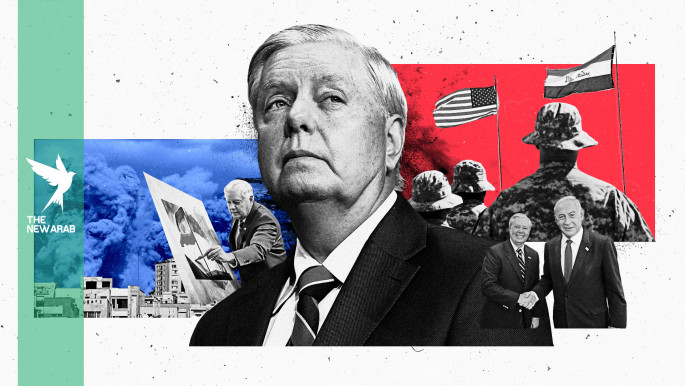
Graham did not merely support disastrous wars once they had begun. He spent decades demanding them, legitimising them and attacking anyone who proposed diplomacy or restraint, writes Hossam el-Hamalawy.
The tributes that followed Lindsey Graham’s death predictably described him as a tireless defender of American leadership, a committed internationalist and a politician willing to cross party lines. Benjamin Netanyahu called him a “great friend of Israel”. Such eulogies obscure the people who lived with the consequences of Graham’s politics.
Across the Middle East, his idea of leadership meant invasions, regime change, collective punishment, unconditional support for Israel and an almost pathological enthusiasm for bombing countries he would never have to rebuild.
Graham did not merely support disastrous wars once they had begun. He spent decades demanding them, legitimising them and attacking anyone who proposed diplomacy or restraint. From Iraq to Iran and from Lebanon to Gaza, he approached the region as a collection of targets to be disciplined through American and Israeli firepower.
invasion, war and occupation
Born in Central, South Carolina, in 1955, Graham was raised by parents who ran a restaurant and pool hall. After their deaths, he helped care for his younger sister. He trained as a lawyer, served in the US Air Force and later joined the South Carolina Air National Guard. He entered the House of Representatives in 1995 and was elected to the Senate in 2002, succeeding the segregationist Strom Thurmond.
In Washington, his military background and friendship with Senator John McCain helped him become one of the Republican Party’s most prominent foreign-policy hawks. He later exchanged his early denunciations of Donald Trump for personal loyalty, becoming a trusted intermediary between the president and foreign leaders.
His Middle East legacy began with one of the greatest crimes and strategic disasters of the 21st century. Graham championed George W Bush’s invasion of Iraq, asserting in February 2003 that Baghdad’s denial that it possessed weapons of mass destruction was “a flat-out lie”. Saddam Hussein, he said, had to be “disarmed or replaced”.
No such weapons were found. The invasion destroyed the Iraqi state, killed hundreds of thousands of people, displaced millions, entrenched sectarian politics and created the conditions from which the ultra-fanatic Islamic State would later emerge.
Graham never subjected his own judgement to serious examination. Instead, the catastrophe became an argument for further American military involvement. He supported keeping US troops in Iraq indefinitely and warned in 2011 that the country could “go to hell” without them.
Iraqis appeared in his rhetoric mainly as objects of American policy, incapable of determining their future without occupation, military tutelage or Washington’s approval.
Always more violence
That arrogance shaped his approach to the entire region. Graham embraced the fantasy that violence could remake societies, topple hostile governments and produce favourable political orders at manageable cost. The repeated failure of that model did not temper him. Each failed intervention became the justification for another.
Iran was his most persistent target. For years, Graham demanded crippling sanctions and treated war as both inevitable and desirable. He opposed the 2015 nuclear agreement despite its inspection mechanisms and restrictions on Iran’s programme, preferring a policy that offered Tehran little incentive to compromise. In the same year, he advocated military action that would leave Iran’s armed forces “a shell of its former self”.
After the 7 October 2023 attack led by Hamas, Graham urged Washington and Israel to bomb Iran even in the absence of direct evidence that Tehran had helped plan or execute the operation. He repeatedly proposed destroying Iranian oil infrastructure, threatening to “blow up” the country’s refineries.
By 2026, Graham’s long campaign for war had helped shape Trump’s assault on Iran. In the weeks before the attack, he shuttled between Israel and the White House, arguing that war was necessary and helping Netanyahu’s government press its case to the president.
Graham declared that his “ultimate hope” was regime change and said the collapse of Iran’s government would be “historical in nature”.
After the war began, he urged Trump to continue it for “a few more weeks” and proposed sending US forces to seize Kharg Island, through which roughly 90% of Iran’s crude-oil exports passed. “We did Iwo Jima, we can do this,” he boasted. The comparison captured his romanticised view of WW2, in which foreign countries became battlefields for demonstrations of American military resolve.
Enabling and defending Israel
Nowhere was Graham’s moral depravity clearer than in his response to Israel’s destruction of Gaza. Days after 7 October, he announced: “We’re in a religious war here.” He told Israel to “do whatever the hell you have to do” and concluded: “Level the place.” The target he proposed levelling was one of the most densely populated territories on earth, home to more than two million Palestinians, around half of them children. His words removed any distinction between Hamas and the civilian population under Israeli bombardment.
Asked whether there was a limit to the number of Palestinian civilian deaths that would make him question Israel’s conduct, Graham replied: “No.”
He occasionally added that Israel should try to minimise casualties, but this qualification was meaningless when he refused to identify any degree of slaughter that might alter his support. His position granted Israel political immunity in advance, regardless of how many families were killed, hospitals disabled, neighbourhoods erased or children buried beneath rubble.
His language about Palestinians was repellent. In July 2024, Graham described Palestinians in Gaza as “the most radicalised population on the planet”, claiming they were “taught to hate Jews from birth”. More than a million Palestinian children became, in his account, carriers of an inherited pathology rather than human beings growing up under occupation, siege, displacement and bombardment.
Graham’s hostility extended to Palestinian political existence itself. He dismissed the possibility of investing even “15 cents” in a state involving either Hamas or the Palestinian Authority, while offering no credible path to Palestinian sovereignty outside institutions Israel and the United States had spent decades weakening. At the same time, he defended Netanyahu’s government and attacked international institutions attempting to impose legal accountability.
When the International Criminal Court moved against Israeli leaders, Graham demanded sanctions. He threatened allied governments that might enforce the court’s warrants and portrayed the application of international law to Israel as an attack on the United States.
His message was straightforward: courts may investigate African, Arab or Russian leaders, but Israeli and American officials must remain beyond their reach.
U-turn on Saudi Arabia
His relationship with Mohammed bin Salman exposed sheer opportunism. After Jamal Khashoggi’s murder, Graham called the Saudi crown prince “beyond toxic”, demanded that Washington “sanction the hell out of Saudi Arabia” and declared that he would not return to the kingdom while bin Salman remained in power. Less than five years later, he reversed himself, meeting and praising the same ruler while celebrating Saudi investment in South Carolina and promoting closer security cooperation and normalisation with Israel.
Graham’s defenders would call this pragmatism. It was more accurately a politics without ethical limits. Authoritarianism, occupation and civilian suffering were objectionable only when condemning them advanced US strategy. When repression served Washington’s regional architecture, Graham accommodated it.
His enduring impact lies partly in how normal he made such rhetoric sound. He translated fantasies of mass violence into the cheerful vocabulary of Sunday television interviews. Bomb the refineries. Destroy the air force. Level the place. Give them the weapons. He made war appear cost-free because its costs would be paid in Iraqi, Iranian, Lebanese, Syrian, Yemeni and Palestinian lives.
Graham may be remembered in Washington as a forceful advocate of American power. Across the Middle East, he should be remembered as something else: a politician who repeatedly mistook destruction for strategy, supremacy for security and the suffering of millions for an acceptable instrument of policy. His career offers no model to preserve. It is a warning about the grotesque consequences of allowing powerful men to treat entire peoples as expendable.
Hossam el-Hamalawy is an Egyptian scholar-activist in Germany, focusing on the military, policing, and labour.
Follow Hossam on X: @3arabawy
Have questions or comments? Email us at editorial-english@newarab.com
Opinions expressed in this article remain those of the author and do not necessarily represent those of The New Arab.