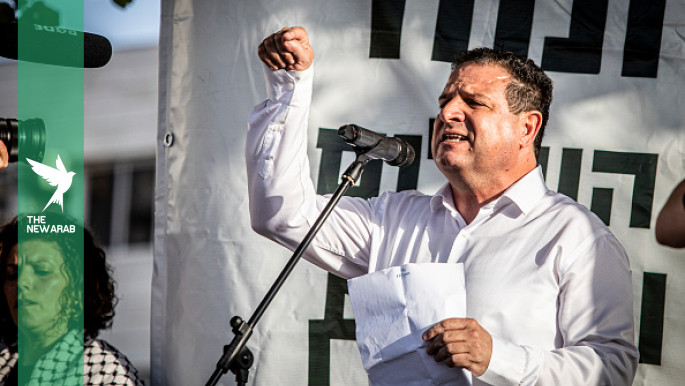
Entering the Israeli government does not simply mean having the ability to influence certain day-to-day issues. It also means directly assuming political and moral responsibility for the government’s broader policies, writes Hiba Khoury. [GETTY]
As Israel’s Knesset elections approach, debate has returned to the possibility of a Palestinian party joining the Israeli governing coalition at a complex political moment that is unprecedented in both its intensity and context.
This debate cannot be separated from the profound transformations taking place across the region, particularly after more than two years of the war in Gaza, the escalating assault on the occupied West Bank, continuing violations in Lebanon and Syria, and the intensifying policies of settlement expansion and racial discrimination against Palestinians.
In this context, the issue does not appear to be merely a tactical political step or an attempt to secure limited civil or municipal gains. Rather, it raises deeper questions about the very essence of Palestinian political representation within the Knesset system itself.
Entering the Israeli government does not simply mean having the ability to influence certain day-to-day issues. It also means directly assuming political and moral responsibility for the government’s broader policies, whether in Gaza, the West Bank, within Israel, or across the wider region.
Historically, the essence of Palestinian political representation within the Knesset has been to serve as a platform to defend the rights of the Palestinian community inside the Green Line, expose policies of discrimination and exclusion, and stand against a political system that regards Palestinians as second-class citizens.
However, moving from the position of opposition or protest representation to one of government partnership represents a qualitative shift. It means going from representing a marginalised community to becoming a partner in the structure of government itself.
This is because the Israeli right is no longer merely a governing coalition that can be replaced but has become the dominant political culture across broad sectors of Israeli society. And this dominance has been reflected in state institutions, public discourse, and official and societal policies. Therefore, from the perspective of Palestinians in the diaspora, these questions take on a broader dimension.
Indeed, Palestinians in the diaspora, living beyond the constraints of imposed geography, view the Palestinian landscape as a single political and historical unit that cannot be fragmented. Accordingly, any discussion of political representation must begin with one fundamental reality: the Palestinian people, wherever they are, are one people, and their political and legal causes are interconnected, regardless of the different forms of struggle and daily realities in the West Bank, the Gaza Strip, Jerusalem, within Israel and the diaspora.
From this standpoint, limiting the discussion to Palestinians citizens of Israel, or to any other Palestinian community, amounts to reducing the nature of the national cause itself and reproducing the fragmentation imposed by the occupation on the Palestinian people over decades.
Historically and politically, the question of Palestine has never been the cause of an isolated geographical area or a separate population group. It is the cause of one people, despite their different places of residence and varying political and legal circumstances. This means that any discussion concerning the future of the Palestinian national project cannot exclude Palestinians in the diaspora, who make up more than half of the Palestinian people and carry an essential part of the national memory, as well as the political, diplomatic and legal struggle.
Their right of return is not merely a humanitarian demand but a political and legal right that does not expire with time. It is an inseparable pillar of the Palestinian cause and of any national vision that seeks to represent the Palestinian people as a whole and preserve their historic rights.
Here, a profound dilemma emerges: how can a party that is supposed to represent part of the Palestinians within Israel join a government that pursues policies affecting the Palestinian people as a whole? Can a distinction truly be made between civil representation within state institutions and participation in shaping or legitimising the state’s broader policies?
This dilemma becomes even more complex when viewed in the context of Israel’s ideological transformation, where the right is no longer merely a changing governing trend but has become a dominant cultural and political structure within state institutions and society, extending from legislation to security and public discourse.
Under these circumstances, how can participation in a government that represents an extension of this political project be justified without this becoming a form of normalisation with a structure fundamentally based on denying Palestinian national rights?
Furthermore, the discussion is not limited to its immediate political dimension but extends to the future. Any decision of this kind will have direct implications on what shape Palestinian political action takes, not only amongst Palestinians citizens of Israel, but also throughout the diaspora and within student and organisational spaces.
Younger generations, who are redefining their methods of struggle and their political questions, will find themselves confronting a new model of engagement with the Israeli establishment, one that could reinterpret the boundaries of what is considered acceptable and unacceptable in Palestinian political action.
Against this backdrop, the central question remains that when the slogan “from the river to the sea” is invoked, with its vision of the unity of the land, the people and the struggle, how can the political or representative fragmentation of that people be accepted?
And how can an all-encompassing discourse of unity be reconciled with political practices that may reproduce division within the Palestinian body itself?
Article translated from Arabic by Afrah Almatwari. To read the original, click here.
Hiba Khoury is a Palestinian human rights activist and development consultant.
Follow Hiba on Facebook: @Hiba Khoury
Have questions or comments? Email us at: editorial-english@newarab.com
Opinions expressed here are the author’s own, and do not necessarily reflect those of their employer, or of The New Arab and its editorial board or staff.