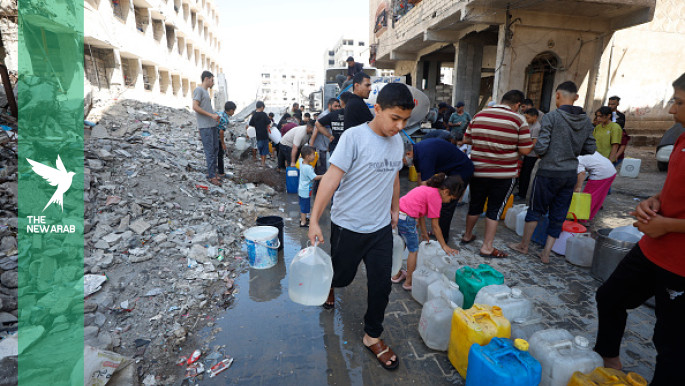
Seeking to draw global attention back to the war-torn coastal enclave, Palestinian journalists, humanitarian workers, and supporters from several countries launched the online campaign #TheyLiedToYou on 16 July. [Getty]
In the past 24 hours, Israeli attacks on the Gaza Strip killed three Palestinians and injured 22 others.
Months after a ceasefire agreement took effect in the Gaza Strip, a growing number of Palestinian journalists, activists, and residents believe that the territory has largely disappeared from international headlines despite continued Israeli attacks worsening the humanitarian conditions on the ground.
Seeking to draw global attention back to the war-torn coastal enclave, Palestinian journalists, humanitarian workers, and supporters from several countries launched the online campaign #TheyLiedToYou on 16 July.
Built around videos, photographs, and first-hand testimonies from inside Gaza, the campaign argues that the decline in international media coverage has created the impression that Israel’s war on Gaza has ended. But residents and human rights groups have pointed out that Israeli violence continues, including airstrikes, evacuation orders, ensuring shortages of food and medicine, and stopping reconstruction.
Speaking with The New Arab, campaign participants said that they are not disputing the existence of the ceasefire agreement but rather highlighting that it has yet to bring the expected improvement in the lives of Gaza’s more than two million residents.
Participants attribute this to what they describe as continued Israeli crimes against Palestinians in Gaza, the expansion of areas under Israeli control, delays in humanitarian aid deliveries, and the lack of reconstruction efforts.
The campaign comes amid renewed Israeli attacks in several parts of Gaza, which local health authorities say have caused dozens of casualties in recent days.
Residents have also expressed concern over repeated evacuation orders and the expansion of what the Israeli military describes as a “security zone,” raising fears of further displacement.
Local estimates indicate that around 80 per cent of housing units in Gaza have been destroyed or damaged since the war began, with hundreds of thousands of displaced Palestinians unable to return to their homes.
Restoring global attention
Mohammed Edwan, a Palestinian journalist participating in the campaign, said local reporters continue documenting airstrikes and civilian casualties despite the noticeable decline in international interest.
“Every day we cover airstrikes, document those killed and injured, and report on the humanitarian situation, but sometimes it feels as though the world believes the war has already ended,” Edwan told TNA.
He said the campaign emerged from a shared feeling among journalists and residents that Gaza’s reality was no longer reaching international audiences.
“The war has not stopped. What has changed is the level of attention it receives,” he added.
Gaza-based photojournalist Abdul Hakim Abu Riyash said he has spent more than two and a half years documenting destruction, injured civilians and displaced families across Gaza.
“The scenes repeat every day, but the pain does not become any easier,” Abu Riyash told TNA.
He said many of the photographs documenting recent events receive far less international attention than they did during the early stages of the conflict.
“That is why we felt it was important to participate in this campaign and remind people that these events are still taking place,” he added.
Suffering continues
Behind the campaign are dozens of thousands of personal stories reflecting the humanitarian situation facing displaced families.
Khitam Abu Amsha, who was displaced from the northern town of Beit Hanoun and now lives in a tent in al-Nuseirat refugee camp, told TNA that she continues struggling to provide for her five children after her husband was killed in 2025 while attempting to obtain food from one of the U.S.-backed aid distribution centres in Gaza.
“What hurts me most is hearing people say the war is over while we continue living it every day,” Abu Amsha said.
“We wake up to the sound of aircraft and sleep fearing another airstrike. My husband left to look for food for our children and never returned,” she added.
She explained that repeated displacement, the lack of basic services and the constant fear of bombardment have made daily life a continuous struggle.
Ali Saidam, another resident of al-Nuseirat, told TNA that the Israeli army killed his son Obaida with seven others only days earlier in an Israeli airstrike while on his way to help prepare for his sister’s wedding.
“He was going to share his sister’s happiness, but instead we buried him,” Saidam said.
He added that residents remain concerned about continued military operations and repeated evacuation orders.
“Every day we hear about more areas becoming inaccessible, and every day people fear they will have to move again,” he continued.
Battle over public narrative
The online campaign quickly evolved into a platform where Palestinians shared hundreds of videos, photographs and testimonies documenting continued bombardment, displacement and humanitarian hardships.
Palestinian influencer Mahmoud Zaiter wrote on his Facebook account that despite launching numerous online campaigns, many Palestinians feel the international community has failed to respond.
Mahmoud Basal, spokesperson for Gaza’s Civil Defence, also joined the campaign, saying that continued civilian casualties contradict claims that the ceasefire has brought an end to the conflict.
Gaza-based political analyst Mustafa Ibrahim told TNA the campaign reflects growing Palestinian efforts to restore international attention to developments in Gaza.
“The issue today is not only what is happening on the ground, but also how it is being perceived internationally,” Ibrahim said.
He added that many people abroad now associate the ceasefire announcement with the end of the conflict, despite continued military operations, restrictions on humanitarian aid, and ongoing displacement.
“The decline in media coverage has reduced international pressure, while developments on the ground continue,” he explained, adding that digital campaigns have become an increasingly important tool for conveying developments inside Gaza.
According to figures released by the health authorities in Gaza, 1,158 Palestinians have been killed and 3,756 others injured since the ceasefire took effect on 11 October 2025, while 802 bodies have been recovered from beneath the rubble.
The authorities said the overall death toll since Israel’s genocidal war began in October 2023 has reached 73,283, with 173,864 people injured.
For participants in the #TheyLiedToYou campaign, those figures illustrate what they describe as the gap between perceptions that the war has ended and the reality they say Palestinians continue to experience every day.