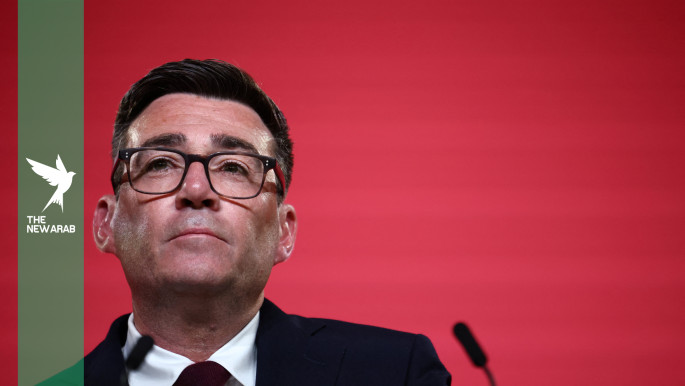
On 20 July, Andy Burnham enters Downing Street facing a Middle East transformed by widening conflict.
Gaza lies in ruins despite a fragile ceasefire, Israeli settlements are expanding across the occupied West Bank, while the US-Israeli war against Iran has heightened risks to regional stability and the global economy.
Those expecting an immediate overhaul of British policy may nevertheless be disappointed. The former Greater Manchester mayor enters office with limited recent foreign policy experience, while his immediate priority will be restoring the Labour Party’s weakened domestic standing.
Under Keir Starmer, the Labour government’s popularity sank amid the cost-of-living crisis, continued fiscal austerity, alongside criticism from the right over perceived weakness on migration.
Burnham’s Middle East approach is likely to constitute a selective reset rather than a comprehensive one. That may include some more pressure on Israel, caution over involvement in another war with Iran, and broad continuity in Britain’s economic and security relationships with Washington and the Gulf.
However, answering critical public opinion of Labour’s handling of Middle East policy will guide his stance.
Chief among those concerns is Britain’s engagement with Israel and Palestine.
On Palestine, how far will Burnham go?
Burnham’s clearest signal has been his apology for Labour’s initial response to Israel’s destruction of Gaza, which was characterised by Starmer voicing support for Tel Aviv’s assault in October 2023 and Israel’s “right to self-defence” following Hamas’s 7 October attack.
While the immense suffering in Gaza became visible for the world to see, Starmer’s shadow cabinet hesitated to call for a full ceasefire and refused to fully suspend arms sales to Israel. And after his party came to power in July 2024, many critics felt he had done “too little, too late”.
There is no doubt that Starmer’s perceived indifference to the people of Gaza’s suffering had inflicted electoral damage on the Labour Party, Patrick Diamond, a former senior policy adviser for the Labour government under Tony Blair and Gordon Brown, told The New Arab.
He added that Burnham has sought to win back voters who defected over Gaza.
The new PM has acknowledged that the party “didn’t get it right” and Britain had been too slow to call for a ceasefire. He has also promised to place greater pressure on Benjamin Netanyahu’s government.
Possible measures may include additional individual sanctions, alongside a ban on trade with illegal Israeli settlements. These would build on Starmer’s recognition of Palestine in September 2025, restrictions on some arms licences, and sanctions against far-right Israeli ministers and violent settlers.
There are some indications that Burnham’s position may reflect more than simple political manoeuvring. Burnham visited the occupied West Bank in 2012, where Israel’s illegal settlements and oppressive checkpoint infrastructure reportedly made a lasting impression on him.
In October 2023, he joined Sadiq Khan and Anas Sarwar in calling for a ceasefire while Starmer and much of the party were still resisting one. He later urged the government to recognise Palestine.
However, expectations of an immediate decisive break should be restrained.
Burnham joined Labour Friends of Israel during his 2015 leadership campaign and promised that Israel would be his first overseas destination as Labour leader. More recently, he declined to characterise Israel’s actions in Gaza as genocide, saying that determination belongs to international courts.
Nor has he committed to suspending all remaining arms export licences, including those linked to the F-35 programme, despite UK arms licensing laws that explicitly prohibit sales where there is a clear risk of the weapons being used in international humanitarian law breaches.
“Burnham’s motive for the slight policy shift is probably more tactical and electoral than moral. He recognises the deep anguish on the left of the Labour Party over the destruction of the Gaza Strip,” Avi Shlaim, Emeritus Professor at The University of Oxford and one of Israel’s New Historians, told The New Arab.
So far, his position remains within Labour’s conventional framework, including vocal support for a two-state solution, even as Israel’s growing de facto annexation of the West Bank gathers pace and Gaza remains uninhabitable.
While incremental steps like sanctions on individuals may take place, in alignment with the growing discontent in other European capitals towards Israel’s far-right government, many analysts doubt London may act alone to impose drastic punitive measures on Israel.
“What [Burnham’s leadership] likely doesn’t touch is the underlying architecture binding London to Tel Aviv – intelligence sharing, arms licensing – which takes a more radically formidable leader than Britain probably has on offer to shift,” H.A. Hellyer, Senior Fellow at the Royal United Services Institute (RUSI) and Centre for American Progress, told The New Arab.
Hellyer added that Israel’s own growing isolation under Netanyahu gives Burnham room to criticise at low diplomatic cost.
For Shlaim, the threshold for genuine change is considerably higher. It would involve calling Israel’s actions a genocide, imposing trade sanctions, banning all arms sales to Israel and repealing the ban on Palestine Action.
“The real question remains: will Andy Burnham have the courage to liberate the Labour Party’s policy on Palestine from the dead hand of Sir Keir Starmer?”
Caution on Iran, continuity with Washington and the Gulf
On Iran, Burnham’s approach appears relatively cautious. Although he voted in favour of the disastrous 2003 invasion of Iraq, he has since drawn on the destruction of that war to warn against dragging Britain into another major regional conflict.
He would likely resist direct British participation in any open-ended military campaign against Iran. Yet maintaining a clear line of non-participation may prove difficult.
Pressure from the Trump administration, Britain’s military facilities across the region, its defence partnerships with Gulf monarchies, and its commitment to securing shipping through the Strait of Hormuz all bind London closely to the US-led regional security architecture.
Burnham’s decision to retain Jonathan Powell as national security adviser further signals that Britain’s Atlanticist orientation will endure.
Hellyer noted that while there’s “real scope” for a European tilt, “Washington remains the anchor, since real strategic autonomy needs capabilities Britain doesn’t have and shows no institutional ability to build”.
Burnham’s immediate priorities, such as steadying the ship domestically and restoring Labour’s lost popularity, make broad continuity in foreign policy the most likely outcome.
He has promised closer security cooperation with France, Germany and the EU, which could open the door to a more coordinated European approach on sanctions, Palestine, and diplomacy with Iran.
However, this will not diminish Washington’s centrality, especially while Donald Trump’s decisions continue to drive regional escalation.
“Britain’s relationship with Washington is ultimately a choice, and one whose wisdom is obviously questionable in the context of an increasingly extreme and unstable Trump presidency,” David Wearing, assistant professor in international relations at the University of Sussex, told The New Arab.
“The obvious choice is to balance more closely toward the Europeans, but the attachment to Washington in British policymaking circles is strong – more an article of faith than a product of cold reason – which leaves the UK stranded in a very uncomfortable position.”
Gulf monarchies are also likely to see even greater continuity. In May, Starmer’s government concluded a free-trade agreement with the six GCC states, projected to add £3.7 billion annually to the British economy.
With Burnham’s focus on reviving the UK economy and sustaining a military and security presence in the Gulf, including efforts to secure the Strait of Hormuz, ties are set to remain strong. Gulf investment into the UK, British arms sales, energy cooperation, and broader trade links are all expected to continue largely uninterrupted.
A selective reset
For now, Burnham appears likely to change Labour’s tone and move further on some issues, rather than overturn Starmer’s approach. For those alienated by Labour’s record, that may still offer some cautious hope.
The clearest signs will come from his early decisions: whether he bans trade with Israeli settlements, reviews remaining arms licences, keeps Britain out of military action against Iran, and appoints ministers to his cabinet who are willing to question existing policy.
His first months in office will show whether his more sympathetic language leads to meaningful change, or whether continuity ultimately prevails.
Jonathan Fenton-Harvey is a journalist and researcher who focuses on conflict, geopolitics, and humanitarian issues in the Middle East and North Africa
Follow him on Twitter: @jfentonharvey
Edited by Charlie Hoyle