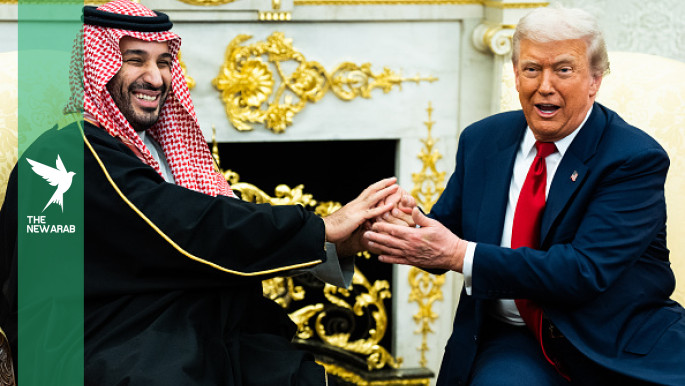
Saudi Arabia’s nuclear ambitions were previously packaged as part of a raft of potential deals with the US [Getty]
Saudi Arabia’s historic nuclear deal with the US shows Washington’s willingness to do “business on Saudi terms”, while appearing prepared to sideline interests related to Israel, a geopolitics analyst has told The New Arab.
But on Thursday, US President Donald Trump appeared to unilaterally add a new condition to the agreement, saying it would only be implemented if Saudi Arabia joined the controversial Abraham Accords.
While the full details of the nuclear agreement have yet to be disclosed, its announcement has prompted speculation about its implications, particularly for the prospects of Saudi-Israeli normalisation.
The New Arab takes a closer look at the nuclear deal, what it means for the region, the future of Saudi-Israeli normalisation, and the Saudi-US relationship.
How did the deal emerge?
Previous rounds of talks between Saudi Arabia and the US – particularly under the Biden administration – tied a Saudi civilian nuclear programme to a broader package that also included Saudi normalisation with Israel and a mutual defence treaty.
Since those negotiations began, however, the region has undergone dramatic changes. Israel has killed more than 70,000 Palestinians in Gaza, while the US-Israeli war on Iran saw key US allies, including Saudi Arabia, come under direct Iranian attack.
Those developments appear to have fundamentally changed Riyadh’s calculations, but they did not prevent Washington and Riyadh from reaching a nuclear agreement this week.
“That architecture was ambitious and internally coherent. It collapsed not because of poor diplomacy but because Saudi normalisation with Israel became politically impossible in the near term,” Hesham Alghannam, a geopolitics analyst and nonresident scholar at the Malcolm H. Kerr Carnegie Middle East Center, told The New Arab.
“Saudi Arabia has consistently held that normalisation requires a credible, irreversible path to Palestinian statehood, and Israel’s current government opposes that categorically,” Alghannam added.
“Trump did not so much break Biden’s framework as acknowledge what was already broken and extract what remained viable from the wreckage,” he said, adding that the deal marks a shift from “a conditional to a more transactional partnership”.
What’s in it for both sides?
Announcing the 30-year agreement on Wednesday, US Energy Secretary Chris Wright said the deal reflected “our two nations’ shared commitment to strengthening US-Saudi commercial relations, delivering prosperity at home and security to our allies abroad”.
Under Crown Prince Mohammed bin Salman’s Vision 2030 programme, Saudi Arabia has pursued an ambitious economic diversification agenda, with civilian nuclear energy forming a key part of its long-term strategy.
With the involvement of US firms, Riyadh will gain access to American technology and expertise.
The US Department of Energy (DoE), meanwhile, described the agreement as giving American companies “great access” to Saudi Arabia’s nuclear programme.
“Both got what they prioritised. The older model – security guarantees in exchange for oil flows and diplomatic compliance – has not disappeared, but it has been renegotiated on more explicitly transactional terms,” Alghannam said.
The Trump administration has also presented the deal as a way to counter Russian and Chinese influence in the kingdom.
Alghannam noted that Russia’s Rosatom and the China National Nuclear Corporation had already been competing for Saudi nuclear contracts.
“A 30-year agreement anchoring Riyadh in US nuclear supply chains, primarily through Westinghouse, is a tangible commercial and strategic interest, even if it comes at the cost of traditional safeguards,” he said.
Loosening the safeguards
One of the main criticisms of the agreement, including from members of Congress, is that the US has departed from longstanding safeguards governing nuclear cooperation.
Benjamin Ashraf, an analyst at the Open Nuclear Network, said that while the agreement appears compliant with international conventions on paper, its implementation weakens traditional non-proliferation safeguards.
“On paper, Saudi Arabia stays inside the nuclear treaty and IAEA inspections, and the agreement uses the standard US ‘123’ framework that is meant to keep reactors and fuel formally for peaceful use,” Ashraf told The New Arab.
“In reality, the administration’s own notification to Congress makes clear that this pact drops the tougher IAEA ‘Additional Protocol’ – the snap-inspection regime the US has demanded from Iran – and still keeps the door open for Saudi uranium enrichment on its own soil in future,” he said.
The concerns have already been echoed by US lawmakers, who must approve the agreement before it can take effect.
While Saudi Arabia has consistently insisted its nuclear programme is intended solely for civilian purposes, Crown Prince Mohammed said in 2018 that the kingdom would seek nuclear weapons if Iran acquired them.
“Nuclear watchdogs are concerned because, in high-risk regions, the norm has been to push for more intrusive access via the Additional Protocol,” Ashraf said.
“This deal instead moves away from the US ‘gold standard’ on inspections and enrichment, and it signals a broader shift away from the kind of non-proliferation leadership many of us rely on to keep nuclear risks in check,” he added.
Alghannam argued, however, that despite relaxing its own “gold standard”, Washington had still avoided what it viewed as the worse geopolitical outcome – Saudi Arabia turning instead to Russia or China for its nuclear programme.
Israel Normalisation?
Amid criticism of the deal, Trump took to social media on Thursday to insist Saudi Arabia would have to normalise relations with Israel before the agreement could be implemented.
“The Civil Nuclear Deal (There will be no enrichment of material!)… which pertains only to non-military use… will be approved, but is totally subject to Saudi Arabia joining the very respected and successful Abraham Accords,” Trump wrote on Truth Social.
Shortly afterwards, Israeli Prime Minister Benjamin Netanyahu welcomed Trump’s remarks.
“The joint American and Israeli military action against the genocidal regime in Tehran and Israel’s crushing of Iran’s terror axis have created the possibility to expand the circle of peace,” the Prime Minister’s Office said in a statement.
“As President Trump has said, Saudi Arabia’s joining of the Abraham Accords would be an historic leap forward for peace in the Middle East,” the statement added.
The comments came after criticism from within Israel.
Yair Golan, leader of Israel’s Democrats Party, said Netanyahu had “both lost normalisation with Saudi Arabia and enabled its nuclear capabilities”.
Saudi officials have yet to comment on what appear to be Trump’s newly announced conditions for implementing the agreement.