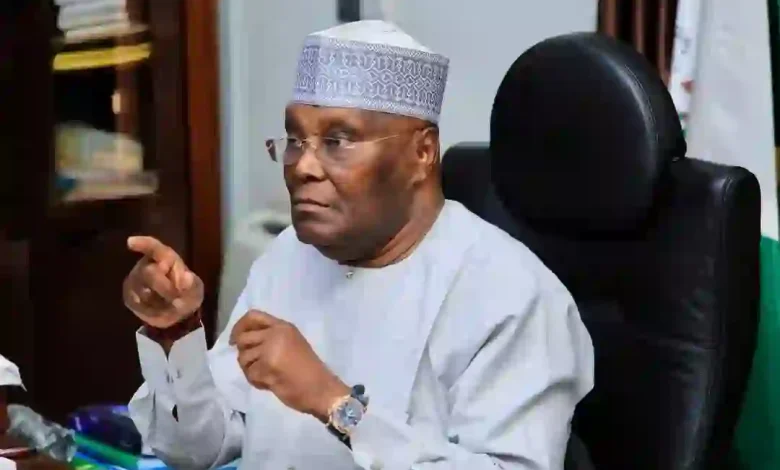
The presidential candidate of the African Democratic Congress (ADC), Atiku Abubakar, has promised to reopen Nigeria’s land borders if he wins the 2027 presidential election.
Atiku said restrictions on cross-border movement had negatively affected businesses and contributed to job losses, particularly among young Nigerians who depend on transborder trade for their livelihoods.
The former Vice President made the pledge while addressing supporters in a video shared on Friday by an ADC chieftain, Dele Momodu.
Atiku noted that several northern states share borders with Cameroon, Chad, Niger Republic and Benin Republic, stressing that cross-border commerce remains an important economic activity in the region.
He argued that the closure and restrictions imposed on the borders had forced many young traders and entrepreneurs out of business.
According to him, some Nigerians who had invested between ₦10 million and ₦20 million in their businesses were pushed into bankruptcy, leaving them and their employees without income.
Atiku linked the loss of economic opportunities to the country’s security challenges, particularly among unemployed young people.
He said, “All the upcoming young men and women who used to have a capital of 10 million, 20 million, and they were employing two, three other people, and then all of them went bankrupt and unemployed. How can there be security?”
The ADC candidate subsequently promised that his administration would reopen the country’s land borders.
“So I said I am going to reopen the borders and I will,” Atiku stated.
Beyond border reopening, Atiku also promised to improve port infrastructure in southern Nigeria to make the movement of goods to other parts of the country faster and more efficient.
He said he had previously held discussions with shippers and ship development companies in Europe about developing ports in the South and South-East.
According to Atiku, expanding port capacity outside Lagos would reduce transportation costs and shorten the time required to move imported goods to northern states.
He cited his factory in Yola, Adamawa State, as an example, saying transporting a container from Lagos to Yola currently takes considerably longer because of poor road infrastructure and the distance involved.
Atiku argued that containers discharged at ports in Calabar, Uyo or Port Harcourt could reach Yola within about 24 hours if the necessary infrastructure and road networks were properly developed.
He said, “So when, if I drop my container in Calabar or in Uyo or in Port Harcourt, it will just take me 24 hours to take the container to Yola.”
He contrasted this with the current situation, where moving a container from Lagos to Yola can take up to two months.
Atiku maintained that improving southern ports alongside the country’s road network would ease the movement of goods, reduce the burden on businesses and promote economic activity across Nigeria.
Nigeria’s land borders were largely closed in August 2019 under the administration of former President Muhammadu Buhari as part of measures to curb smuggling and encourage domestic production.
The Federal Government had cited the smuggling of rice, poultry products, petroleum products and other commodities, as well as the movement of illegal arms and drugs, among the reasons for the restrictions.
In December 2020, Buhari directed the reopening of four border posts, including Seme in Lagos, Illela in Sokoto, Maigatari in Jigawa and Mfun in Cross River.
The administration of President Bola Tinubu subsequently reopened the Tsamiya land border with Benin Republic in Kebbi State and the Kamba corridor linking Nigeria with Niger Republic in February 2026.
Although some major border routes have since reopened, several land borders remain subject to tighter controls aimed at preventing smuggling and other illegal activities.
READ ALSO: