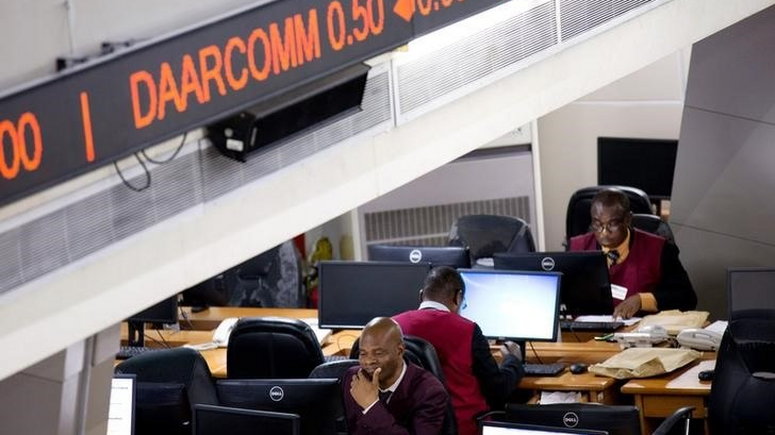
The Nigerian Exchange (NGX) extended its downward trend on Wednesday as the benchmark All-Share Index (ASI) declined 0.17 percent to close at 238,682.92 points, while equity market capitalisation slipped to N154.14 trillion.
At face value, the session appears to reinforce the narrative that has dominated much of August—a market struggling to regain momentum amid sustained profit-taking.
However, the headline numbers tell only part of the story.
A closer examination of trading activity suggests that while the market remained under pressure, the nature of the selling continued to evolve. Rather than broad-based liquidation across sectors, investors appeared to be rotating capital into selected opportunities with trading activity strengthening considerably even as the benchmark index edged lower.
One of the clearest indications came from market turnover.
Investors traded 733.35 million shares valued at N34.52 billion across 49,210 deals, representing a notable increase in activity despite the negative market close.
Higher trading volume accompanied by a relatively modest decline in the index often suggests that buyers remain willing to absorb selling pressure. If investors were rushing for the exit, the market would likely have experienced a much steeper decline despite the increased turnover. Instead, the index lost only 0.17 percent, indicating that buying interest continued to offset much of the selling.
The composition of trading activity also reinforces this view.
Institutional liquidity remained concentrated in large-cap financial stocks.
First HoldCo Plc dominated the market by transaction value with investors exchanging 88.94 million shares worth N11.06 billion, making it the Exchange’s most actively traded stock by value.
Zenith Bank Plc followed with transactions worth N3.71 billion, while Access Holdings Plc recorded trades valued at N910.46 million.
Although Fortis Global Insurance Plc led the market by volume after 134.01 million shares changed hands, the transactions were worth N267.98 million, significantly below the value recorded in First HoldCo and Zenith Bank.
The concentration of trading value in banking stocks suggests institutional investors continued to deploy capital into fundamentally important financial companies despite the overall weakness in the market.
Another important development was the behaviour of investors toward stocks that had experienced sharp declines in previous sessions.
Neimeth International Pharmaceuticals Plc rallied 9.66 percent, while LOTUSHAL15 gained 8.46 percent after featuring among recent losers.
Such rebounds often indicate bargain hunting, where investors accumulate stocks they believe have become undervalued following heavy selling.
This selective buying contrasts sharply with indiscriminate market-wide selling and points to improving investor confidence in specific counters.
At the same time, profit-taking did not disappear—it simply shifted.
The day’s biggest losers included Fidson Healthcare Plc, FTN Cocoa Processors Plc, International Energy Insurance Plc, Livestock Feeds Plc, and Omatek Ventures Plc, demonstrating that investors continued to lock in profits or reduce exposure in selected equities.
The absence of broad selling across all sectors suggests the market is becoming increasingly stock-specific rather than directionless.
The exchange-traded fund (ETF) segment painted an even more optimistic picture.
Most of the leading ETFs closed higher, led by MERVALUE, which advanced N9.12, and MERGROWTH, which gained N9.10.
GREENWETF and VETGRIF30 also posted gains, while VETGOODS was the only ETF among the top movers to close lower.
The broad strength in ETFs contrasts with the weakness in the benchmark equity index and suggests investors continued to diversify portfolios while maintaining exposure to the capital market.
Meanwhile, the bond market remained largely inactive.
Benchmark securities including AXA2027S1, CEMC2045S1, COLE26CPS6, DAN2034S1, and FG182032S2 all closed unchanged, indicating that major portfolio repositioning did not occur within the fixed-income segment.
Taken together, Wednesday’s trading session presents a more nuanced picture than the headline decline in the All-Share Index suggests.
The market undoubtedly remained weak, extending its August correction. However, stronger turnover, sustained institutional activity in banking stocks, bargain hunting in recently beaten-down equities, resilience in the ETF market and stability in bonds all point to a market undergoing portfolio rotation rather than widespread investor capitulation.
For investors, this distinction is significant.
A declining index accompanied by rising trading activity and selective accumulation often reflects a market searching for its next leadership group rather than one experiencing a wholesale withdrawal of capital. While sentiment remains cautious, Wednesday’s trading indicates that investors continue to identify opportunities beneath the surface, even as the broader market struggles to regain positive momentum.