Nigeria has called for stronger international cooperation to tackle terrorism, cybercrime and other security threats that operate across national borders.
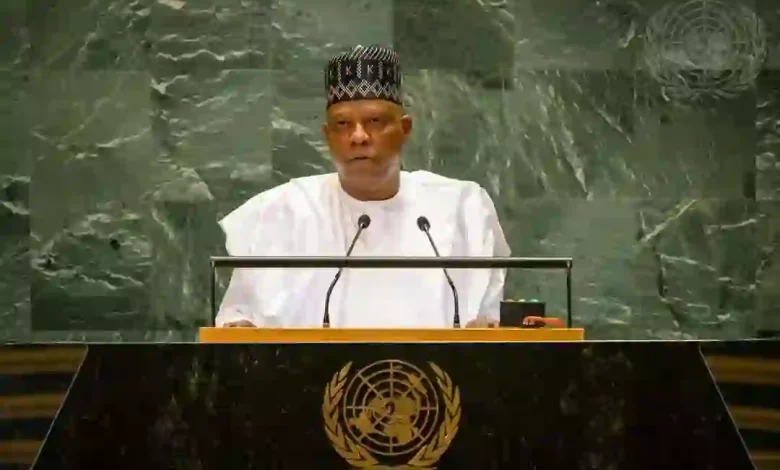
Vice-President Kashim Shettima made the call on Thursday while delivering President Bola Tinubu’s national statement at the 81st United Nations General Assembly in New York.
Shettima said Nigeria’s long-running fight against Boko Haram, ISWAP and other armed groups had shown that countries could not rely solely on their national security systems to defeat threats that extended beyond their borders.
According to him, modern security challenges exploit gaps between countries, making isolated national responses insufficient.
He noted that while military action remained important in the fight against violent extremism, it could not alone guarantee lasting peace.
Shettima said sustainable security also required investment in education, economic opportunities, accountable governance and the protection of human rights.
The Vice-President said Nigeria remained committed to working with neighbouring countries and international partners to address terrorism and other threats to peace and stability.
He highlighted Nigeria’s involvement through the Economic Community of West African States, the African Union and Gulf of Guinea partnerships in areas including mediation, counter-terrorism, maritime security and democratic governance.
Shettima also recalled Nigeria’s contributions to peace operations across Africa, citing its engagements in Liberia, Sierra Leone, Darfur, Mali and The Gambia.
He said the country’s participation in such efforts reflected its belief that instability in one nation could have serious consequences for neighbouring countries and the wider international community.
The Vice-President warned that conflicts far from a country’s borders could still affect it through disruptions to trade, humanitarian crises, displacement, the spread of extremist networks and wider economic and security pressures.
He consequently urged world leaders to renew their commitment to dialogue, mutual respect, collective responsibility and international law.
Shettima reaffirmed Nigeria’s support for resolving disputes peacefully in line with the United Nations Charter.
He identified Sudan and other conflict-affected countries as requiring urgent diplomatic attention because of the humanitarian and regional consequences of prolonged conflicts.
The Vice-President also cautioned against growing nationalism and declining commitment to multilateral cooperation, saying the continuing conflicts around the world underscored the importance of the principles that led to the creation of the United Nations after World War II.
He said Nigeria remained committed to an international system where disputes were resolved through diplomacy and respect for international law rather than the use of arbitrary power.
Shettima further linked security to development, noting that poverty, deprivation and weak institutions could undermine gains achieved through military operations.
He called for stronger global institutions capable of coordinating responses to terrorism, cyber threats and other challenges that do not respect national boundaries.
The address was delivered as the 81st UN General Debate entered its third day, with Shettima speaking fourth during Thursday afternoon’s session.
Nigeria maintained that its experience with insurgency had reinforced the need to combine effective security measures with social and economic conditions that reduce opportunities for violent groups to recruit and operate.
Shettima therefore urged greater international solidarity, stronger regional leadership and sustained investment in the foundations of lasting peace.
READ ALSO: