The Editor-in-Chief of PREMIUM TIMES, Musikilu Mojeed, has urged Nigerian journalists to go beyond reporting killings, clashes and other violent incidents by investigating how affected communities are resolving disputes, rebuilding relationships and preventing renewed violence.
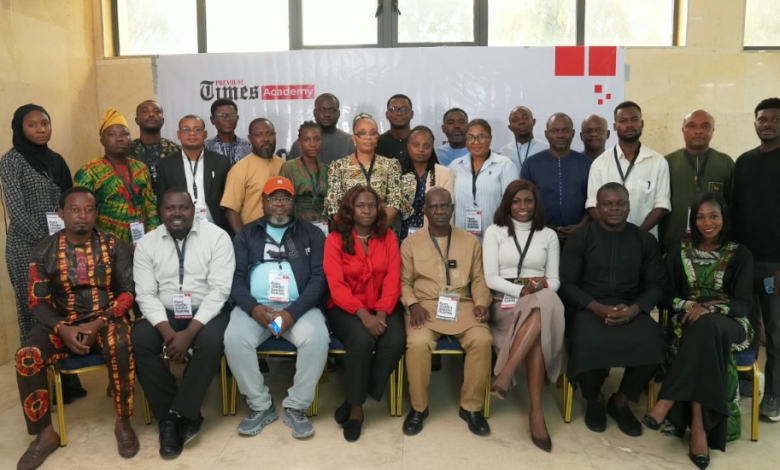
Mojeed made the call during a two-day Peace and Conflict-Sensitive Reporting Workshop organised by the Premium Times Academy in Abuja.
He encouraged journalists to embrace solution-oriented reporting by examining how individuals, communities and institutions respond to crises, including what approaches are being tried, what works, what does not and what lessons can be learned.
He said journalists should return to conflict-affected communities after reporting violent incidents to examine how residents are responding to the crisis, rebuilding trust and finding ways to live together peacefully.
According to him, conflict reporting should not end with accounts of casualties, destruction and government visits to affected communities. “So, when we report crises, let us not end there by reporting the clashes, the killings, government visits to the place and all of that,” Mojeed said.
“Let’s go back. How are these communities? How are they trying to resolve? What solutions are they finding? How are they then trying to live together?”
Mojeed illustrated the importance of such reporting with an award-winning story about two communities in Jos that had experienced prolonged conflict but began organising inter-community football competitions. He said the initiative brought young people from the rival communities together, allowing them to form friendships despite the history of violence between their communities.
“Those kids who play football together across communities were establishing friendships across communities, and before you know it, these then become entrenched in those communities, and then you don’t see disagreement, conflict, killings anymore,” he said.
Mojeed said such developments demonstrate why journalists should investigate what happens after the immediate crisis and report efforts that could help communities prevent a recurrence of violence.
He also urged journalists to pay greater attention to humanitarian information and data when covering conflicts, noting that reliable information is crucial to affected populations, humanitarian responders and decision-makers. “How humanitarian crises are handled depends largely on how journalists do their work,” Mojeed said.
The two-day workshop, held from September 23 to 24, brought together journalists from various media organisations for sessions on conflict-sensitive reporting, hate speech, misinformation, ethnic profiling, humanitarian information, social media verification and artificial intelligence.
Publisher of PREMIUM TIMES, Dapo Olorunyomi, during the training stressed the distinction between reporting and storytelling, noting that reporting is primarily concerned with presenting verified facts, while storytelling uses those facts to construct compelling narratives that help audiences connect with the subject.
Olorunyomi also encouraged journalists to take cognisance of the narratives they push to the public. He explained that this is important because “narratives have now become a weapon; the same pen that records testimony can distort it.” He said this at the Premium Times Academy training for journalists in Abuja.
Similarly, Dayo Aiyetan, Executive Director of the International Centre for Investigative Reporting, highlighted the importance of conflict-sensitive journalism and urged journalists to avoid reporting practices that could aggravate tensions. He noted that the choice of words, headlines, images, sources and context could influence how audiences understand conflicts.
Also, Professor Isaac Albert of the University of Ibadan, who spoke on the nature, causes and dynamics of conflict, urged journalists to investigate beyond the immediate effects of violence and understand the underlying issues driving conflicts.
While, the Managing Editor of PREMIUM TIMES, Idris Akinbajo, also stressed accuracy and urged journalists to understand the root causes and cycles of conflicts rather than concentrating only on violent incidents.
Other facilitators included PREMIUM TIMES Standards Editor Oluwaseyi Ayeni and Silas Jonathan, Research and Digital Investigations Manager at the Centre for Journalism and Innovation Development.
The training also emphasised the need for journalists to verify information obtained from social media, avoid ethnic profiling and hate speech, and understand how headlines, images, language and sourcing can influence public perceptions during conflicts.