In this second of a four-part series on Nigeria’s maternal health crisis, BusinessDay reveals how rising maternity costs are forcing women to make difficult choices about care, sometimes with life-threatening consequences.
Nearly N1 million stood between Grace Philip’s sister and the Caesarean Section doctors had recommended for her delivery.
She had been diagnosed with placenta previa, a condition that can cause severe bleeding during childbirth, but the cost of the surgery and other hospital expenses was more than her family could afford.
Philip said her sister sought care at another health facility in Abuja, where she continued her check-ups while hoping she could deliver vaginally.
“There was no way she could afford that amount, so they had to look for a much cheaper alternative,” Philip narrated.
Late last year, Philip’s sister went into labour and was rushed to the facility where she delivered a baby girl.
However, the family’s joy was short-lived. Less than an hour after giving birth, Philip’s sister began bleeding heavily and died.
“We took her to the facility. After she delivered successfully, not up to one hour, she did not make it.
“It was a painful experience we never expected,” Philip narrated bitterly to our correspondent.
The death of Philip’s sister highlights a growing financial dimension of Nigeria’s maternal mortality crisis, as the cost of childbirth has risen sharply while millions of women remain without adequate financial protection for healthcare.
BusinessDay’s findings show how steeply that financial threshold has risen.
Across antenatal care, obstetric scans and childbirth, the cost of some maternity services has increased between 100 percent and 800 percent over the last decade, depending on the service and type of facility.
The increases are occurring in a country already carrying one of the world’s heaviest maternal mortality burdens.
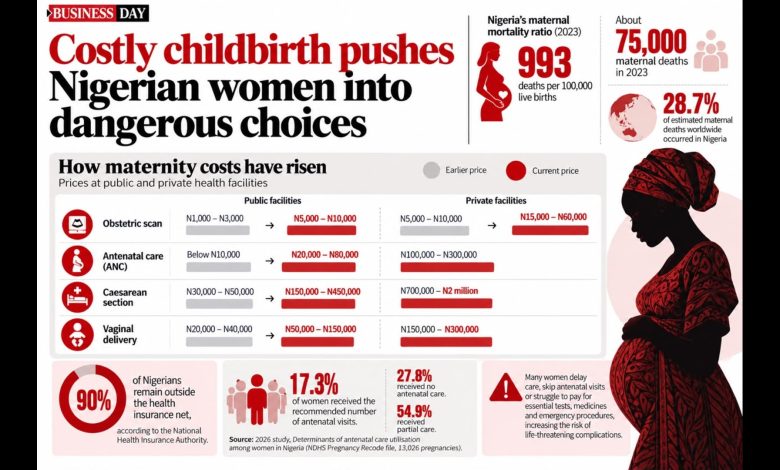
The United Nations estimates, covering 2023, put Nigeria’s maternal mortality ratio at 993 deaths per 100,000 live births, roughly 10 maternal deaths for every 1,000 live births.
Nigeria recorded about 75,000 maternal deaths in 2023, the highest number globally and has 28.7 percent of estimated maternal deaths worldwide.
Behind those numbers are pregnancy complications that can often be treated when detected and managed early, but for which timely access to care can be constrained by cost.
Maternity costs climb
Findings by BusinessDay showed that the cost of routine pregnancy monitoring has risen beyond what an average low-income Nigerian woman can afford.
This paper tracked the prices of key maternity services across public and private health facilities and compared them with what women paid in previous years.
It was discovered that obstetric scans that cost about N1,000 to N3,000 in public facilities in 2016 now cost about N5,000 to N10,000, while anomaly scans cost between N10,000 and N20,000.
In private hospitals, obstetric scans that previously cost about N5,000 to N10,000 now range from N15,000 to N60,000.
Antenatal care, which previously cost below N10,000 in public hospitals, now costs between N20,000 and N80,000. In private facilities, the cost ranges from N100,000 to N300,000.
This paper observed that the financial burden rises further when childbirth requires surgery.
A Caesarean section that cost about N30,000 to N50,000 in 2016 now costs between N150,000 and N450,000 in public hospitals. In private hospitals, the procedure ranges from N700,000 to N2 million.
Vaginal delivery, which cost about N20,000 to N40,000 in 2022, now costs N50,000 to N150,000 in public hospitals and N150,000 to N300,000 in private facilities.
For women with multiple or high-risk pregnancies, the final bill can rise further because of additional monitoring, tests, medication and emergency interventions.
It was also observed that the financial pressure is compounded by Nigeria’s limited health insurance coverage.
About 90 percent of Nigerians remain outside the health insurance net, according to the National Health Insurance Authority.
For many households, maternity expenses therefore come directly from income and savings.
For some women, that means difficult decisions about how much care they can afford.
Gift John, a primary school teacher and resident of Lugbe, Abuja, said she skipped antenatal care throughout her pregnancy because she wanted to save money for delivery and expenses after childbirth.
“I bought and took the important drugs, which are folic acid and ferrous, just as I did for my last pregnancy,” John said.
John’s pregnancy was uneventful and she delivered successfully, but not everybody can be as lucky as her.
However, researchers have noted that skipping antenatal care can leave complications undetected, particularly when they initially present few or no obvious symptoms.
A 2026 study titled Determinants of antenatal care utilisation among women in Nigeria found that inadequate antenatal care remained a critical public health problem associated with socioeconomic disparities.
The study analysed 13,026 pregnancies from the NDHS Pregnancy Recode file and found that only 17.3 percent of women received the recommended number of antenatal visits.
Another 27.8 percent received no antenatal care, while 54.9 percent received partial care.
The researchers identified poverty as an important determinant of antenatal care utilisation, finding that women from poorer households were less likely to receive appropriate care.
When an emergency changes the bill
For women who develop complications, the need for emergency treatment can dramatically increase the cost of childbirth.
Martha Uchenna, a resident of Lugbe, Abuja, who narrated her experience with our correspondent, said she developed pre-eclampsia, a pregnancy complication characterised by high blood pressure and which can become life-threatening.
Uchenna said she went to her health facility expecting routine antenatal care but was instead prepared for an emergency Caesarean section.
She added, “After I arrived, the routine tests were carried out, and I was shocked when the doctor said I would need an emergency section. Apart from emotional readiness, I was not financially ready.
“I had saved up about N500,000 for vaginal delivery and other expenses. But we ended up paying over N1.8 million, part of which was borrowed. My joy is that my baby and I came out alive.”
Uchenna’s experience shows how quickly the financial demands of childbirth can multiply when an emergency occurs.
Financial burden discouraging hospital care
Medical experts warned that the rising financial burden of maternity care is contributing to low hospital patronage.
They lamented that some pregnant women delay seeking care, miss antenatal visits or struggle to pay for essential tests, medicines and emergency procedures.
Muhammad Sanusi, an Abuja-based medical doctor, told BusinessDay that women with high-risk pregnancies sometimes arrive at health facilities already struggling to pay for investigations, medicines and delivery.
Sanusi said the rising cost of investigations, medicines and delivery is putting families under increasing financial pressure, particularly when a pregnancy becomes high-risk.
He expressed concern that the situation becomes more dangerous when an emergency procedure such as a Caesarean section is required and families cannot raise the money quickly, resulting in delays that can worsen complications.
He stressed, “In obstetrics, that delay can change the entire outcome, a woman who could have had a controlled delivery may end up with severe haemorrhage, organ complications, emergency surgery or even death.”
Also, Adaobi Onyechi, a public health expert, said reducing maternal deaths would require tackling the financial barriers to emergency care while ensuring that health facilities have the resources to treat women when they arrive.
Onyechi called for stronger financial protection for pregnant women, particularly those requiring emergency obstetric care.
She said reducing maternal deaths would also require adequately equipped public hospitals and referral systems that can quickly move women with complications to facilities where they can receive appropriate treatment.
“A woman should not lose her life because her family cannot raise money at the point when she needs lifesaving care,” she said.
This is the second part of BusinessDay’s series on Nigeria’s maternal health crisis. You can read the first part here.