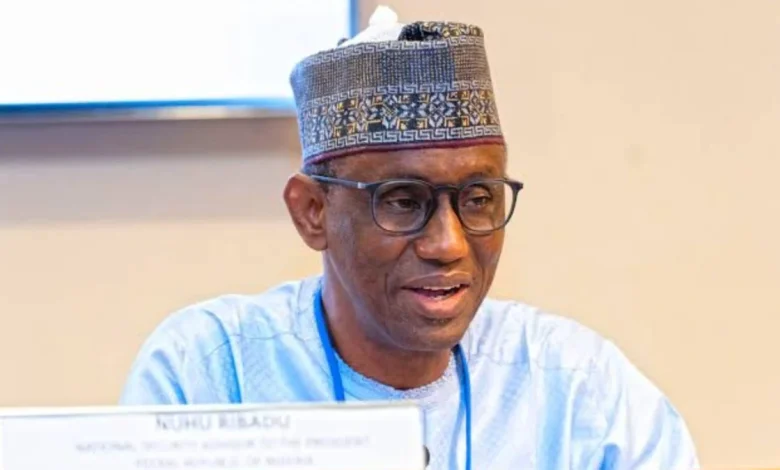
The National Security Adviser, Nuhu Ribadu, has warned that terrorist groups are increasingly using artificial intelligence, cryptocurrencies, drones and other digital technologies to evade security agencies, finance their operations and recruit new members across West Africa and the Sahel.
Ribadu said the growing use of technology by terrorist organisations had introduced new challenges for Nigeria and neighbouring countries.
He called for stronger intelligence sharing, improved technical skills and closer cooperation among regional security agencies to identify and disrupt threats before attacks occur.
The NSA gave the warning in Abuja on Tuesday through the National Coordinator of the National Counter Terrorism Centre, Major General Adamu Laka.
He was speaking at a three-day regional training conference focused on detecting and disrupting terrorists’ exploitation of information and communication technologies and emerging technologies.
Ribadu said terrorist groups were taking advantage of social media and other digital platforms to circulate propaganda, influence vulnerable individuals, raise funds and coordinate activities across national borders.
He noted that developments in artificial intelligence, unmanned aerial systems and virtual assets had expanded the tools available to terrorist networks, making it necessary for security agencies to adapt their strategies.
“Emerging technologies add further complexity: Artificial Intelligence can rapidly produce personalised content; drones and autonomous systems can expand operational capabilities; and virtual assets can create new financing channels. We must, therefore, strengthen our ability to anticipate, detect, analyse and disrupt threats before they materialise,” he said.
The security adviser stressed that addressing the problem would require more than the purchase of advanced surveillance equipment.
He said countries in the region must invest in specialised personnel, build stronger institutions and improve coordination between intelligence and law enforcement agencies.
According to him, timely access to actionable cyber threat information would be critical to preventing terrorist activities, particularly where criminal networks operate across several countries.
“Nigeria recognises that no institution, country or sector can defeat terrorism alone,” he said.
Ribadu also disclosed that Nigeria was working with the African Union Counter-Terrorism Centre to secure regional accreditation for the National Counter Terrorism Centre as a centre of excellence for counterterrorism in West Africa and the Sahel.
He said the initiative followed President Bola Tinubu’s declaration at the High-Level Africa Counterterrorism Summit held in April 2024.
However, in a related development, Politics Nigeria recalls that the National Security Adviser Nuhu Ribadu was recently linked to armed deals involving sales to terrorist groups in the country. Though he dismissed the allegations as false.
The proposed recognition is expected to support regional efforts to strengthen counterterrorism capacity and improve cooperation among countries confronting extremist violence.
Speaking at the conference, the Acting Director of the African Union Counter-Terrorism Centre, Idriss Lalalli, said terrorist organisations were expanding their use of digital tools to strengthen recruitment, financing, communication and operational planning.
He identified the Islamic State West Africa Province (ISWAP), Boko Haram and Jama’at Nusrat al-Islam wal-Muslimin (JNIM) among the groups exploiting emerging technologies to extend their reach across West Africa and the Sahel.
“Across West Africa and the Sahel today, ISWAP, Boko Haram and JNIM are extending their reach through technology. They recruit on social media platforms, move and conceal funds via mobile money, gift cards and cryptocurrencies.
“They buy weapons on darknet marketplaces, communicate over satellite links beyond our networks, and fly drones across borders, using artificial intelligence to tailor propaganda and evade detection.”
Lalalli said the accessibility and speed of digital technologies had made it possible for relatively small terrorist cells to reach large audiences without maintaining a significant physical presence in the areas they target.
He warned that security agencies could struggle to respond effectively when terrorist groups adopt new tools faster than governments develop the capacity to detect and counter them.
“What makes this difficult is speed and cost. A cell with a modest budget can now reach audiences far beyond its physical presence and move faster than our procedures can respond. The capability to counter it remains thinly and unevenly distributed across our member states,” he said.
The AU official said the gap in technological capacity could be reduced through targeted training, stronger regional partnerships and greater collaboration between governments and private companies that operate digital platforms and financial services.

He explained that the conference was designed to equip participants with practical skills in cyber threat intelligence, open-source intelligence, digital forensics and blockchain analysis.
These areas of training are expected to help security personnel identify online recruitment activities, preserve electronic evidence, investigate suspicious digital transactions and trace funds suspected of supporting terrorist operations.
The training also seeks to improve the ability of investigators to turn digital intelligence into evidence that can support criminal investigations and prosecutions.
Lalalli emphasised that these capabilities must complement one another.
He said identifying terrorist propaganda online would have limited impact if investigators could not preserve the evidence, establish links between suspects and financial transactions, or present reliable findings before a court.
He further called for stronger working relationships with social media companies, telecommunications operators and financial service providers.
According to him, much of the infrastructure used by terrorist organisations is controlled by private companies.
Cooperation with these operators is therefore important for identifying suspicious activity, disrupting communication channels and tracing funds while respecting applicable legal procedures.
The conference also placed emphasis on developing local expertise that can be shared across participating countries.
Addressing the participants, Lalalli said the programme carried a responsibility beyond the completion of the training.
“You leave as this continent’s first cohort of trainers in this domain. You will leave here not just carrying home a certificate, but a responsibility. The Centre will stand behind you. But the multiplier is you,” he said.
The three-day conference brought together participants from West Africa and the Sahel, alongside representatives of the African Union, the Economic Community of West African States (ECOWAS), the Multinational Joint Task Force, regional intelligence structures and international organisations.