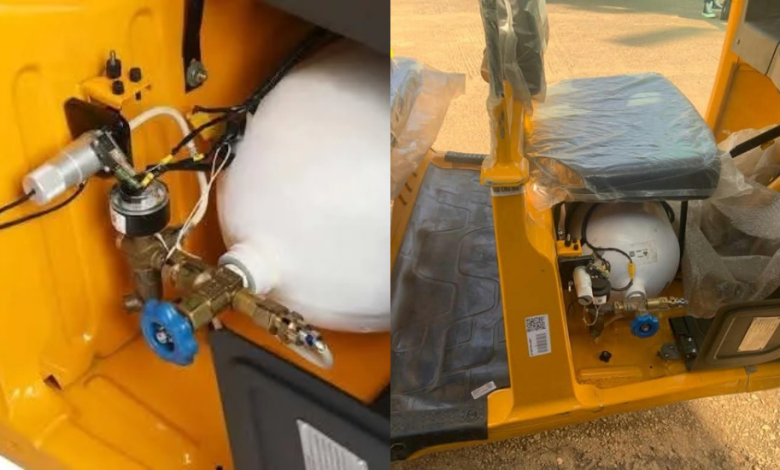
For Murtala Umar, a commercial tricycle rider in Kano, the difference between running a Keke on petrol and switching to Compressed Natural Gas (CNG) could mean more money at the end of a working day.
For riders who depend on their tricycles to feed their families, pay rent and meet other household responsibilities, the cost of fuel is more than an operating expense. It determines how much they take home after spending hours navigating Kano’s busy roads in search of passengers.
The rising cost of petrol has made that calculation increasingly difficult. But with the expansion of CNG infrastructure in Kano, some commercial transport operators are beginning to consider a cheaper alternative that could ease the pressure on their daily earnings.
Umar is among the riders identified as using CNG-powered tricycles. Another operator, Abubakar Abdullahi, has also embraced the alternative fuel.
Their experiences offer an opportunity to examine whether the transition can provide meaningful financial relief to operators.
For Musa Nura, however, the situation is different.
Still operating a petrol-powered Keke, he represents riders who continue to bear the burden of rising fuel costs and may not yet have the financial means or access needed to switch.
The daily battle over fuel costs
The financial pressure facing petrol-powered tricycle operators is reflected in the figures released by the Federal Government.
At the commissioning of two Liquefied Compressed Natural Gas (LCNG) facilities in Kano, the Executive Director of the Midstream and Downstream Gas Infrastructure Fund, Oluwole Adama, said told THE WHISTLER that a tricycle operator spending N14,200 daily on 10 litres of petrol could spend about N6,000 on CNG for equivalent energy.
That represents a potential daily saving of N8,200.
Over 30 working days, the difference could reach N246,000, a significant amount for an operator whose income depends on daily passenger trips.
Adama said the savings could help transport workers meet household expenses, pay school fees and save towards owning their tricycles.
The comparison is based on the prices announced at the commissioning: petrol at about N1,420 per litre and the equivalent energy from CNG at approximately N600.
For Musa, who still operates on petrol, the cost of keeping his tricycle on the road remains a major consideration.
A cheaper alternative, but at what cost?
The Federal Government’s latest investment in Kano’s gas infrastructure is intended to make the alternative more accessible to transport operators.
The facilities commissioned include an LCNG Mother Station at Tamburawa and a Daughter Station at Hotoro Quarters in Tarauni Local Government Area.
The facilities are expected to support the refuelling of up to 2,500 cars and tricycles daily, while also supplying gas to other stations.
The Tamburawa facility has a stated capacity of 300,000 standard cubic metres of gas daily.
For operators, however, cheaper fuel is only one part of the transition.
The cost of acquiring a CNG-powered tricycle or converting an existing petrol-powered one could determine who benefits.
A listing by a Nigerian CNG equipment vendor puts the price of a new CNG tricycle at about N4.2m and a used one at N2.7m. The same vendor lists a Keke conversion package at N600,000.
The Presidential Initiative on Compressed Natural Gas and Electric Vehicles, however, gives an estimated conversion range of N180,000 to N280,000 for tricycles, depending on the kit and vehicle type, with subsidised options available through its conversion programme.
Actual prices should be confirmed with an accredited conversion centre.
The difference between these figures highlights the need for transparent pricing, accessible financing and reliable conversion services if more operators are to make the switch.
Beyond fuel savings
For Umar and Abdullahi, the key question is how much of their daily earnings they can retain after paying for fuel and meeting other operating expenses.
If the savings projected by the MDGIF are achieved in practice, CNG could give operators more room to meet family needs, maintain their vehicles and build savings.
But the transition must also address concerns about access to refuelling stations, the availability of conversion kits, maintenance costs and safety.
Earlier, the Founder and Chief Executive Officer of Rolling Energy Limited, Mubarak Umar Danbatta, said the new facilities would reduce the logistical challenges of transporting gas over long distances.
He explained that his company previously travelled hundreds of kilometres from Abuja to source CNG from Ajaokuta and Obajana in Kogi State before transporting it to its stations.
The new infrastructure, he said, would bring gas closer to businesses and investors in Northern Nigeria.
The company also plans to establish vehicle conversion workshops equipped with Greco CNG conversion kits, with the capacity to convert 66 vehicles daily across five stations.
The development could make it easier for tricycle operators to access conversion services, although the cost and availability of the service will remain important considerations.
Will CNG change the economics of Keke business?
For Kano’s commercial tricycle operators, the success of the transition will ultimately be measured by what remains in their pockets after a day’s work.
The N8,200 daily saving announced by the MDGIF offers an attractive prospect. But that benefit will depend on actual fuel consumption, the price of CNG, the distance covered, the availability of refuelling stations and the cost of maintaining converted vehicles.
There is also the question of whether operators can afford the initial cost of conversion or purchase without taking on debts that could erase some of their savings.
The government’s investment in gas infrastructure may therefore be only the beginning. Affordable conversion, accessible financing, safety enforcement and dependable refuelling services will determine whether the benefits reach ordinary transport workers.
For riders like Umar and Abdullahi, CNG could offer a chance to keep more of their daily earnings.
For Musa and thousands of other petrol-dependent operators, that opportunity will mean little unless the transition becomes affordable and accessible.
The real test is not simply how many CNG stations Kano opens, but how many ordinary Keke riders can afford to use them — and how much better off they are when they do.