Isaga Monarch Rallies Descendants For Unity, Development, Backs Political Participation

Toyyibat Qasim
The Onisaga of Saga, Oba Joseph Oladele Olusoji Tella, has called on sons and daughters of Isaga, both at home and in the diaspora, to unite, strengthen their ancestral bonds and mobilise their resources towards the development of their community.
The monarch also urged traditional rulers, community leaders, professionals, youths and other stakeholders to set aside personal differences and work towards a common development agenda capable of transforming Isaga and its settlements.
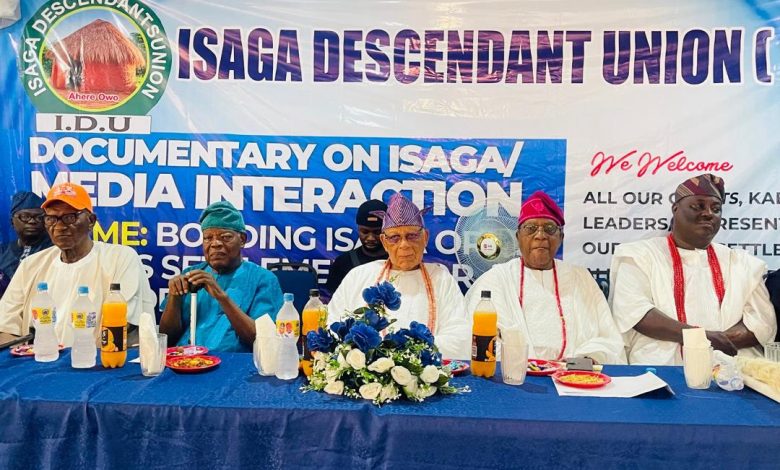
Oba Tella made the call in a speech delivered on his behalf by the Balogun of Isaga, Chief Lawrence Osayemi, at a gathering of the Isaga Descendants Union held at Isaga Orile, in Abeokuta North Local Government Area of Ogun State, on Saturday.
The gathering, themed, ‘Bonding Isaga Orile and Its Settlements for Development’, brought together traditional rulers, prominent indigenes and descendants of the ancient community from different parts of Nigeria and abroad for a reunion, media interaction and documentation of Isaga’s history.
The monarch, who regretted his inability to attend the event physically, commended the organisers for creating a platform for descendants scattered across different settlements and geographical locations to reconnect with their common ancestry.
He described the reunion as an opportunity to preserve the community’s cultural heritage, strengthen relationships and renew collective commitment to the development of their ancestral homeland.
Oba Tella maintained that Isaga’s strength should not be measured only by its historical heritage or geographical spread but also by the unity, cooperation and determination of its people.
He said, “Our geographical separation should not become a barrier to our unity or make us lose sight of the fact that we share a common origin. We must recognise that wherever we find ourselves, Isaga remains our ancestral home.”
The traditional ruler stressed that community development should not be left in the hands of traditional institutions or a few wealthy individuals, insisting that every indigene had a responsibility to contribute, irrespective of social status, occupation or location.
He urged academics, entrepreneurs, political leaders, artisans, youths and elderly people to deploy their knowledge, experience, resources and influence towards advancing the community.
The monarch also called for stronger political mobilisation among Isaga descendants, urging eligible voters to participate actively in the electoral process and support peaceful, lawful and democratic political engagement.
He warned that divisions arising from political affiliations, religious differences and geographical separation could weaken the community’s collective influence.
Meanwhile, a Professor of International Boundaries, Chief Anthony Asiwaju, has traced the dispersal of Isaga descendants across different Yoruba settlements to the devastating wars and insecurity that characterised 19th-century Yorubaland.
He said the emergence and growth of several major settlements in Yorubaland were closely connected to the movement of people fleeing conflicts and searching for security.
Using Ibadan as an example, the professor explained that what began as a war camp eventually developed into one of Africa’s largest cities, following the movement of people from different parts of Yorubaland, including Egba communities.
According to him, hunters and other people familiar with the forests and surrounding territories played significant roles in guiding displaced families to safer locations.
He said, “Historically, the Yoruba people experienced considerable movements and migrations from one settlement to another, largely as a result of wars and insecurity.
“These wars scattered communities, displaced families and forced people to establish new settlements.”
Asiwaju further identified the historical connections among Yoruba communities in present-day Nigeria and the Republic of Benin, particularly Ketu, Sabe and Oyo, explaining that their cultural and traditional relationships predated modern national boundaries.