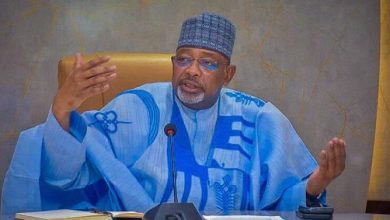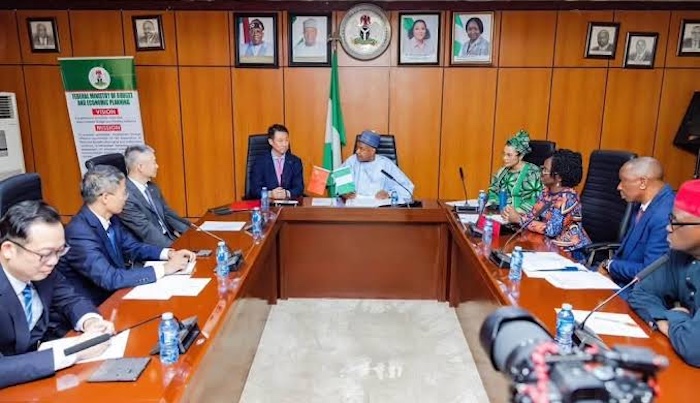
The agreement, valued at RMB 200 million, was signed by representatives of both countries under the Nigeria-China Development Cooperation framework.
Minister of Budget and Economic Planning, Senator Abubakar Atiku Bagudu, said the grant would support projects designed to address specific development needs at the community level, stressing the need to ensure that bilateral agreements deliver measurable improvements in the lives of Nigerians.
The funding will be deployed under China’s “Small but Beautiful” initiative, which prioritises targeted development interventions with direct impact on livelihoods and local communities.
Bagudu disclosed that the federal government, working with the Nigeria-China Strategic Partnership Office, had been developing project proposals submitted by state governments to address identified grassroots needs.
He linked the initiative to Nigeria’s Renewed Hope Ward Development Plan, which seeks to identify economic opportunities and map economically active individuals across the country’s 8,809 wards as part of efforts to promote inclusive growth and reduce poverty.
According to him, Nigeria is interested in sharing the initiative with China and drawing on the Asian country’s experience in poverty reduction and community-level economic development.
The minister said the grant represented a continuation of China’s development support to Nigeria, recalling an earlier $1 million contribution in 2026 towards strengthening the country’s technological and knowledge development capacity.
He also called for stronger economic engagement between the two countries, particularly in leveraging China’s zero-tariff policy for Nigerian exports to expand market access and stimulate domestic production.
Bagudu underscored the importance of technical cooperation and institutional capacity building, including training opportunities for Nigerian officials in China, to strengthen the country’s ability to execute development programmes.
China Seeks Longer-term Trade Framework
Chinese Ambassador to Nigeria, Yu Dunhai, said the grant reflected Beijing’s commitment to supporting Nigeria’s development priorities and strengthening strategic partnership between both countries.
Dunhai said the agreement was consistent with the understanding reached between President Bola Tinubu and Chinese President Xi Jinping during their meeting in China, as well as the outcomes of the Fourth China-Nigeria Cooperation Forum held in Beijing.
He stated that 2026 marked 55 years of diplomatic relations between the two countries, adding that their cooperation has expanded across several sectors over the decades.
Providing an update on economic relations, the ambassador said bilateral trade reached $18 billion in the first half of 2026, while Nigeria’s exports to China rose by 80 per cent.
He attributed the improved export performance partly to China’s zero-tariff policy for Nigerian products, which took effect on May 1, 2026, describing it as an opportunity to expand market access, attract investment, and strengthen Nigeria’s industrial base.
However, Dunhai warned that the current zero-tariff arrangement was scheduled to expire on May 1, 2028, urging both countries to accelerate negotiations towards a broader economic development partnership agreement before the deadline.
Such an agreement, he said, would consolidate existing trade gains and provide a more sustainable framework for economic cooperation beyond the current preferential arrangement.
The ambassador specifically urged Nigeria’s Ministry of Budget and Economic Planning to work with the Federal Ministry of Industry, Trade and Investment to advance discussions on the proposed framework.