Informal ambulance services like commercial buses or community-based services by ‘good samaritans’ accounted for 47 percent of all emergency response transportation services in 2025 according to recent industry reports by Salvus Emergency on Nigeria’s emergency healthcare system.
Public ambulance services account for only seven percent of all emergency response services, private ambulance services account for 15 percent while private vehicles or private owned vehicles that are hired by relatives of victims account for 31 percent of all emergency response, the report stated.
According to the report, public ambulance services like Lagos State Ambulance Services (LASAMBUS) and FCT emergency response services among others are more affordable but lack proper coordination to offer rapid response.
“About 83 percent of public ambulance agencies lack a shared database, with calls often siloed and dispatch mostly arbitrary,” the report stated.
While public ambulance services are mostly underfunded and untrusted, private ambulance services are expensive with costs ranging from N67,000($50) to N202,000($150) an amount often too expensive for 70 percent of Nigerian households, Salvus Industry report stated.
Evidence shows that out of the 2.4 million annual deaths in Nigeria, at least 1.2 million of those fatalities could potentially have been prevented by an efficient emergency medical service system.
A recent pilot study by Emergency Response Africa (ERA) in collaboration with Edo State government, revealed that about 90 percent of emergency patients arrived health facilities through other means other than the the conventional Emergency Management Services (EMS) due to high costs (N173,873) and lack of trust in the system.
Read Also: Stablecoins power Nigeria’s Web3 surge as startups hits $43m
Government efforts
In recent times, the Federal Government has intensified efforts to strengthen emergency medical care across Nigeria through the National Emergency Medical Service and Ambulance System (NEMSAS), while urging improved access to and awareness of the 112 national emergency number.
This was disclosed by the national programme manager of NEMSAS, Emuren Doubra, during a review of an article on the state of Nigeria’s emergency healthcare in 2025, published in the African Journal of Emergency Medicine, according to a report by the Nigerian Observer.
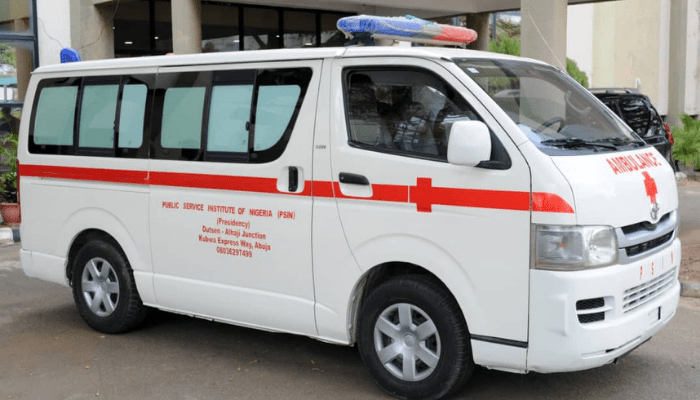
The FCT Minister, Nyesom Wike, recently commissioned 12 ambulance buses to enhance emergency response in healthcare facilities within Abuja.
Read also:Wike directs recruitment of additional health workers, hands 12 ambulances to FCT hospitals
The progress review report on Nigeria’s emergency healthcare system acknowledged notable advances in emergency medicine but stressed the need for stronger collaboration between out-of-hospital and in-hospital services, as well as expanded training across all professional cadres.
Other state governments, including Lagos, Plateau, and Anambra among others, are also making measurable efforts to boost emergency care through the purchase of additional ambulance buses.
The Federal Government also recently urged the Nigerian Communications Commission (NCC) to address poor connectivity disrupting emergency response, noting that Nigeria currently operates about 500 ambulances, far below the estimated 4,000 needed nationwide.