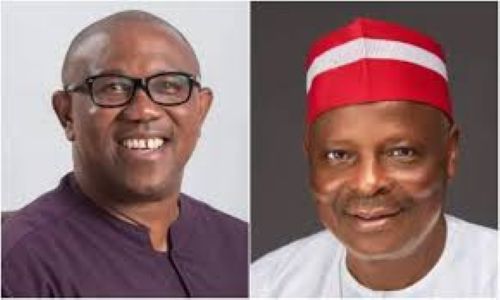
The Kwankwasiyya Movement has called for national unity and issue-based politics ahead of the 2027 general elections, warning against political division and targeted attacks on individuals.
This was contained in a statement issued on Friday and signed by Habibu Sale Mohammed, spokesperson of the Kwankwasiyya Movement.
The statement came as a reaction to ongoing discussions around a possible political understanding between its leader, Rabiu Musa Kwankwaso, and Peter Obi under the Nigeria Democratic Congress (NDC).
In its reaction, the group said Nigerians should focus on building a broad coalition that reflects national interest rather than promoting narratives that deepen division.
According to the group, many Nigerians across regions and political backgrounds have welcomed the talks as a step toward national unity and democratic growth.
However, it expressed concern that some commentators, particularly from parts of the Northern political space, are pushing what it described as misleading narratives aimed at discrediting Kwankwaso.
“It is unfortunate that some commentators have resorted to selective attacks and misleading narratives aimed specifically at discrediting Senator Rabiu Musa Kwankwaso,” Mohammed said.
The group suggested that the criticism may be driven by fear of the political strength such an alliance could bring
“What appears to be troubling certain interests is not merely the possibility of political cooperation, but the enormous national potential such an alliance represents,” he stated.
He noted that a partnership between Kwankwaso and Obi could reshape Nigeria’s political landscape by bringing together strong support bases from both the North and the South
“For the first time in recent political history, Nigerians are witnessing the realistic possibility of a broad-based political understanding capable of bridging the long-standing regional divide,” the group said.
Mohammed added that while Kwankwaso has a strong grassroots structure in the North, Obi enjoys wide support among youths and urban voters, especially in the South.
“Such cooperation introduces a new political equation that transcends ethnicity, religion, and regional sentiment,” he said.
The group also criticised what it described as double standards in how political engagements are judged.
“Some commentators portray Kwankwaso as ambitious or disruptive, while describing similar engagements by others as strategic and patriotic. This double standard is both unfortunate and revealing.”
The Kwankwasiyya Movement insisted that coalition-building is a normal and necessary part of democracy and should not be discouraged.
“Any honest political observer understands that the coming together of leaders with proven electoral strength and independent structures can reshape Nigeria’s democratic landscape,” he added.
The group further defended Kwankwaso’s political relevance.
According to Mohammed, it is rooted in years of service and grassroots support rather than influence from federal power.
“His political relevance is not manufactured by media or sustained by access to power, but built on trust, service, and connection with ordinary Nigerians,” he said.
The group urged political actors and commentators to act with fairness and maturity, especially at a time when Nigerians are facing economic and security challenges.