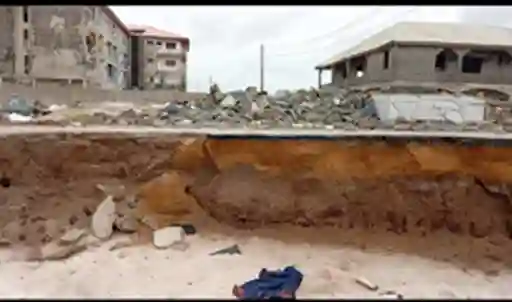
Once a thriving tourist hub and residential community, Okun Alfa (Alpha Beach) was devastated by a 2009 ocean surge that destroyed homes and claimed lives. Juliana Francis reports that the Eko Atlantic City project and unbridled sand dredging activities pose new threats to its continued existence.
When first approached for an interview, Ms Adejat Murayo, whose ancestral home in the coastal community of Okun Alfa in Lagos was wiped out by ocean surges, refused to speak.
She was visibly angry.
“I don’t want to be interviewed; I have nothing to say,” she said. “My mother’s burial site is in the ocean. Everything is gone!”
 Destruction of Okun Alfa By Ocean Surges
Okun Alfa with wave breakers
Weeks later, she agreed to speak briefly.
She recalled the night the disaster struck in 2009, when the Atlantic Ocean washed away the 10 houses she inherited from her late mother.
She said it occurred at about 1 a.m., while most residents were asleep. Waves surged violently into the community. Families woke to chaos—parents grabbing children and fleeing into the darkness as water swallowed homes.
“It was a nightmare,” she said quietly. “Please, I don’t like talking about these things.”
Nearly two decades later, the trauma lingers—and so does the threat.
The Night the Ocean Took Everything
Olayinka Ajandi, a struggling architect in his 40s, said residents had initially noticed unusual waves at dusk but assumed they would pass without incident.
They did not.
“By 1 a.m., it came with full force. Many people were asleep. Not everyone could swim.”
He described the sound of waves crashing into buildings, the panic, and the screams.
“Those of us who survived did so because we could swim. Later, the ocean returned bodies to what was left of our community.”
The surges did not stop after 2009.
Ajandi said they continued until the administration of former Lagos State governor Babatunde Raji Fashola installed shoreline breakers.
“If not for those breakers, the community would have disappeared,” he said.
Still, the damage was irreversible.
“My father lost seven buildings. The shock killed him. He kept asking how to start again.”
Many families whose homes were destroyed in surges have had to relocate. But indigenous landowners like Murayo and Ajandi said they have nowhere else to go.
Murayo says the community’s health centres and schools were flooded, so women now must travel far to access medical care.
Residents trace the beginning of recurring surges to 2008, when sand dredging for the Eko Atlantic project began.
“The first surge happened in 2009, and the ongoing Eko Atlantic City project started sand mining from the sea in 2008. That was when we first noticed their activities,” Ajandi said.
The project promises to transform Lagos into the “Dubai of Africa.” But for Okun Alfa residents, it has brought fear, despair, loss, and uncertainty.
A 2025 Report, Lagos: City Report by African Cities Research Consortium (ACRC), states that coastal displacement in Lagos is primarily driven by climate-related flooding and forced evictions.
The report states that approximately 18% of Lagos, a low-lying coastal city with poor drainage and rising rainfall, is becoming increasingly prone to flooding, with waterfront communities facing the greatest risk of flooding and displacement.
ACRC also states that the All-Progressives Congress (APC) vision of making Lagos more beautiful and modern has led to the demolition of many slum communities, often in harsh ways.