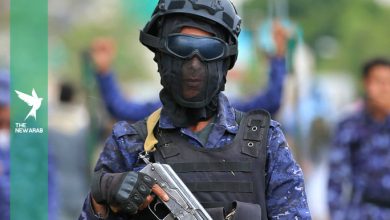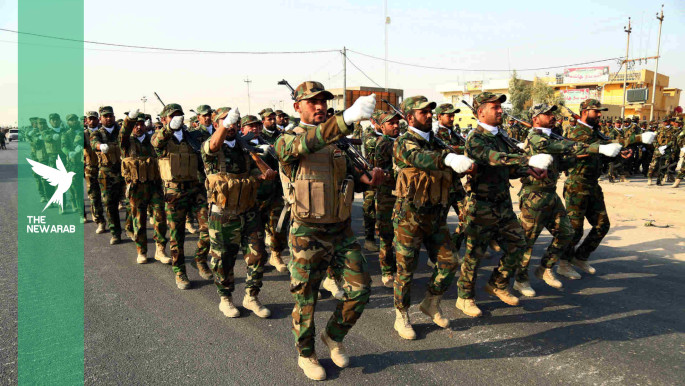
The visit comes as US pressure intensifies on the government over Iraqi factions allied with Iran. [Getty]
Former director of the US Central Intelligence Agency and architect of the “Sahwa” (Arabic for “Awakening”) strategy, a key component of the US “surge” in Iraq from 2007 to 2008 against Al-Qaeda in Iraq, General David Petraeus has been visiting the Iraqi capital, Baghdad, since last Friday, 15 May.
He is holding official meetings with senior Iraqi officials, without disclosing the nature of the visit or the capacity in which he is carrying out his mission in Iraq.
The visit comes as US pressure intensifies on the government over Iraqi factions allied with Iran.
According to political sources in Baghdad who spoke to The New Arab, Petraeus’ visit “is inseparable from the efforts of US President Donald Trump’s administration to exert direct pressure on the government over the issue of disarming the factions.”
A current member of parliament from the “Coordination Framework” alliance said he had been tasked with conveying messages to Iraqi officials and politicians with whom he worked closely between 2003 and 2009, noting that no one knows the content of these messages and that there is much speculation surrounding them.
Some of it has been treated as information, but in reality, the visit and meetings in Baghdad fall within the US approach, and the messages may be advice or warnings.
While in Baghdad, the US general met with the head of the Supreme Judicial Council, Faeq Zidan. According to an official statement issued by the judiciary’s media office, “Zidan expressed his gratitude for the efforts made by Petraeus during his tenure in Iraq, particularly in the field of counter-terrorism and encouraging national reconciliation efforts during that period.”
Petraeus also met with the Speaker of Parliament, Heibat Al-Halbousi. According to a statement published by the latter, the “meeting discussed the overall situation in Iraq, as well as regional and international developments.”
Last week, a political adviser in the Iraqi government, Aed Al-Hilali, said in a press statement that there is “a new US movement led by Petraeus to help support Ali Al-Zeidi and influence the shape of his government”.
“Petraeus carries ideas related to restructuring the security landscape through the establishment of a new security ministry that would include the Popular Mobilisation Directorate, the Federal Police, the Border Police, some units of the Sahwa forces, and the Peshmerga, alongside internal changes within the structure of the Popular Mobilisation Forces, including dismissals of several brigade commanders and faction leaders,” he added.
This comment, and other interpretations of Petraeus’ role in Baghdad, revived discussion of his experience in Iraq after the US occupation, when he led efforts to integrate Iraqi groups in support of US forces in their fight against al-Qaeda.
Mahmoud Al-Hayani, a member of the ruling Coordination Framework alliance in Iraq, said Petraeus’ visit to Baghdad and his meetings with several officials and political figures “carry implications that go beyond protocol and fall within sensitive security and political contexts linked to complex domestic files”.
He told The New Arab that “the timing of the visit cannot be separated from the stage of rearranging the political landscape in the country. Among the key messages the visit may carry are those related to the issue of armed factions and the future of their weapons amid growing regional and international discussions on mechanisms to control security and restrict arms to the state.”
“Information indicates the existence of indirect US conditions or approaches linking political and security support for Iraq to steps related to restructuring the status of the factions or integrating them within state institutions. This file remains one of the most sensitive at present,” al-Hayani said.
He stressed that “the visit at this time reflects renewed US interest in Iraqi affairs, particularly with the formation of the Iraqi government under Ali Al-Zeidi”.
“The visit is part of a broader diplomatic and security movement aimed at shaping the features of the next stage, and dealing with the factions file must take place within a purely sovereign framework that respects the specificity of Iraq’s security situation and ensures that internal stability balances are not disrupted,” he added.
Political activist Majaash Al-Tamimi said, “The timing of Petraeus’ visit to Baghdad is not a procedural detail but reflects growing US concern over the nature of political and security balances inside Iraq, particularly amid increasing talk in Washington about the need to recalibrate relations with Baghdad according to stricter standards related to sovereignty, arms, and regional influence.”
He told The New Arab that “Petraeus’ meetings, particularly with Judge Faeq Zidan, carry implications that go beyond the judicial aspect, as the United States now views the Iraqi judiciary as a key component in regulating the political and economic environment and pursuing corruption networks, money laundering operations, and funding for armed factions.”
“The US messages appear clear: supporting Iraq’s stability is conditional on reducing the influence of Iran-linked factions, restricting weapons to the state, and preventing Iraqi territory from being used as a theatre for regional conflict or a route to circumvent US sanctions. Washington is also pushing to protect Western investments and keep official institutions away from the influence of armed groups,” al-Tamimi added.
“The visit can be seen as a gradual return of Iraq to the centre of US-Iran calculations, and the coming period may witness greater political and security pressure to redraw the balance of influence within the Iraqi state,” he noted.
Article translated from Arabic by Afrah Almatwari. To read the original, click here.