As organisations increasingly collect and process customer data across payments, marketing, support, and analytics systems, data protection has become a fundamental operational requirement rather than solely a compliance obligation. A prevalent method for achieving this is PII tokenisation, which replaces sensitive personal identifiers such as names, emails, phone numbers, or customer-linked IDs with protected token values, thereby limiting exposure of the original data.
Done well, tokenisation reduces privacy risk without making the data useless; if not, it creates a different problem.
Typically, a project is initiated to enhance data protection: sensitive fields are tokenised, access controls are strengthened, and the programme is considered complete. Subsequently, however, reporting accuracy declines, analytical joins become unreliable, and teams discover that certain data products still depend on legacy sources intended for decommissioning.
The issue does not stem from tokenisation being an inappropriate choice; in most cases, it is the correct approach. Rather, the challenge arises when organisations treat tokenisation solely as a privacy initiative, neglecting its broader implications for systems and data dependencies. When tokenisation affects live reporting, downstream logic, and operational workflows, the sequencing of implementation becomes as critical as the protection mechanism itself.
I have seen this pattern closely enough to know that the issue is usually not tokenisation itself. It is the sequence. Teams move too quickly into the technical controls before they fully understand how the data moves, what depends on it, and what will quietly break when protection is applied without enough context.
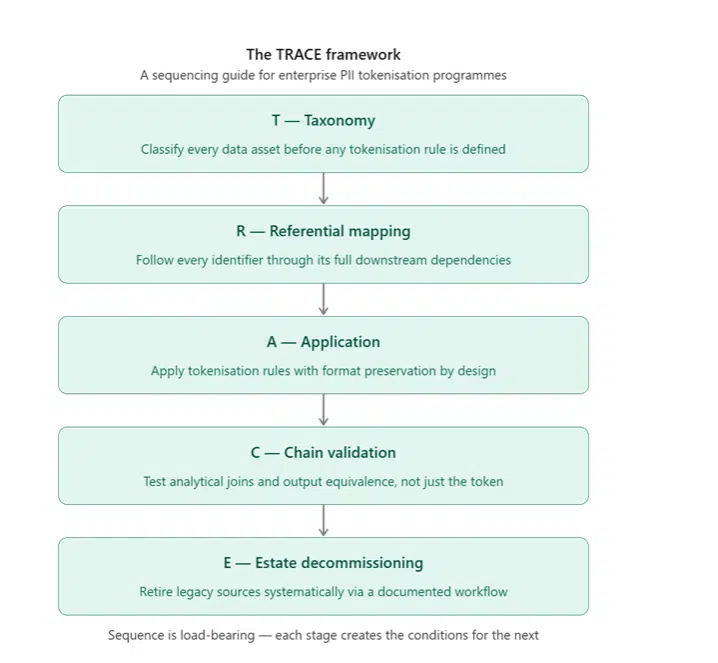
I developed a straightforward framework for evaluating the practical robustness of tokenisation programmes: TRACE, acronym for Taxonomy, Referential mapping, Application, Chain validation, and Estate decommissioning.
TRACE is not a formal standard, but rather a practical operating model informed by observing common failures in tokenisation programmes following the completion of compliance activities.
T – Taxonomy: classify before you tokenise
Most tokenisation programmes begin with the obvious question: where is the PII? While this step is necessary, it is not sufficient.
The substantive work begins when one moves beyond labeling a field as merely “sensitive” and instead examines its role within the broader data environment. It is important to consider what the field connects, which tables depend on it, which reports join on it, and what assumptions have been established regarding its format or consistency.

Victoria Fakiya – Senior Writer
Techpoint Digest
Stop struggling to find your tech career path
Discover in-demand tech skills and build a standout portfolio in this FREE 5-day email course
That is what taxonomy means here. It involves not only identifying sensitive fields but also classifying them by their functional roles within the system.
This is where teams often move too fast. They may identify a personal identifier, designate it for tokenisation, and assume that defining the protection rule is the most challenging aspect. In practice, the greater challenge often lies in understanding the additional functions that the field serves.
I have seen dependencies surface late, not because the field was missed, but because it was understood too narrowly. It had been classified as sensitive, but not fully mapped as an analytical dependency. That kind of mistake is expensive because it creates confidence early and instability later.
An effective taxonomy phase should provide the following insights:
- where the sensitive attributes sit
- how they are used
- what they anchor
- and which downstream processes depend on them behaving consistently
Without this comprehensive understanding, tokenisation rules may be applied to fields identified as sensitive, but not yet fully understood as integral system components.
R – Referential mapping: follow the identifier
Once a field has been classified, the next job is to follow it. Although this process appears straightforward, it is often complex in practice.
In most enterprise environments, customer-linked identifiers are not stored in a single location. These identifiers are distributed across payments, service interactions, marketing records, complaints, operational extracts, and reporting layers. They are frequently moved, transformed, and reused. Furthermore, not every dependency is explicitly represented in the schema.
Referential mapping involves tracing the identifier throughout the data estate and determining the potential failures that may occur if tokenisation is inconsistent.
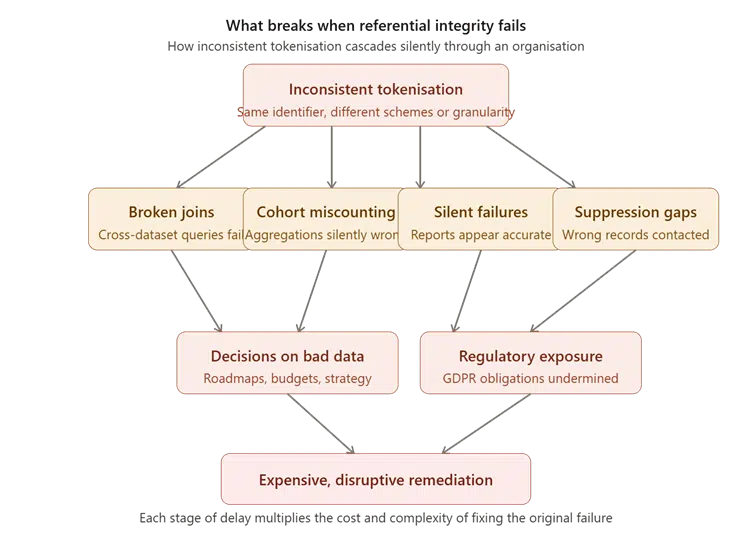
This stage is often the origin of numerous silent failures. A join can still run and still be wrong.
This characteristic makes such failures particularly hazardous. The system does not crash, and the query executes as expected, yet the output may change in ways that are not immediately apparent.
I have observed tokenisation logic that appeared correct at the table level but exhibited different behaviour downstream due to inconsistent preservation of the identifier across datasets. Although the join remained syntactically valid, the resulting cohorts were misaligned.
For this reason, referential mapping should not be the sole responsibility of engineering teams. Analysts and product teams must also be involved, as they often possess a deeper understanding of practical dependencies than the schema reveals. Their familiarity with actual data usage in reporting and decision-making is essential.
It is necessary to trace the identifier throughout its entire lifecycle, not only to its storage location but also to every point where its consistency remains critical.
A – Application: format preservation is a design constraint
After identifying sensitive data and mapping its flow, tokenisation rules can be applied.
This is the stage most teams think of as the actual tokenisation work. It is also where implementation shortcuts create downstream fragility. The most significant risk is neglecting to preserve the data format. A token may be secure yet still cause operational disruptions.
If downstream systems require a specific structure, such as length, pattern, data type, or level of detail, careless alterations can disrupt processes that may not be explicitly documented as token-sensitive.
Therefore, format preservation must be regarded as a fundamental design constraint rather than an optional enhancement.
At this stage, tokenisation rules should be documented with clarity:
- what is being tokenised
- how it is being tokenised
- where the rule applies
- and what must remain consistent downstream
Some organisations mistakenly tokenise only new or visible data flows, excluding historical extracts or legacy dependencies. While this approach may save time initially, it often necessitates a subsequent remediation programme.
Tokenisation extends beyond protecting individual data fields; it is essential for maintaining the integrity of the surrounding system.
C – Chain validation: test the join, not just the token
This stage is often expedited by teams as project deadlines approach. It is also the part that determines whether the programme actually holds.
Most tokenisation validation focuses on the token itself:
- was the original value replaced?
- is the mapping consistent?
- is access controlled?
These aspects are important, but they are insufficient on their own. The critical consideration is the impact on downstream processes.
- Do the joins still behave properly?
- Do the outputs still reconcile?
- Do the reports still produce the right cohorts and totals?
This process defines the purpose of chain validation.
In practice, this involves running tokenised and non-tokenised outputs in parallel for selected use cases prior to retiring legacy sources. It requires verifying output equivalence rather than solely field-level accuracy. Additionally, it necessitates the involvement of subject matter experts familiar with reporting logic, not only those responsible for implementing tokenisation.
This is important because certain failures may not be immediately apparent. Processes may continue to run, dashboards may load, and queries may return results, yet discrepancies can persist within the data.
Such failures undermine trust in the system. It is essential to validate the integrity of data joins, not solely the tokens themselves.
E — Estate decommissioning: retire the old estate properly
At this stage, many tokenisation programmes prematurely claim success.
The tokenised version may be operational, validation may be complete, and privacy controls may be implemented. However, legacy non-tokenised sources often remain accessible in the background. This situation reduces risk but does not eliminate it.
A tokenisation programme is only complete once the legacy sources it replaced have been fully and properly retired.
That retirement needs to be staged:
- identify the old source
- confirm that a validated tokenised replacement exists
- check that downstream dependencies have truly moved
- secure owner and governance sign-off
- retire the old source in a controlled way
- record what changed and why
This is significant because dual-state estates can inadvertently undermine organisational data protection efforts. One dataset may be governed, while another persists due to reluctance to decommission it promptly.
The outcome is a programme that appears complete in governance documentation but remains incomplete in actual implementation.
Why TRACE works
TRACE is not meant to be clever. It works because each stage creates the conditions for the next one.
- Classify before you tokenise.
- Follow the identifier.
- Apply protection with system behaviour in mind.
- Test the analytical chain, not just the control.
- Then retire the old estate properly.
Omitting a stage or accelerating the sequence often results in increased costs that become apparent after compliance milestones have passed, leaving teams to address subsequent analytical challenges.
For this reason, tokenisation should not be regarded solely as a privacy initiative.
- Tokenisation constitutes a privacy project.
- It also represents a systems project.
- It is a reporting project.
- It is a dependency project.
- If executed correctly, it also establishes a sequencing discipline.
Protecting customer data is essential. However, if implementation compromises system reconciliation, reporting, or decision support, the process remains incomplete. The optimal standard is to ensure both data protection and sufficient system usability to maintain trust.
About the Author
Chinwendu Nwaozuzu is a product manager with over 12 years of experience delivering digital transformation across education, telecommunications, and enterprise platforms. Follow her on LinkedIn for more insights.