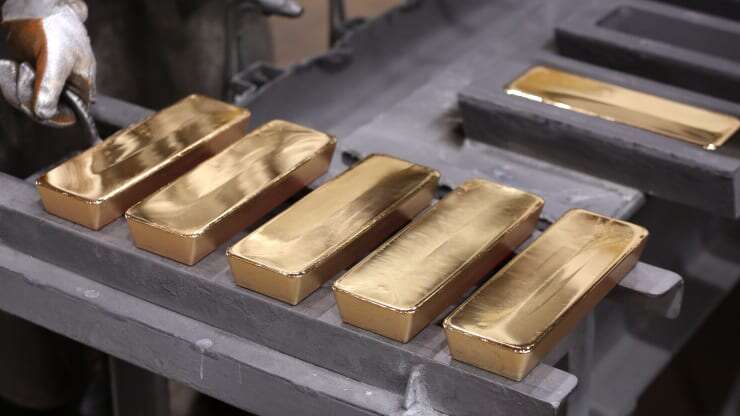
Gold prices declined on Monday as investors reduced exposure to the precious metal amid growing expectations that the U.S. Federal Reserve will maintain a restrictive monetary policy, dampening demand for non-yielding assets.
Spot gold fell about 0.7% to trade near $4,061.51 per ounce, while U.S. gold futures slipped 0.5% to approximately $4,076.20 per ounce as traders reassessed the outlook for interest rates and inflation.
The decline extended bullion’s recent weakness, with gold on track to record its fourth consecutive monthly loss, reflecting shifting investor sentiment as monetary policy expectations overshadow traditional safe-haven demand.
Market participants continue to focus on the Federal Reserve’s policy outlook following recent economic data that reinforced expectations of higher interest rates.
Higher interest rates generally weigh on gold because the precious metal does not generate interest or dividend income, making yield-bearing assets such as Treasury securities more attractive to investors.
Analysts noted that expectations for another rate increase later this year have strengthened as inflation concerns remain elevated, prompting investors to reduce holdings in bullion.
The market is now closely watching upcoming U.S. economic data, particularly employment figures, which could provide further insight into the Federal Reserve’s next policy move.
While geopolitical developments in the Middle East typically boost demand for safe-haven assets, analysts said recent market activity suggests monetary policy remains the dominant driver of gold prices.
Renewed tensions in the region initially lifted oil prices, raising concerns that higher energy costs could sustain inflationary pressures.
However, investors interpreted the inflation outlook as increasing the likelihood of prolonged higher interest rates rather than triggering a sustained flight to safety in gold.
As a result, the negative impact of rising rate expectations outweighed the traditional safe-haven appeal of the precious metal.
Attention is now shifting to upcoming U.S. economic releases, including labour market data, which could influence expectations for the Federal Reserve’s next interest rate decision.
Stronger-than-expected economic figures could reinforce the case for tighter monetary policy, potentially placing additional pressure on gold prices.
Conversely, signs of slowing economic activity may revive expectations for policy easing and provide support for bullion.
Elsewhere in the precious metals market, silver traded lower alongside gold, reflecting broad-based weakness across the sector.
Platinum recorded modest gains, while palladium outperformed as investors assessed supply conditions and industrial demand prospects.
Despite recent losses, analysts believe gold will remain highly sensitive to changes in interest rate expectations, inflation trends and geopolitical developments.
With uncertainty surrounding the Federal Reserve’s policy path and global economic growth, bullion is expected to remain volatile in the coming weeks as investors balance safe-haven demand against the opportunity cost of holding non-yielding assets.
Market participants will also continue monitoring developments in the Middle East, movements in the U.S. dollar and Treasury yields, all of which are expected to play a significant role in determining gold’s near-term direction.