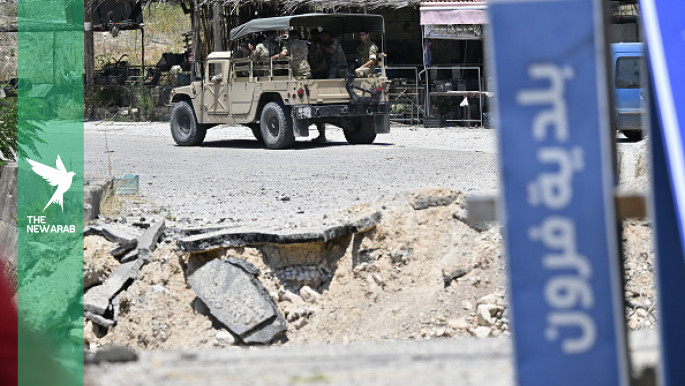
Lebanese army units deploy in Froun as part of the first pilot zone under the US-backed south Lebanon framework. [Getty]
The United States has announced the launch of the first “pilot zones” in southern Lebanon under the trilateral framework agreement signed by Lebanon, Israel and the US in Washington on 26 June, marking the first phase of a plan to gradually transfer security responsibility to the Lebanese Armed Forces (LAF).
The announcement coincided with Lebanese President Joseph Aoun’s visit to Washington, where he is expected to meet US President Donald Trump on Tuesday.
According to the US State Department, pilot zone operations began on Monday in the southern villages of Froun, Srifa and Zawtar al-Gharbiya (also West Zawtar), under the supervision of the Lebanon Military Coordination Group established as part of the agreement.
None of the three villages were under Israeli occupation, although they have all suffered extensive destruction during Israel’s attacks on Lebanon and remain affected by ongoing military activity in nearby areas.
The rollout was immediately overshadowed by renewed violence after Israeli troops opened fire near the Lebanese army units on Monday evening as they were deploying in one of the designated pilot zones in southern Lebanon. No casualties were reported, but the incident highlighted the challenges facing the deal’s implementation.
The incident came as Lebanese officials continued to argue that Israel’s military presence and operations in parts of southern Lebanon remain the main obstacle to the army’s full deployment under the framework agreement.
Froun
Froun, in Bint Jbeil district, lies on a hill overlooking the Marjayoun, Tyre and Nabatieh districts and is home to around 2,200 residents, most of whom rely on agriculture and livestock farming.
The village suffered extensive destruction during Israel’s war on Lebanon, with local officials estimating around 80% of its infrastructure and buildings were damaged.
Only around 15% of residents have returned since the ceasefire took effect due to the scale of the destruction and ongoing security concerns.
Lebanese army checkpoints and regular patrols are present in the village alongside UNIFIL peacekeepers.
Speaking to The New Arab, Froun mayor Hassan Bazzi said the village lies outside the Israeli-declared “yellow zone” and is not occupied by Israeli forces.
“The Lebanese army is present in the village, while Israeli forces are around five kilometres away,” he said.
Bazzi noted that Froun had long been at the centre of previous Israeli military campaigns in southern Lebanon, including during Israel’s occupation and successive wars, although Israeli troops did not enter the village during the latest conflict.
Srifa
Located north of Tyre on the border between South and Nabatieh governorates, Srifa has a population of around 12,000.
The village also sustained widespread destruction during the war, with municipal officials documenting both partial and total damage to homes and infrastructure.
Since the ceasefire, residents have gradually begun returning as the municipality clears rubble and restores basic services, including electricity, water and telecommunications.
Mukhtar Khodr Najdi told The New Arab that Israeli troops were not present inside the village and that the Lebanese army maintains a permanent position while conducting daily patrols.
He said approximately 320 housing units had been completely destroyed by Israeli attacks, while most remaining homes suffered varying levels of damage.
Najdi described the pilot zone initiative as little more than “window dressing”, expressing scepticism about its practical impact.
West Zawtar
Unlike Froun and Srifa, Zawtar al-Gharbiya remains largely inaccessible despite the absence of a permanent Israeli military presence inside the village.
Residents have been unable to return because Israeli forces continue operating in nearby Zawtar al-Sharqiyah (also East Zawtar), carrying out raids, demolitions, road excavation and house burnings, according to local officials.
Mayor Abdel Ezzeddine questioned how the Lebanese army could assume responsibility for Zawtar al-Gharbiya while Israeli forces remain in East Zawtar, through which the main access road passes.
“How can civilians safely return when the only road to the village runs through an occupied area?” he told The New Arab. “What kind of pilot zone is this? Frankly, this is an insult to our intelligence.”
What the pilot zones are meant to achieve
The pilot zones form part of the security annex of the trilateral framework agreement reached between Lebanon, Israel and the United States in June.
Under the agreement, the Lebanese army is to gradually assume full and effective security control in designated areas free of any non-state armed groups, while Israeli forces carry out a phased and verified redeployment.
Once the areas are verified as free of armed groups and their infrastructure, the Lebanese army will take full responsibility for security, reconstruction efforts can begin with international backing, and displaced civilians will be allowed to return under the authority of the Lebanese state.
The agreement initially envisioned two pilot zones, with additional areas to be added later by mutual agreement between Lebanon and Israel. Monday’s announcement named Froun, Srifa and Zawtar al-Gharbiya as the first areas where implementation has begun.