The Federal Government has officially flagged off the construction of the first phase of the Akwanga–Kaduna–Jos–Bauchi–Gombe–Biu–Maiduguri Superhighway, with President Bola Tinubu describing the project as a key component of his administration’s legacy infrastructure programme.
The initial phase of the project spans 125 kilometres, stretching through Akwanga, Kaduna and Jos. It forms part of the larger 700-kilometre Akwanga–Maiduguri Superhighway, which is expected to connect several states across Nigeria’s North-East and improve regional transportation.
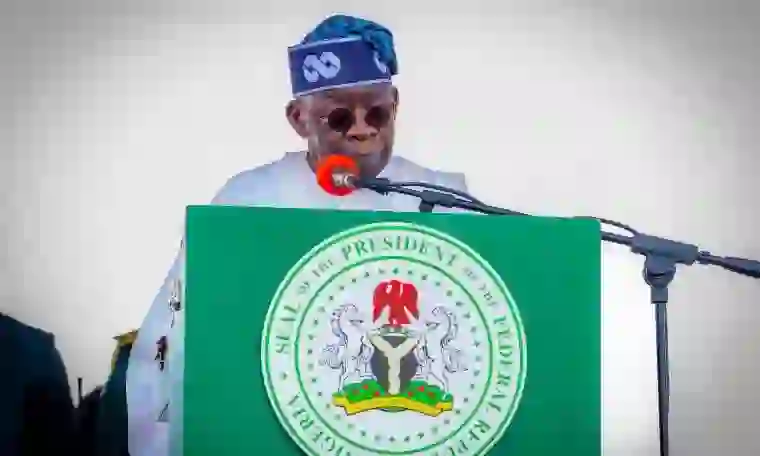
Speaking during the groundbreaking ceremony in Akwanga, Nasarawa State, on Saturday, President Tinubu said the highway would enhance connectivity, stimulate economic activities, improve security operations and unlock development opportunities for communities along the route.
The President, represented by the National Chairman of the All Progressives Congress (APC), Professor Nentawe Yilwatda, said the project is one of four legacy road initiatives designed by his administration to strengthen transportation links across the country.
According to Tinubu, the highway is more than just a road project, describing it as a strategic economic and security corridor connecting key commercial centres, agricultural hubs, state capitals and communities.
He said the route linking Akwanga, Jos, Bauchi, Gombe, Biu and Maiduguri would serve as a critical gateway into one of Nigeria’s most economically significant regions.
Tinubu stated that the Federal Government had approved the complete reconstruction of the corridor using modern engineering standards to ensure long-term durability.
One of the project’s major innovations, he explained, is the use of Continuously Reinforced Concrete Pavement (CRCP) technology instead of conventional asphalt. The road will feature a 12-metre-wide carriageway reinforced with 20mm and 16mm high-tensile steel in line with approved engineering specifications.
He added that the project would also include extensive drainage systems, bridges and other hydraulic structures to improve its resilience and lifespan.
The President further disclosed that mobilisation had already begun for the Gombe section of the highway, which will extend towards Maiduguri.
Minister of Works, Senator David Umahi, revealed that the project would be financed through a funding arrangement comprising 70 per cent foreign financing and 30 per cent counterpart funding from the Federal Government.
Although Umahi did not disclose the total cost of the entire superhighway, he announced that the Federal Executive Council had approved ₦111 billion as mobilisation funds for the contractor to commence work.
He confirmed that the China Geo-Engineering Corporation would execute the project.
Umahi also announced that Nigeria would gradually phase out the use of asphalt for major federal highways, arguing that many asphalt roads have deteriorated prematurely. He maintained that concrete pavement technology would provide more durable and cost-effective road infrastructure.
Nasarawa State Governor Abdullahi Sule commended President Tinubu for approving the highway project, describing it as a transformative investment that would significantly benefit Nasarawa State and the wider northern region.
Sule also praised the administration’s economic reforms, saying they had substantially increased monthly allocations to states through the Federation Account Allocation Committee (FAAC), enabling state governments to finance critical infrastructure projects without resorting to heavy borrowing.
According to the governor, Nasarawa State previously received about ₦3.5 billion monthly from FAAC but now receives more than ₦13 billion, a development he said has strengthened the state’s capacity to execute capital projects.
He expressed confidence that the completion of the superhighway would improve the movement of people and goods, boost agricultural productivity, expand commercial activities and promote greater economic integration across the states along the corridor.
READ ALSO: