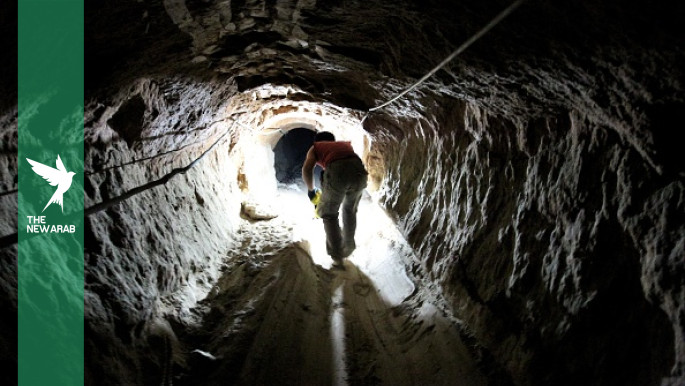
A Palestinian man works at a tunnel used for smuggling goods into the Gaza Strip, which links Egypt to the southern Gaza town of Rafah, in March 2011 [Getty]
The US House of Representatives has approved a provision that would direct Defence Secretary Pete Hegseth to prepare a report identifying and mapping alleged tunnel networks along the Egypt-Gaza border.
On Wednesday, the House of Representatives passed the National Defence Authorisation Act (NDAA) for Fiscal Year 2027 by a vote of 216 to 212. The bill authorises a record $1.15 trillion defence budget but must still be approved by the Senate and signed into law by President Donald Trump before it can take legal effect.
As part of the NDAA, Hegseth was tasked with coordinating with Tel Aviv and Cairo to prepare a report on steps to secure Egypt’s border with the besieged Gaza Strip, including what the House described as “strengthening international security measures along the Egypt-Gaza border.”
The provision, approved by the House at the request of Democratic Representative Josh Gottheimer – a recipient of funds from pro-Israel lobbying group AIPAC – states that its purpose is to “ensure that Hamas or other parties do not use tunnels or maritime routes in the Mediterranean to smuggle weapons and illicit goods.”
Hegseth would be required to submit the report’s findings and recommendations to the armed services and foreign affairs committees in both the House and the Senate.
In August 2024, Egypt denied Israeli claims that there are active tunnels running under its border with Gaza, enabling the smuggling of weapons – destined for Hamas or other groups – or people.
The Israeli army had said at the time that they located several tunnels on the Gaza side of the border, but Egypt reasserted that all tunnels have been blocked on the Egyptian side years prior.
Israel currently controls the Palestinian side of the Gaza-Egypt border after storming the Rafah area in May 2024. Israeli forces currently occupy more than 60 percent of the coastal enclave.
Despite a ceasefire since October last year, Israeli attacks have continued to kill Palestinians in the territory.
Hamas recently handed over authority to an interim government in Gaza, stepping down from power for the first time since 2007, as part of the ceasefire. The group, however, has refused to relinquish its weapons as long as the Israeli occupation continues.
Meanwhile, the House rejected a proposal by Republican Representative Thomas Massie to remove another provision — Section 219 — which calls for the Pentagon to expand and accelerate US-Israeli military-industrial cooperation in several areas, including missile defence, artificial intelligence, cyber capabilities, drones, electronic warfare, network integration and data sharing.
The provision would deepen US-Israeli military cooperation in sensitive sectors, giving Israel unprecedented access to advanced US military technologies and closer integration with the US defence establishment.
The US has given Israel unwavering support throughout its genocidal campaign in Gaza, where more than 73,000 Palestinians were killed, most of them civilians.