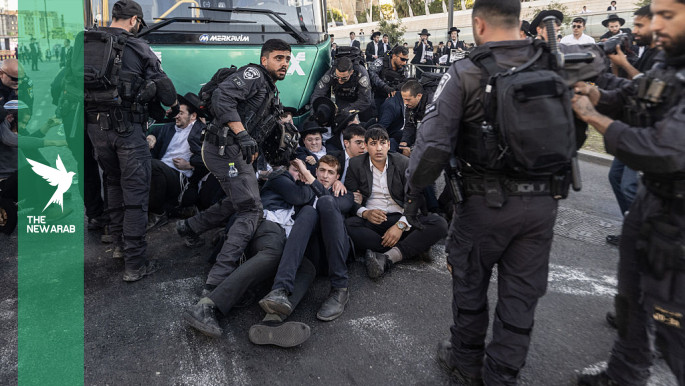
Leaders of the insular ultra-Orthodox community have long opposed the conscription of its members. [Getty]
Israel’s Supreme Court suspended on Wednesday a contentious law passed just the previous day that would have blocked the arrest of Jewish ultra-Orthodox men who refuse military service.
The court said it was issuing a “temporary order suspending” enforcement of the law after opposition leaders Yair Lapid and Avigdor Liberman, along with others, petitioned against the legislation.
The Israeli parliament approved the legislation on Tuesday, drawing sharp criticism from the opposition as the army struggles with a shortage of personnel due to Israel’s broadening wars on Gaza, Lebanon, Syria, Iran and elsewhere since 2023.
The court said it was suspending the law as it applies “to only certain segments of the population”, and added that “the hearing on the petitions will be held as soon as possible”.
Leaders of the insular ultra-Orthodox community have long opposed the conscription of its members, arguing that army service would pull young men away from religious study and erode their way of life.
Under an arrangement dating back to 1948, ultra-Orthodox men engaged in full-time religious study have been exempt from military service.
But calls to draft them have intensified in recent years as Israel has become embroiled in multiple wars.
The Supreme Court has also repeatedly challenged the exemption, culminating in a 2024 ruling that the government must conscript ultra-Orthodox men.
The new law would have frozen arrests of draft-age seminary students until 30 November—well after the date of the 27 October general election, in which ultra-Orthodox parties are expected to back Prime Minister Benjamin Netanyahu’s far-right coalition.
This week, the parliament also passed a bill declaring the study of Jewish religious texts a “fundamental value” of the state, a move widely seen as strengthening the ultra-Orthodox community’s case for draft exemption.