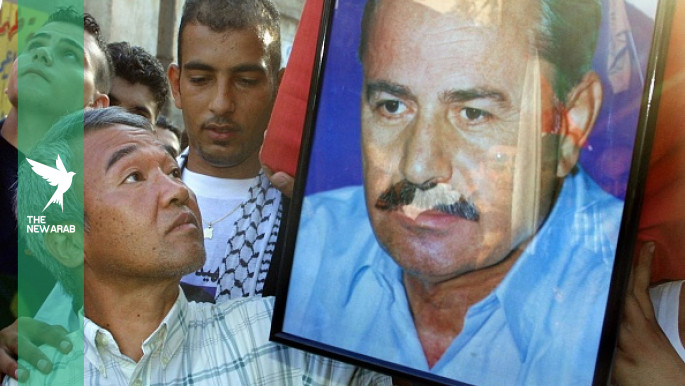
Kozo Okamoto (left) is the only surviving member of the Japanese Red Army unit that carried out the Lod attack [Getty]
Japanese Red Army militant Kozo Okamoto, the sole surviving perpetrator of the 1972 Lod Airport attack in Israel that killed 26 people, has died in Lebanon at the age of 78, according to the Popular Front for the Liberation of Palestine (PFLP).
The Palestinian group said Okamoto died on 23 July in the southern suburbs of Beirut, where he had lived for decades after being granted political asylum by Lebanon.
Okamoto was one of three members of the far-left Japanese Red Army (JRA) who carried out the attack on 30 May 1972 on behalf of the PFLP, marking one of the deadliest attacks in Israel’s history.
The three men arrived at Lod Airport, now Ben Gurion Airport, on a flight from Paris before retrieving firearms and grenades from their luggage and opening fire in the arrivals hall.
The assault killed 26 people, including Israeli civilians and foreign visitors, among them a large group of Christian pilgrims from Puerto Rico, and wounded dozens more.
Okamoto’s two accomplices were killed during the attack, while he was wounded and arrested by Israeli authorities.
He later pleaded guilty before an Israeli military court and was sentenced to three life terms. His lawyer argued that he was mentally incompetent at the time of the attack, a claim rejected by the court.
Okamoto remained imprisoned until 1985, when Israel released him as part of the Jibril Agreement, a prisoner exchange with the Popular Front for the Liberation of Palestine-General Command that secured the release of three captured Israeli soldiers.
He subsequently travelled through Libya and Syria before settling in Lebanon.
In 1997, Lebanese authorities arrested Okamoto on charges related to illegal residence after he and other Japanese Red Army members were found living in the country using forged documents. While four other members were deported to Japan, Lebanon granted Okamoto political asylum in 2000, rejecting Tokyo’s request for his extradition.
“I am a fighter for the Arab resistance. I did it for the Palestinians,” Okamoto said at the time.
Born in 1947, Okamoto joined the Japanese Red Army, a revolutionary Marxist-Leninist militant organisation that forged close ties with the PFLP in Lebanon during the early 1970s.
The alliance saw Japanese militants participate in operations alongside Palestinian factions, including the Lod Airport attack, while the JRA later carried out a series of hijackings and attacks on diplomatic missions in Europe, the Middle East and Asia.
Although the Japanese Red Army formally dissolved in 2001 following the arrest of its founder Fusako Shigenobu, Okamoto remained in Lebanon, where he was regarded by the PFLP and some supporters of the Palestinian cause as an international revolutionary who had fought alongside Palestinians.
He made occasional public appearances, including at a Beirut ceremony in 2022 marking the 50th anniversary of the Lod Airport attack, where he wore a Palestinian flag and the emblem of the PFLP.
His death was announced by the PFLP, which paid tribute to him as a comrade in the Palestinian struggle.