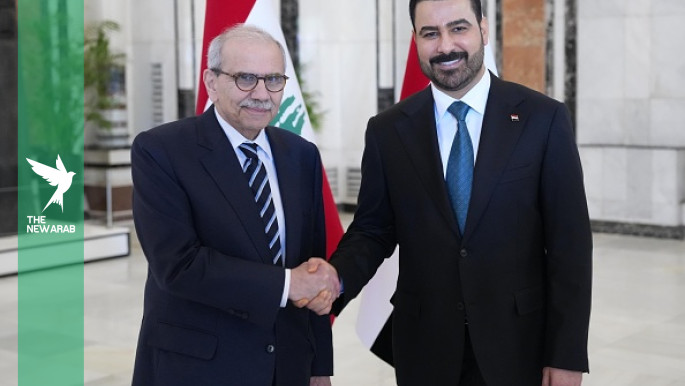
Salam met with his Iraqi counterpart Ali al-Zaidi to discuss energy and security issues [Getty]
Lebanese Prime Minister Nawaf Salam arrived in Baghdad on Sunday for talks with Iraqi leaders focused on energy cooperation, security coordination and regional developments, as Beirut seeks to secure continued Iraqi fuel supplies amid its ongoing electricity crisis.
Salam was accompanied by a ministerial delegation on the official visit, which Iraqi officials say is intended to expand bilateral cooperation across the energy, economic and investment sectors, while also addressing regional political and security developments.
The visit comes at a critical time for Lebanon, which continues to face a severe economic crisis alongside chronic electricity shortages.
Iraq has become one of Lebanon’s most important energy partners in recent years, supplying fuel under agreements that have helped keep Lebanese power stations operating.
According to an Iraqi government source who spoke to The New Arab, discussions are expected to focus on extending oil cooperation, strengthening trade and investment ties, and expanding collaboration in transport, banking and reconstruction.
The talks also carry wider political significance as both Iraq and Lebanon navigate a volatile regional environment marked by renewed efforts to strengthen state institutions and reinforce the authority of official security forces.
Iraqi government economic adviser Mazhar Mohammed Salih said Salam’s visit represented an opportunity to deepen the economic relationship between the two countries beyond existing political ties.
“Salam’s visit carries more than just a political meeting; it is an attempt to reshape an economic relationship,” Salih told journalists in Baghdad on Sunday.
He said extending and developing Iraq’s agreement to supply fuel to Lebanon would be central to the discussions.
“At the heart of this visit is the energy file, where both sides seek to extend and develop the agreement to supply Lebanon with Iraqi fuel, which has helped keep Lebanon’s electricity sector alive over recent years,” he said.
Salih described any renewed agreement as “a strategic lifeline” linking Baghdad and Beirut through shared economic interests extending beyond fuel supplies.
He added that the visit could also create opportunities to facilitate trade, encourage investment in industry, agriculture and services, and advance proposals to use Lebanon as an additional Iraqi outlet to the Mediterranean.
“If realised, this idea would give Lebanon an important logistical role and open a new commercial outlet for Iraq to the world,” he said.
Salih said Iraq viewed the visit as a chance to strengthen its economic presence in the Levant and diversify its regional partnerships, while Lebanon could benefit from stable energy supplies and increased Iraqi investment to support its economic recovery.
“The true value of this visit will be translated into agreements that can be implemented and practical projects on the ground. Political understandings remain limited in impact unless they become tangible economic steps that make a difference in the lives of the two brotherly peoples,” he said.
Mukhtar Al-Moussawi, a member of the Iraqi parliament’s Foreign Relations Committee, said the visit came at an important moment for both countries.
“The visit of Lebanese Prime Minister Nawaf Salam to Baghdad represents an important milestone in Iraqi-Lebanese relations, particularly as it comes amid complex regional circumstances that require strengthening political coordination between Arab states and unifying positions on common challenges,” he told The New Arab.
Al-Moussawi said Iraq and Lebanon faced similar political, security and economic challenges, making the visit particularly significant as regional tensions continue.
He said the discussions would cover political cooperation, security coordination, regional stability and expanding economic, trade and investment partnerships, with Iraq’s continued fuel supplies to Lebanon expected to top the agenda.
The two sides are also expected to discuss the impact of regional military tensions on Arab security, as well as ways to prevent further escalation and support political and diplomatic solutions to crises across the Middle East.