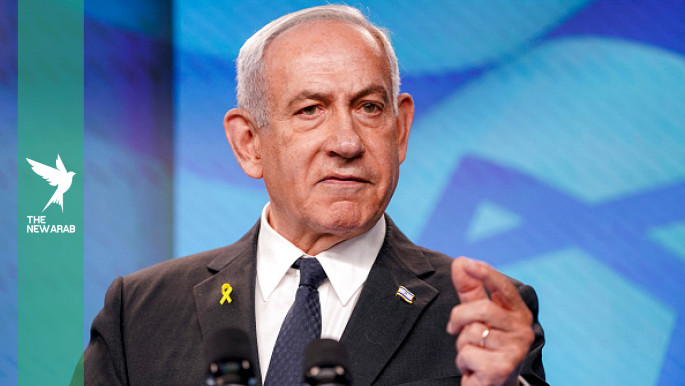
Benjamin Netanyahu has appeared to block a Knesset vote on the recognition of the Armenian genocide, despite it being advanced last month [Getty]
Israeli Prime Minister Benjamin Netanyahu has backtracked on recognising the Armenian genocide, blocking the vote from the Knesset after pressure from Azerbaijan, with experts telling The New Arab the move highlights Baku’s growing leverage over Israel despite their close strategic partnership.
Israeli sources said Netanyahu’s decision to block the vote from the Knesset was due to pressure from Azerbaijan, Haaretz reported.
The decision from the government comes after Hikmat Hajiyev, an advisor to Azerbaijani President Ilham Aliyev, contacted Netanyahu’s office.
The Israeli government then informed officials in Azerbaijan that the issue had been swiftly removed from the Knesset’s agenda and would not be voted on.
Speaking to The New Arab, Baku-based journalist and independent analyst Rovshan Mammadli said Israel’s reversal reflected Azerbaijan’s strategic importance, despite the diplomatic tensions caused by the proposal.
Last month, a proposal on recognising the Armenian genocide was submitted by Israeli Foreign Minister Gideon Sa’ar, and while it still needed ratification by the Knesset, officials in Tel Aviv praised it.
However, at the time, commentators and analysts told The New Arab that the move from Israel was “opportunistic” and ironic, as it was seen as a rebuke to Turkey and came while Tel Aviv continues to bomb Gaza indiscriminately.
The Azerbaijani government last month issued a formal condemnation of Israel’s decision to recognise the Armenian genocide, demanding it be reconsidered.
The foreign ministry said the recognition represented “the distortion of the historical facts surrounding the events of 1915″ and reduced “a complex historical issue to a political decision without a sound legal or scholarly basis.”
Mammadli said recognising the Armenian genocide would have put Azerbaijan in an increasingly difficult position because of its close alliance with Turkey, which strongly rejects the characterisation of the 1915 killings as genocide.
“Remaining silent after Israel’s recognition of the Armenian genocide would have further strained ties with Turkey and reinforced perceptions in Ankara that Baku prioritises its strategic partnership with Israel over Turkish sensitivities,” he told The New Arab.
He added that Israel’s subsequent decision to halt the measure reflected “a straightforward cost-benefit calculation”, arguing that the strategic importance of Azerbaijan as a security and energy partner outweighed the symbolic diplomatic value of recognising the genocide.
Last week, Azerbaijan’s President Aliyev also hosted Palestinian Prime Minister Mohammed Mustafa at his palace in Baku, a move Israel sees as a snub.
After the meeting, a statement from Azerbaijan’s presidency said that it supports the establishment of a Palestinian state with occupied East Jerusalem as the capital, referring to it as the Arabic name of “Al-Quds al-Sharif” or “The Noble Jerusalem”. The statement further detailed that Azerbaijan continues to assist Palestinians through the UN agency UNRWA and plans to build a school in the occupied West Bank.
While Israel views Baku as an important partner, particularly as it relies on Azerbaijan for oil, some commentators believe this marks a cooling of relations between the two.
Mammadli cautioned that the episode was unlikely to fundamentally alter Azerbaijani-Israeli relations but said it exposed the increasingly difficult balancing act facing Baku as relations between Israel and Turkey continue to deteriorate.
“Eventually, Baku may be forced to align more openly with either Turkey or Israel – an outcome it has consistently sought to avoid,” he said
Azerbaijan takes the same position as Turkey regarding the Armenian genocide.
Turkey states that Armenians and Turks died as a result of World War One, denying accusations and putting the death toll at hundreds of thousands, rather than the often cited 1.5 million. It also continues to reject calls to formally recognise it as a genocide.
Editor’s note: This article has been updated to include additional expert analysis from Baku-based journalist and independent analyst Rovshan Mammadli.