Damascus, Syria – Over six months on from the 30 January agreement formalising the integration of the Syrian government and the Kurdish-majority Syrian Democratic Forces (SDF), the painstaking process of merging Syria’s two largest armed camps and administrative systems is moving forward at an uneven pace.
In January, a wave of fighting spread from Aleppo into the SDF’s former heartlands in northeast Syria, which, following a large-scale defection by Arab tribes within its territory, brought the SDF to the brink of capitulation.
Facing a likely defeat, the SDF accepted the government’s offer to integrate both its armed forces and its governmental institutions into those of Damascus.
While meaningful progress has been made in security cooperation and public services, deeper disputes over political representation, governance and the nature of the Syrian state remain unresolved.
A security-first approach
The work to integrate the SDF into Syria’s Ministry of Defence is one of the areas that have seen the most progress over the last six months.
The agreement outlines that the SDF will be given four separate brigades covering northeast Syria. The SDF has confirmed that a large number of fighters have already been integrated into the Syrian security services.
Around 5,000 fighters have reportedly been integrated into the Ministry of Defence, whilst another 4,000 members of the SDF’s internal security have also joined the Ministry of Interior’s Internal Security Forces.
In recent months, most of them have been passing through retraining centres in Damascus governorate. Equally, high-ranking SDF leadership have been given senior positions within the Ministry of Defence, with Sipan Hamo, the former leader of the SDF’s military, being made Deputy Minister of Defence.
They too will be required to enlist in retraining in order to qualify for formal ranks within the military.
Inside the formerly autonomous area of northeast Syria, the government has deployed internal security forces into the region.
“Movement between formerly government-controlled territory and SDF territory has become quite smooth,” Alex McKeever, a researcher and author of the This Week in Northern Syria blog, tells The New Arab.
“There are joint checkpoints manned by both Internal Security forces and Asayish (the SDF’s internal security), which have operated without issue so far.”
However, inside the region itself, the presence of Damascus’ security forces is far more limited. “In Qamishli, they are stationed within their bases and don’t come out, so people don’t see the presence of the central government,” he adds.
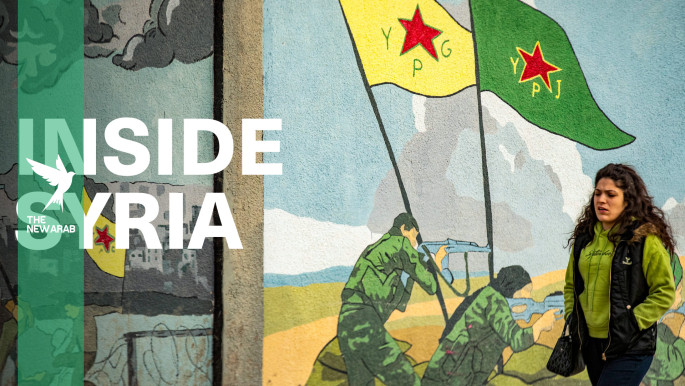
One of the largest obstacles moving forward is the outstanding issue of the YPJ – the all-female wing of the SDF’s military. So far, the government has refused to integrate them into the military, instead offering them a role within the Ministry of Interior in roles suitable for women.
“Many of these women have years of combat experience against ISIS, with some belonging to coalition-trained counter-terror units,” McKeever explains to The New Arab. “They consider being relegated to an administrative office or the tourist police to be an insult.”
There is essentially an ideological gap between the two sides on this issue that they’re struggling to span.
“Damascus simply doesn’t believe women belong in the military, whereas this matter is both ideologically important for the SDF, which employs women in all positions across military and civilian structures and comes as it seeks to secure government positions for as many members as it can.”
Integrating the two governments
Alongside the SDF’s military, the January agreement also established the integration of its state institutions, under the Autonomous Administration of North and East Syria (AANES), into the central government.
Progress on the integration of civilian governance structures has been slower. “The AANES has largely not been integrated at this point,” explains McKeever.
In certain areas there has been progress. A report by ETANA, a research organisation focused on Syria, found that “the most progress on integration so far has been in the governorates health sector, possibly because of its importance, service-based character, and apolitical nature in comparison to other files”.
Damascus has appointed a director of health to oversee the region’s healthcare and 12 administrators to manage the integration of the various departments under the AANES’ healthcare body.
However, the integration of the rest of the AANES is largely deadlocked over a fight to integrate the justice system.
“Essentially it’s a fight over how many AANES judges will be appointed, as well as who those from the government side are to be,” says McKeever. “The SDF side is pushing for as many employees of the AANES judicial system to end up on government payrolls, despite some lacking recognised credentials.”
“This impasse has largely frozen the broader administrative integration process.”
Growing frustration on the ground
For those living in the northeast, there is a widespread sense amongst people that they’re not included within the integration process, a sense of dissatisfaction compounded by mutual distrust between communities in the region.
“Many Kurds are not happy in general with the agreement, but there are not many other options,” Wladimir Van Wilgenburg, a journalist and analyst specialising in Kurdish affairs, tells The New Arab.
Fortunately, “[there] hasn’t been much violence so far, although there have been tensions between the Arab tribes and Kurds in Kobani and Qamishli, but these tensions are also seen in other parts of Syria [between communities]”.
Much of this frustration is being fixated on particular social issues. Although a presidential decree in January officially recognised Kurdish as a ‘national language,’ the signage on many new government buildings in the region has just included Arabic, spurring protests from the Kurdish community.
The frustrations are also increasingly inflamed by the region’s worsening economic situation. “The economic woes are directly linked to the process of integration, and the government’s neo-liberal approach to economic reform,” explains McKeever.
The government has taken over the Semalka border crossing, which linked northeast Syria to Iraqi Kurdistan, imposing customs duties on Iraqi imports. Equally, in line with their national policy, they have cut generous SDF subsidies on fuel.
“These reforms have both driven up prices and negatively affected the supply of goods such as fuel, which alongside low levels of employment have caused increased hardship,” says McKeever.
However, there have been some important steps taken to rectify old communal wounds in the northeast. In 1962, a census stripped 120,000 Syrian Kurds of their citizenship, leaving them stateless.
In January, Al-Sharaa issued a presidential decree providing full citizenship to all Syrian Kurds. The Ministry of Interior announced in May that more than 10,000 applications for citizenship have already been received.
Integration without representation
Despite the process of integration, Kurdish politics in Syria have witnessed a peculiar bifurcation.
Although SDF cadres are increasingly working within Syria’s security and governance system, the SDF is not represented in parliament and SDF leader, Mazloum Abdi, reportedly rejected an offer by Damascus to be made Deputy Defence Minister, insisting instead on working “to form a political reference” for Syria’s Kurds.
According to McKeever, “Abdi has made a political decision based on his intentions to shape Kurdish politics going forward and possibly form some new Kurdish political movement”.
What form such a movement would take remains unclear, especially considering the SDF’s boycott of parliamentary elections in the northeast.
“They decided that even if they were in parliament, with only a few MPs, they would have no influence on decision-making,” says van Wilgenburg.
They saw the elections “more as a selection that didn’t reflect a general popular vote, and so they decided to boycott it.” Instead, a coalition of anti-SDF Kurdish parties ran and were selected in the vote.
Among Al-Sharaa’s parliamentary appointees, which constitute a third of the chamber, the only Kurdish members selected were from anti-SDF backgrounds. The result of this is that whilst members of the SDF are being integrated into the Syrian state, even at a relatively senior level, they are entirely absent within the formal political arena.
Currently, it is difficult to assess the impact of this bifurcation because the role of the parliament itself is unclear, but certainly the SDF’s absence within the chamber will neutralise the possibility of an alternate power bloc coalescing around them within parliament.
In many ways, the agreement is evolving into two parallel processes. One is a technical exercise in which the shared interest of security, service-provision, and the prevention of renewed conflict has allowed progress to be made.
The other is the integration of different political visions, centred around questions of who can exercise power and in what form. For now, both sides appear content to postpone those disputes in favour of preserving a fragile partnership.
Cian Ward is a journalist based in Damascus, covering conflict, migration, and humanitarian issues
Follow him on X: @CP__Ward
Edited by Charlie Hoyle