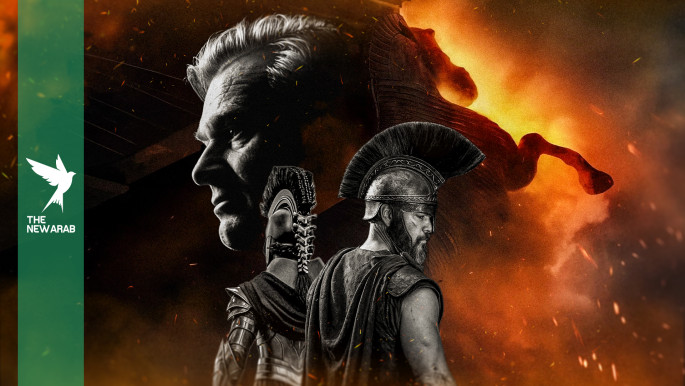
For almost three millennia, Homer’s Odyssey has been retold, reimagined and reinvented.
Christopher Nolan’s magnificent adaptation understands that the greatest way to honour the poem is not to preserve it in amber, but to continue that tradition.
The result is not simply the finest cinematic interpretation of Homer’s epic yet made, but one of the most intellectually ambitious blockbusters of recent years: a profoundly human story about war, trauma and the blood and guts that lie behind heroic myths.
Nolan’s willingness to reinterpret Homer is entirely in keeping with the poem’s own history.
As Oxford classicist Christopher Metcalf told The New Arab, “the art of the early Greek poets was precisely to take up and develop traditional material.”
The Odyssey itself was the product of inherited stories, conventions and myths that Homer reshaped into something unmistakably his own.
Nolan’s film belongs to that same tradition of creative reinvention rather than antiquarian reconstruction.
That creative reinvention remains faithful to Homer. Whether it is equally faithful to the wider Mediterranean world that shaped the poem is a more complicated question.
Like Homer, Nolan first establishes the crisis in Ithaca before introducing Odysseus himself on Calypso’s island. It is a remarkably faithful adaptation of the poem’s broad architecture, even as it condenses Homer’s lengthy opening books into something more cinematically economical.
Yet the opening act occasionally mistakes solemnity for momentum.
When Odysseus finally appears, however, it becomes clear Nolan is not interested in merely illustrating Homer.
Matt Damon gives one of the finest performances of his career as the king of Ithaca, introduced where Homer first presents him, marooned on Calypso’s island after years of wandering.
But the emphasis has shifted. Homer’s Odysseus longs for home; Nolan’s, as we see as the narrative plays out, is haunted by the man he was before Troy.
Charlize Theron’s Calypso is less a captor than the custodian of a psychologically broken warrior, immediately recasting The Odyssey as a story not only of homecoming but of recovery.
When the bard Demodocus sings of Troy, Homer has Odysseus break down in tears, comparing his grief to that of a woman watching her husband die before she is dragged away into slavery.
The ancient poet never abandons the heroic code, yet repeatedly complicates it with loss, hubris and the human cost of war. Nolan’s achievement is to make those tensions the emotional architecture of his film.
Only with the arrival at the Cyclops’ cave does The Odyssey truly announce itself.
If the film has a defining artistic achievement, it is Nolan’s refusal to treat mythology as fantasy. His monsters are not whimsical creations or weightless digital spectacles, but physical presences inhabiting a world governed by the same brutal laws as the humans who fear them.
The miraculous feels strangely plausible, as though these stories have emerged not from fairy tales but from the fearful imagination of sailors navigating an unknowable sea.
Nowhere is this more apparent than in the Cyclops. Brought to life through an extraordinary synthesis of Bill Irwin’s performance, animatronics, puppetry and visual effects, Polyphemus possesses a terrifying physicality rarely found in contemporary blockbuster cinema.
There are echoes of Ray Harryhausen’s great mythological creations, but Nolan never allows nostalgia to overwhelm the drama. The cave is oppressive rather than spectacular, and Odysseus survives not through martial prowess but through intelligence, improvisation and sheer desperation.
The same philosophy shapes Samantha Morton’s unforgettable Circe.
Rather than presenting her enchantments as whimsical fantasy, Nolan plunges into body horror as Odysseus’ men are grotesquely transformed into swine.
The sequence owes more to John Carpenter’s The Thing than to the comforting fantasy usually associated with Greek mythology, with fleeting flashes of Brian Yuzna’s Society in its grotesque distortions of flesh.
Myth becomes nightmare, and the supernatural horrifyingly corporeal.
Hoyte van Hoytema’s sweeping cinematography, Ludwig Goransson’s thunderous score and Jennifer Lame’s precise editing never exist merely to dazzle. They ground even the film’s most extraordinary moments in a world that feels tangible, ancient and profoundly human.
Yet for all its astonishing technical achievement, The Odyssey ultimately lives or dies on the humanity of its central characters.
Its emotional climax arrives not amid clashing swords or divine intervention, but in quiet conversation.
Disguised as an old beggar, Odysseus recounts the horrors of Troy to Penelope, played by Anne Hathaway, who believes she is listening to the testimony of a soldier who fought alongside her absent husband. What follows is one of the finest sequences Christopher Nolan has ever directed.
Stripped of spectacle, the film becomes a meditation on guilt, memory and the moral cost of war.
As Odysseus recounts the sack of Troy, the ancient myth begins to dissolve. The legendary victory gives way to scenes of indiscriminate slaughter, where neither man nor child is spared, until what remains is not triumph but grief and horror — Nolan’s boldest reinterpretation also comes fully into focus here.
The goddess Athena, played by the ubiquitous Zendaya, who has accompanied Odysseus throughout the film, is revealed as the young Trojan girl he saw beheaded during the sack of the city.
The goddess of wisdom becomes inseparable from conscience and Odysseus’ memory of the war’s most defenceless victims: not merely a divine patron, but the form taken by a trauma he cannot escape.
As the memories of Troy unfold, one cannot help but think of the images of shattered cities and civilian suffering that have come to define our own age. Nolan never invites a simplistic historical parallel, nor should Troy be mechanically equated with any contemporary conflict.
Yet, watching the destruction of a great city in 2026, it is difficult not to feel the shadow of Gaza. The association arises less from allegory than from recognition: the gulf between the language of military triumph and the reality endured by civilians beneath it.
If there is one reservation, it lies in the film’s final movement.
Having subjected Odysseus to such a searching moral reckoning, Nolan ultimately grants him a profoundly moving and unmistakably triumphant farewell.
Telemachus (Tom Holland) assumes the throne while Odysseus and Penelope sail west together into exile to honour the dead.
The ending is beautiful, but it raises an uncomfortable question. Does the film’s compassion for Odysseus ultimately outrun its moral scepticism? After confronting us with the suffering he caused, Nolan nevertheless allows him love, dignity and something close to peace.
That question extends beyond Odysseus himself. It also invites a broader consideration of whether Nolan has captured the world that produced Homer.
The Odyssey is often described as one of the foundational works of Western literature. Yet modern scholarship increasingly complicates that familiar description.
Rather than emerging from an isolated Greek civilisation, Homer’s epics grew out of an eastern Mediterranean shaped by centuries of contact between Greece, Egypt, Anatolia, Mesopotamia and the Levant, where ideas, myths and technologies travelled alongside merchants and sailors.
Speaking to The New Arab, classicist Eric Cline describes the Late Bronze Age as a “small world network”, an interconnected international system bound together by diplomacy, trade and cultural exchange.
Classical archaeologist Sarah Morris has likewise argued that Homer belongs within a broader eastern Mediterranean literary tradition rather than an exclusively Greek canon.
Metcalf made a similar point, arguing that while Homer is often regarded as the beginning of Greek literature, the poems are also the culmination of much older traditions.
“Many people tend to think of Homer’s poems as ‘early’ texts,” he told The New Arab.
“But in another sense Homer’s poems can also be described as ‘late’, because they are… expressions of much earlier traditions.”
The Greek alphabet itself was adapted from Phoenician writing, while myths known to Homer, including the rise of Zeus, were shaped by older Near Eastern traditions.
The same scholarship also complicates some of the contemporary debate surrounding representation in adaptations of Homer, especially right-wing “culture war” backlash against the casting of the black actress Lupita Nyong’o as the haunted Helen of Troy and her treacherous twin sister Clytemnestra.
The Odyssey is frequently treated as though it depicts a historically fixed Greek nation whose inhabitants can be measured against modern ideas of race or ethnicity. Yet Homer was composing myth rather than documentary history, drawing on traditions that had evolved across an interconnected Mediterranean.
As Metcalf told The New Arab, the modern separation of Classics and ancient Near Eastern studies “obscures the fact that the cultures in question were neighbours, and had much in common.”
None of this resolves questions of casting, which remain matters of artistic interpretation rather than historical certainty. It does, however, suggest that applying modern concepts of identity to Homer’s world is often a more complicated exercise than either supporters or critics of such casting are willing to acknowledge.
Here, perhaps, lies the film’s one significant blind spot.
Nolan captures Homer’s emotional and moral universe with extraordinary sensitivity, but his Mediterranean remains overwhelmingly Hellenic.
Egypt, Phoenicia and the Levant linger largely beyond the IMAX-enhanced horizon, despite the increasingly persuasive scholarly case that these cultures helped shape the world from which Homer’s epics emerged. That is hardly an unforgivable omission.
Nolan set out to adapt The Odyssey, not reconstruct the cosmopolitan eastern Mediterranean of the early first millennium BC.
Even so, one cannot help wondering whether a slightly broader vision of that interconnected world might have made an already extraordinary film richer still.
Sam Hamad is a historian, writer, and editor at The New Arab