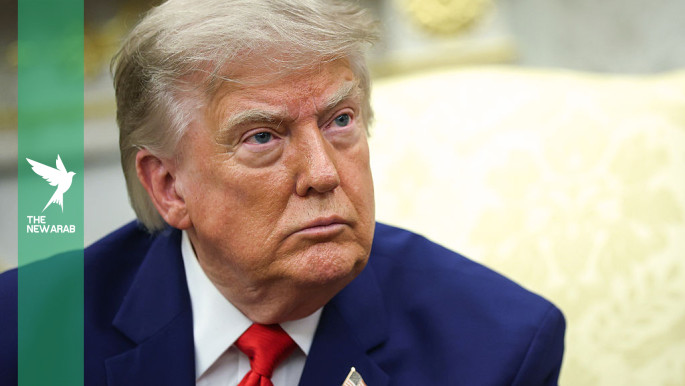
Trump pictured in the White House on 21 July 2026. [Getty]
Saturday was the second consecutive night in almost two weeks that the US did not bomb Iran.
Since resuming strikes on 13 July, the Pentagon has largely limited its attacks to Iran’s southern coastline in an effort to dislodge the Revolutionary Guard from the Strait of Hormuz.
Earlier on Friday, Trump had threatened to expand the war with a “massive attack” on the Islamic Republic. Hours later he did the opposite and ordered a pause in the fighting.
Here’s what is going on.
Oman is giving diplomacy another shot
A report in US news site Axios on Saturday said Trump had decided to hold fire while Omani officials were in Tehran to negotiate the future status of the Strait of Hormuz.
The two sides have met many times since Iran took control of the waterway in March but are yet to reach an understanding over how it will be managed after the war.
Iran has insisted it will continue to charge fees on transiting ships and has proposed a joint management system with Oman.
Oman, meanwhile, has rejected the introduction of fees and reportedly suggested setting up two corridors passing through Iranian and Omani territorial waters. Oman would respect freedom of navigation through its southern corridor while Iran would have the power to deny passage via its northern route.
Iran’s foreign ministry spokesman Esmaeil Baghaei said Sunday that progress had been made over the weekend and that “technical and political consultations between the two sides were continuing”.
The strait was at the centre of the recent resumption of the war despite the US and Iran appearing to have reached an understanding in last month’s memorandum of understanding.
The MOU had given tacit acknowledgement of Iran’s influence over the chokepoint, committing it only to waive fees for 60 days and allowing it to work with Oman to “define the future administration and maritime services” in the strait.
Despite this, the US has continued to demand that Tehran return it to its pre-war status quo and for the past two weeks has been intensively bombing Iran’s southern coast in a bit to weaken its control.
The US is worried about its stockpiles
Officials have told US news media that concerns about its air defences are causing the administration to think twice before returning to a full-scale bombing campaign
According to The New York Times, the administration believes escalation would further drain the military’s already depleted stockpile of missile interceptors and other defensive munitions in the region.
The US and its Gulf allies have used thousands of interceptors to defend against Iranian ballistic missiles and drones since the start of the war.
Following the April ceasefire, analysts raised concerns about the depletion of interceptors for the Patriot and THAAD air defence systems and estimated it would take at least three years for the military to fully replenish its stockpiles.
Since the resumption of the war two weeks ago, Iran successfully struck multiple US bases in the region and hit critical infrastructure in the Gulf.
Should Trump further ratchet up the war, Iran would likely retaliate with heavier strikes, piling more pressure on US and Gulf air defences.
Risks are rising in Red Sea
Destabilising the Red Sea has been a source of leverage that Iran has so far refrained from using.
That changed this week when their Houthi allies in Yemen stepped up their threats against Saudi Arabia and its oil trade.
In recent days, the group has announced a blockade on Saudi ports, targeted Saudi-linked ships in the Red Sea, and launched a major missile attack on Aramco oil refineries. Riyadh and its local allies have likewise conducted airstrikes on Houthi positions in northern Yemen.
Amid the possibility of renewed conflict in Yemen, any escalation in Iran is unlikely to be contained to the Gulf. A return to full-scale operations would bring with it the risk of further disruption, not just in the Strait of Hormuz, but in the Red Sea too.
Such a turn of events would only compound the global energy crunch, a scenario Trump will be eager to avoid ahead of the mid-terms in November.