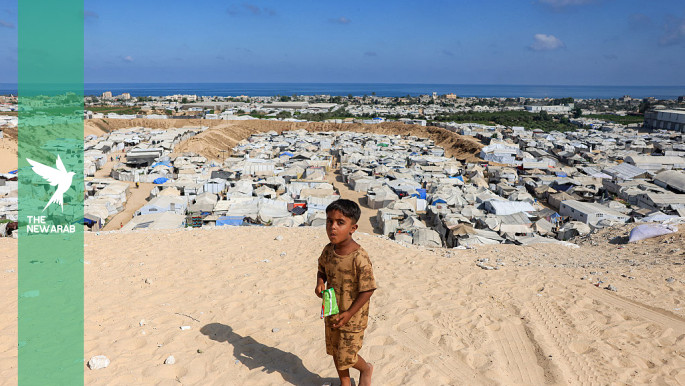
While state media has confirmed Museveni’s receptive response, the Uganda People’s Defence Forces (UPDF) have not yet finalised the size of the deployment contingent, their specific responsibilities, or a timeline for the mission. [Getty]
Uganda has given preliminary approval to deploy military personnel to a proposed international peacekeeping mission in Gaza. The decision follows a direct request from US President Donald Trump to Ugandan President Yoweri Museveni.
According to last week’s edition of the government-owned newspaper, New Vision, President Trump requested Uganda’s backing to establish an international force in Gaza aimed at ending chaos, protecting civilians, and fast-tracking humanitarian aid and reconstruction.
The report stated that President Trump tabled the request to President Museveni under his “Board of Peace” framework to assist in setting up the International Stabilisation Force (ISF) to help maintain order in the territory.
The Board of Peace is an international body established to oversee the administration and reconstruction of Gaza following an alleged “ceasefire”. Formally chartered at the January 2026 World Economic Forum in Davos, the board is chaired by Trump and has recently focused on establishing pilot humanitarian zones in Gaza. President Museveni has reportedly given a positive nod to the request.
While state media has confirmed Museveni’s receptive response, the Uganda People’s Defence Forces (UPDF) have not yet finalised the size of the deployment contingent, their specific responsibilities, or a timeline for the mission.
Colonel Chris Magezi, the acting director of information for the Ugandan armed forces, indicated that the military is waiting for formal strategic directives from the presidency before taking action.
“We are waiting to get instructions from the Commander-in-Chief, President Yoweri Museveni,” Col. Magezi said in an interview. “If the President gives strategic guidance, he will instruct the Uganda People’s Defence Forces to act accordingly, and we will act. We have a very strong record in regional peace and stabilization missions. We are in Somalia, Sudan, and the Democratic Republic of Congo, and we have been in the Central African Republic. We do not lack experience in managing peace and stabilization operations.”
The planned International Stabilisation Force (ISF) is part of a broader US-led initiative backed by UN Security Council Resolution 2803, which was adopted in November 2025. Overseen by US Major General Jasper Jeffers, the mission allegedly aims to secure Gaza, protect its civilian population, facilitate humanitarian aid, and assist with reconstruction. The plan envisions a force of 20,000 international troops working alongside 12,000 local Palestinian police.
Uganda would join a coalition of nations that have pledged personnel, including Morocco, Kazakhstan, Kosovo, and Albania. Indonesia originally offered the largest contribution of 8,000 troops. However, it has indefinitely paused its plans due to regional volatility and a lack of concrete operational guidelines.
Several factors have also delayed deployment.
Major disagreements persist over disarming Hamas, the withdrawal of Israeli forces from Gaza, and the transition of authority to a new Palestinian administrative committee. While Hamas recently expressed readiness to hand over civilian administration to a technocratic committee, Israel continues to strike and kill Palestinians daily, and seeks to expand control in the territory, where over two million Palestinians remain displaced.
Moreover, heightened friction involving the US, Israel, and Iran has also made contributing nations hesitant to send troops without clear protocols.
The news of potential deployment has triggered mixed reactions within the Ugandan Muslim community, with opinions sharply divided on whether Ugandan troops should be sent to the region.
Ashraf Muvawala, the spokesperson for the Uganda Muslim Supreme Council, expressed skepticism regarding the initiative.
“Anything to do with President Trump cannot be taken for granted,” Muvawala said in a phone interview. “Once he is involved, it means there are many implications. To me, these are mere deals meant to benefit him and his country. In fact, I do not want to comment much about it.”
Abbas Mukwaya, a prominent businessman and devout Muslim from the western city of Mbarara, also strongly opposed the move.
“Many Muslims have been killed in Gaza,” Mukwaya said. “Those who have been killing them are the very ones that want to take our troops to keep peace. I do not support the move. They should not take our troops to clean up the mess they have created.”
In contrast, Sheikh Ali Kalango, the coordinator of Muslim Imams in Eastern Uganda, welcomed the prospect of peacekeepers.
“There is nothing wrong with our soldiers going to Gaza to keep the peace,” Sheikh Kalango said. “Our brothers and sisters in Gaza have suffered a lot due to the fighting that has been going on for a long time. They need peace, and our army is renowned for keeping peace in foreign countries.”
Hajjat Sophia Namuddu, a member of the Uganda Muslim Women Association, shared a similar humanitarian view. She said Gaza needs to be secured, and it is fine for the Ugandan army to be part of this process.
“Women and children are the most affected in any conflict,” said Aisha Akello, a teacher at Bugiri Muslim school. “I shed tears whenever I watch television and see children and women being killed by bombs in Gaza. If our soldiers are being taken there to keep the peace, I highly recommend it because it might help stop the killing in that place.”