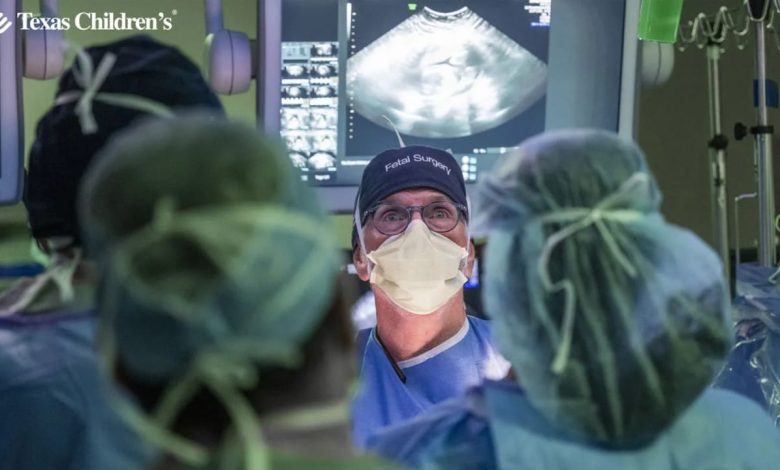
A team of doctors has successfully repaired a serious birth defect in an unborn baby while he was still inside his mother’s womb, marking a major step forward in fetal medicine and opening the door to treating more life-threatening conditions before birth.
The procedure was carried out on baby Theo Savage when his mother, Maisie Savage, was 26 weeks pregnant. Theo was diagnosed with complex gastroschisis, a rare condition in which a baby’s abdominal wall does not form properly, leaving the intestines outside the body.
Instead of waiting until after birth for surgery, doctors performed a pioneering keyhole operation inside the womb. They carefully returned Theo’s intestines into his abdomen and closed the opening before he was born.
Theo is now five months old and developing normally.
The operation is part of the world’s first clinical trial to repair complex gastroschisis before birth. Theo became only the third baby globally to receive the experimental treatment.
The surgery was led by Michael Belfort and his team at Texas Children’s Hospital in Houston after specialists at London’s Great Ormond Street Hospital referred the family when they discovered the condition had become more severe.
The procedure itself was highly complex. Doctors partially exposed the mother’s uterus, replaced the amniotic fluid with carbon dioxide gas to create space, and used minimally invasive instruments to gently move the baby’s organs back into the abdomen before stitching the opening closed.
Unlike a Caesarean section, the pregnancy continued for another 14 weeks after the operation. Theo was later delivered vaginally at full term in February.
Read also: Eno bags outstanding contribution to health insurance development award
A new chapter in fetal medicine
The success of the operation represents more than one baby’s survival. It signals a shift in how doctors may treat some birth defects in the future.
Traditionally, babies with gastroschisis undergo surgery only after delivery. Severe cases often require months in neonatal intensive care, repeated operations and long-term intravenous feeding. Some children eventually need intestinal transplants, while around one in ten die despite advanced medical care.
By correcting the defect before birth, doctors hope to prevent much of the damage that occurs while the baby’s organs remain exposed during pregnancy.
Medical experts say this could significantly reduce complications, shorten hospital stays and improve long-term health outcomes.
“The mother, the baby, the surgery, the time of the surgery, the fact that we had zero complications during and after the fetal surgery, is just remarkable,” Belfort said after the successful procedure.
Collaboration across three countries
Theo’s treatment involved specialists in three countries.
Doctors at Great Ormond Street Hospital in London first diagnosed the condition before referring the family to Texas Children’s Hospital.
Before surgery in the United States, the family travelled to Belgium, where specialists at Leuven Hospital injected Botox into the unborn baby’s abdominal wall to relax the muscles and make the repair possible.
The international collaboration highlights how complex fetal surgery is becoming increasingly dependent on highly specialised medical centres working together.
Paolo De Coppi, head of paediatric surgery at Great Ormond Street Hospital and University College London, said the goal is to eventually offer the procedure to more patients in the United Kingdom if the clinical trial proves successful.
“We hope that we will be able to offer this to patients on a larger scale very soon,” he said.
Looking beyond gastroschisis
The success of the operation could have implications far beyond one birth defect.
Doctors believe the womb is becoming a new surgical space where diseases may be treated months before a baby is born.
Belfort, who previously pioneered fetal surgery for babies with spina bifida, said researchers are already exploring whether similar techniques could eventually be used to perform certain heart and lung operations before birth.
If successful, such procedures could transform prenatal medicine by treating conditions before permanent damage develops.
The approach reflects a broader shift in medicine from reacting to disease after birth to preventing complications before delivery.
Read also: What WHA79 says about Nigeria’s health reforms
Hope for families
For Theo’s parents, the breakthrough is deeply personal.
The diagnosis at the routine 20-week scan came as a shock. They were initially told their baby could face months in intensive care and multiple surgeries after birth.
Instead, after making the difficult decision to relocate temporarily to the United States for the trial, they are now watching their son grow like any other healthy baby.
“Everything they did completely reversed what could have been a really horrible start to his life,” Maisie Savage said.
Theo’s story offers hope to families facing similar diagnoses and demonstrates how advances in fetal surgery could reshape the future of prenatal care.
While the procedure remains experimental and will require further clinical evidence before becoming routine, specialists believe it represents one of the most important advances in fetal surgery in recent years, one that could eventually allow doctors to treat many serious birth defects before a child even takes their first breath.