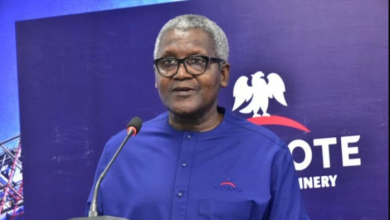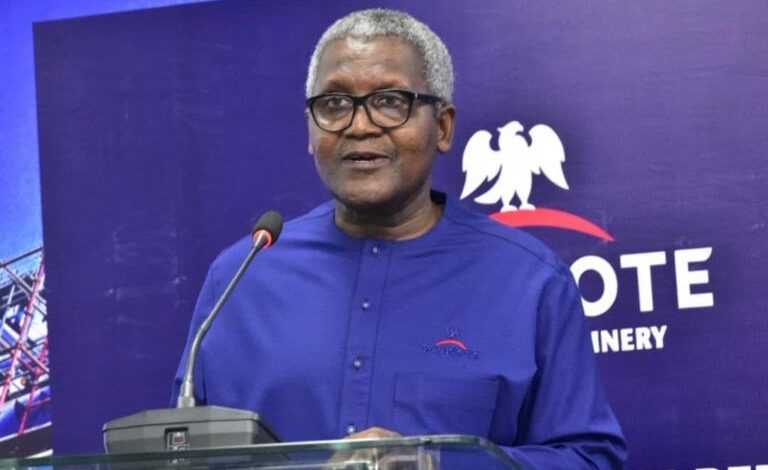
President and Chief Executive of Dangote Industries Limited (DIL), Aliko Dangote, has announced plans to take the group’s fertiliser business public in 2028, projecting that the company would become the biggest fertilisercompany in the world.
Dangote, who disclosed this in an interview with Bloomberg’s Francine Lacqua at the Qatar Economic Forum UNGA Special Edition in New York, said the planned listing would follow the ongoing initial public offering (IPO) of the Dangote Petroleum Refinery, which he said was designed to broaden African participation in the ownership of major businesses.
He said the fertiliser business was being expanded significantly, with the group targeting 12 million tonnes of urea production, alongside investments in potash and phosphate mines and 2.2 million tonnes of diammonium phosphate (DAP) production.
“Yes, we will IPO it. It’s going to be the biggest fertiliser company on earth,” Dangote said when asked about plans to list the fertiliser business. Asked when the listing would take place, he replied: “Yes, it will be here in 2028.”
Dangote Fertiliser currently operates a $2.5 billion fertiliser plant in Ibeju-Lekki, Lagos, with an annual urea production capacity of about three million tonnes. The group has been expanding its fertiliser operations as part of a broader strategy to build production capacity across Africa and reduce the continent’s dependence on imported agricultural inputs.
Dangote said the group was targeting an increase in urea production from three million tonnes to 12 million tonnes, while also developing potash and phosphate resources and adding 2.2 million tonnes of DAP production. “I think we alone can satisfy at least more than 40 per cent of Africa’s demand,” he said.
The businessman said the move was partly driven by the experience of African countries during the Russia-Ukraine war, when disruptions to global fertiliser supplies exposed the continent’s dependence on imports.
“Four years ago, at the beginning of the Ukraine-Russia crisis, the African Union sent the German President Michel to go and say that we needed fertiliser. We are running out of fertiliser because they are our suppliers. And I saw that, so we made an announcement. I said in four years, Africa will not go and beg anybody for fertilizer,” he said.
According to him, the group’s investments in fertiliser are part of a wider ambition to build productive capacity within Africa rather than continue exporting raw materials and importing finished products.
Similarly, Dangote said the group was investing between $46 billion and $50 billion across Africa, arguing that the continent’s growing population and large consumer market provided sufficient demand for large-scale industrial investments.
“Africa is not going to ask for aid anymore. We will now go there and develop our continent,” Dangote said.
“So what we are doing right now is trying to convert most of our raw materials that we will be shipping at a very cheap price, which means when you ship raw material, you are actually shipping jobs out because you are not going to create any jobs. Then you import poverty into your continent. So we have cancelled that now.”
Dangote said the group was investing heavily in refining, fertiliser, petrochemicals and infrastructure, adding that he expected other African businesses to follow.
“We are doing massively, and I’m sure a lot of companies are going to join us. We have $46 to $50 billion, which we are now investing back into the continent. I’m sure a lot of people are going to follow suit,” he said.
The fertiliser IPO announcement comes as the Dangote Petroleum Refinery’s IPO continues to generate significant interest from retail investors, with Dangote targeting 10 million shareholders.
He said the refinery IPO was intended to bring what he described as “democracy into capital markets in Africa” by enabling more Africans to participate in the ownership of major businesses.
“We are looking for 10 million shareholders. So the idea that we’re doing is actually to bring democracy into capital markets in Africa, is to have Africans be able to participate in this prosperity,” he said.
According to him, the response to the offering had been substantial, with technical difficulties occurring after its launch because of the volume of traffic from prospective investors.